


Aloe Semiconductor showcased two major advancements in silicon photonics during OFC 2025 in San Francisco, highlighting its commitment to scaling optical communications through advanced modulation techniques and photonic integration.
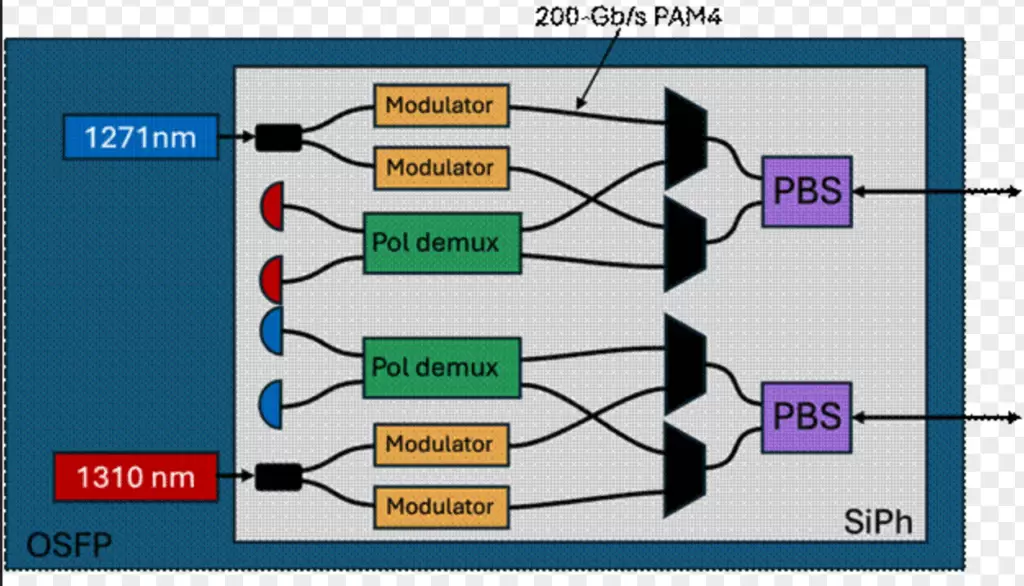
The first demonstration featured the industry’s first 850-Gb/s DP-BiDi-PAM4 OSFP module, delivering a fourfold increase in fiber capacity for short-reach links. The innovation combines dual-polarization (DP) and bi-directional (BiDi) transmission, with each technique doubling cabling density. This was enabled by Aloe’s single-chip silicon photonic integrated circuit (PIC), which integrates both transmitter and receiver, flip-chipped with the Broadcom Sian 2 DSP and packaged by Eoptolink. The BiDi system uses 1271 nm for one direction and 1311 nm for the other, while internal DSP drivers and a TIA IC handle signal amplification and processing. Aloe positions this breakthrough as a precursor to 1.6T per fiber pair using 200-Gbaud DP-BiDi PAM4 in future iterations.
The second demo revealed a 160-Gbaud PAM4 signal generated from a pure silicon photonic Mach-Zehnder modulator (MZM)—a significant leap from today’s 106-Gbaud SiPh modulators. Aloe’s novel MZM architecture increases bandwidth without compromising loss or voltage drive, avoiding the use of non-CMOS materials like LiNbO₃ or III-Vs. The modulator was co-packaged with a high-bandwidth open-collector driver from MACOM, flip-chipped on a high-density substrate, and driven by a Keysight AWG 8199B, with reception by the Keysight 1032A. This all-silicon solution is targeted at OIO and CPO architectures, enabling high-speed, low-cost deployment with fast time to market.
Key Technical Highlights:
- 850-Gb/s DP-BiDi PAM4 OSFP module demoed at OFC 2025
- Combines Dual-Polarization (DP) and Bi-Directional (BiDi) to boost fiber capacity by 4x
- Built using Aloe’s single-chip SiPh PIC integrated with Broadcom Sian 2 DSP
- BiDi wavelengths: 1271 nm TX / 1311 nm RX
- Partnered with Eoptolink, Broadcom
- 160-Gbaud PAM4 from all-silicon photonic modulator
- Uses novel SiPh Mach-Zehnder Modulator (MZM) design
- Fabricated with standard CMOS processing, no exotic materials
- Driven by MACOM open-collector driver, evaluated using Keysight test equipment
- Target applications: Co-Packaged Optics (CPO) and Optical I/O (OIO)
- Partnered with Advanced Micro Foundry, MACOM, Broadcom
“We show that with innovative design, silicon photonic modulators can move well beyond 106 Gbaud, allowing the next generation to continue taking advantage of silicon’s integration capability, advanced packaging compatibility, and fast time to market.”
— Christopher Doerr, CEO, Aloe Semiconductor
- Aloe Semiconductor, founded in 2022 by Christopher Doerr—former Associate VP of Advanced Development at Acacia Communications—is a privately held fabless semiconductor company headquartered in New Jersey. The company’s mission is to develop best-in-class, application-specific photonic integrated circuits (PICs) using standard silicon photonics for optical communications. Aloe focuses on pushing the limits of data rate scaling and fiber efficiency with groundbreaking innovations such as dual-polarization (DP) and PAM4 modulation. Aloe’s core technology leverages standard CMOS processes to create high-performance, cost-effective silicon photonic solutions without relying on exotic materials.

