


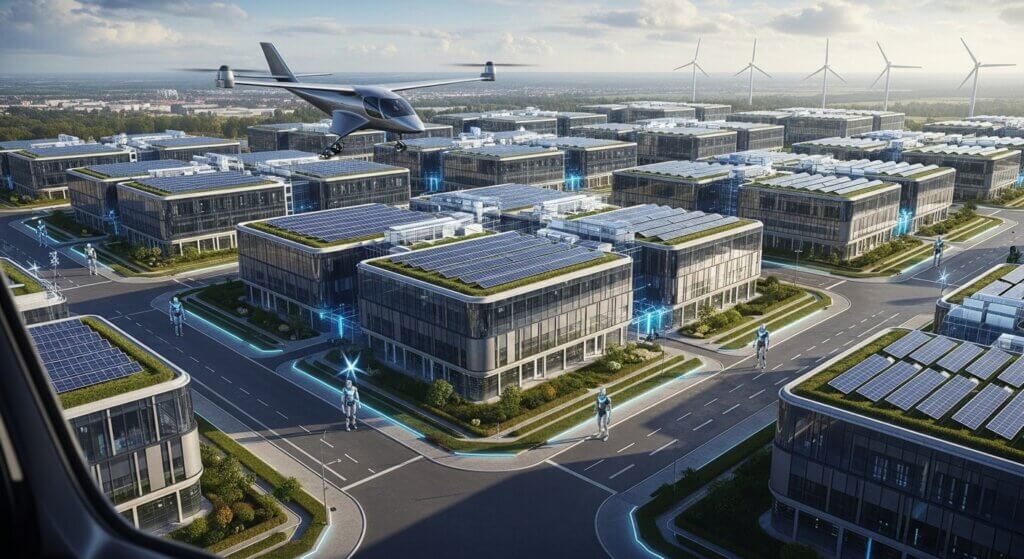
Brookfield launched a $100 billion global AI infrastructure program designed to deploy capital across the full AI value chain. The program begins with the Brookfield Artificial Intelligence Infrastructure Fund (BAIIF), which targets $10 billion in equity commitments and has already secured $5 billion from Brookfield, NVIDIA, and the Kuwait Investment Authority (KIA). The initiative aims to accelerate the construction of AI factories, energy systems, compute infrastructure, and supporting digital assets at a time when global demand for power, land, GPUs, and sovereign-aligned AI capacity is rising sharply.
The program will invest across four verticals: AI factories based on NVIDIA’s DSX reference design; dedicated behind-the-meter power; compute infrastructure tailored for governments and large enterprises; and strategic adjacencies spanning fiber, cooling, and capital partnerships. Brookfield disclosed its first seed investment—a $5 billion framework agreement with Bloom Energy to deliver up to 1 GW of onsite power for AI factories—as well as Radiant, a new NVIDIA Cloud Partner that will deploy “Vera Rubin–ready” GPU clouds. Brookfield also highlighted national-scale commitments in France and Sweden that represent up to $30 billion in combined AI infrastructure investment.
The initiative positions Brookfield to build and operate energy-intensive AI campuses at global scale, alongside NVIDIA’s accelerating push into sovereign AI, GPU cloud blueprints, and national compute infrastructure. The partnership also underscores KIA’s expanding role in strategic digital infrastructure investment worldwide.
• BAIIF launches with a $10 billion equity target and $5 billion already committed
• Up to $100 billion to be deployed across energy, land, data centers, and compute
• Four verticals: AI factories, behind-the-meter power, compute infrastructure, adjacencies
• Seed investment: $5 billion agreement with Bloom Energy for 1 GW onsite power
• Radiant becomes a new NVIDIA Cloud Partner for DSX-based GPU cloud deployments
• National programs: Up to €20 billion in France and $10 billion in Sweden
• Backers include Brookfield, NVIDIA, and the Kuwait Investment Authority
“AI is creating one of the largest infrastructure buildouts in history… We are thrilled to formally launch our dedicated AI program in partnership with NVIDIA and others to deliver this infrastructure at speed, at scale, and to the highest standard,” said Sikander Rashid, Head of AI Infrastructure at Brookfield.
Key Insights from Brookfield’s August 2025 Paper:
Building the Backbone of AI
• Brookfield forecasts more than $7 trillion in AI-related infrastructure investment over the next decade, driven by power, compute, networking, fiber, and semiconductor systems.
• AI factories—GPU-dense data centers with liquid cooling and ultra-low latency fabrics—are expected to scale from 7 GW in 2024 to 82 GW by 2034.
• The installed base of GPUs is projected to grow 7×, reaching 45 million accelerated processors by 2034, representing $4 trillion in cumulative hardware demand.
• Roughly 75% of global AI compute will shift to inference by 2030, driven by multi-step agentic workloads and enterprise-scale deployments.
• Global power demand from AI will exceed 100 GW within 10 years, requiring new approaches such as behind-the-meter generation, battery systems, and small modular reactors.
• Grid interconnection queues now average six years, extending to a decade in some regions—making onsite power essential for deployment timelines.
• Efficiency improvements (DeepSeek, Mixture-of-Experts designs, Meta’s Llama 4) reduce cost per task but increase total consumption due to the Jevons Paradox.
• Sovereign demand is a major driver: France, Sweden, EU InvestAI, KSA, Canada, the U.S., and the U.K. are directly backing national compute hubs and AI gigafactories.
• Scaling laws remain intact: larger models and data sets continue to yield higher accuracy, keeping compute as the binding constraint for frontier AI.
• Robotics—especially humanoid systems using multimodal AI—is expected to reach millions of units annually within 10–15 years, creating new industrial infrastructure needs.
• AI hubs must be designed for rapid refresh cycles as GPU generations now turn over in 12–18 months; modular cooling and electrical architectures are required to avoid obsolescence.
• Brookfield positions integrated digital + energy development as essential to compress project timelines and reduce risk for hyperscalers, sovereigns, and AI labs.
🌐 Analysis
Brookfield’s new program reinforces a major capital shift: AI infrastructure is no longer a hyperscaler-only investment domain but increasingly a sovereign, utility-scale asset class. Governments in Europe, the Middle East, and North America are now directly financing gigawatt-scale AI campuses, driven by national compute requirements, supply-chain security, and the need for power-dense, GPU-rich facilities. NVIDIA’s participation signals continuity with its DSX-based “Sovereign AI” architecture strategy, while KIA’s involvement aligns with the growing presence of Gulf sovereign funds in digital infrastructure. Brookfield’s model—pairing power development, land control, and GPU cloud—suggests that future AI factories will be built using vertically integrated energy-compute financing rather than cloud-only procurement.
Brookfield Asset Management, headquartered in New York, is one of the world’s largest alternative asset managers with more than $1 trillion in assets under management and a global workforce of roughly 61,000 employees. Led by CEO Bruce Flatt, the firm has an extensive history across real assets, including data centers, utilities, transport, renewable power, midstream, and large-scale energy systems. Brookfield owns major digital infrastructure platforms such as Compass Datacenters in North America, Data4 in Europe, and DCI in Asia-Pacific, and is a significant investor in clean energy through assets like Neoen and nuclear technologies via Westinghouse. With over $200 billion dedicated to infrastructure, Brookfield has deep experience developing and operating complex global projects, positioning the company to play a central role in scaling next-generation AI factories, power systems, and compute infrastructure.
Brookfield has also been active in telecom and networking infrastructure. The firm previously invested in fiber networks, tower portfolios, and small-cell infrastructure across the Americas, Europe, and India.