


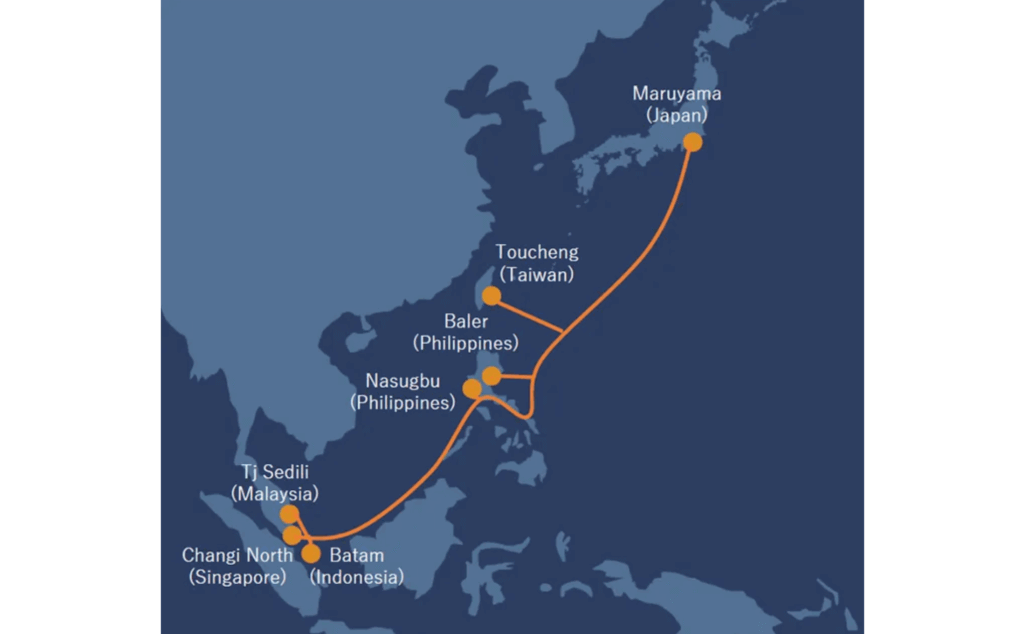
SoftBank, Meta, and regional partners are building a new 8,000 km submarine cable system called Candle to link Japan and Singapore with landings in Taiwan, the Philippines, Indonesia, and Malaysia. NEC has been contracted as system supplier, with operations targeted for 2028.
Candle will deploy 24 fiber pairs, above the typical 16–20 fiber pairs seen in most systems, to deliver higher capacity and lower latency across Asia. The system will provide new redundancy and diversity in response to surging data demand from 5G and generative AI. Meta’s Don Pang, who chairs the Candle Management Committee, said the system will strengthen regional resilience and serve over half a billion people in Asia-Pacific.
SoftBank will serve as the designated landing party in Japan, hosting Candle at its Maruyama Landing Station in Chiba Prefecture. The company is also expanding its cable station footprint with planned sites in Hokkaido and Kyushu. Candle adds to SoftBank’s involvement in other global cables such as JUPITER, ADC, and the under-construction E2A system.
• Candle spans 8,000 km, connecting Japan–Singapore via Taiwan, the Philippines, Indonesia, and Malaysia
• 24 fiber pairs will increase capacity compared to standard 16–20 pair designs
• NEC contracted as system supplier; operations expected in 2028
• SoftBank providing Japan landing station and new facilities in Hokkaido and Kyushu
• Partners include Meta, IPS Inc., TM Technology Services, and PT XLSmart Telecom Sejahtera
“Candle adopts a 24 fiber pair architecture, making it one of the core foundations of next-generation social infrastructure that SoftBank is promoting,” said Kimimasa Kudo, Vice President and Head of the Global Business Division, Enterprise Unit, SoftBank Corp.
🌐 Analysis: Candle joins a growing list of large-capacity submarine cable projects in the Pacific. Meta is already a key backer of Apricot and Echo, linking Japan, Singapore, and Guam to the U.S. Google has invested in subsea systems including Bifrost, Pacific Light Cable Network, and Taiwan’s Taiwan-Philippines-U.S. route. Other major systems under construction include Asia Link Cable (ALC) and Hawaiki Nui, each boosting intra-Asia and trans-Pacific diversity. Together, these systems reflect a wave of investment aimed at supporting hyperscale cloud services and AI-driven applications, while ensuring redundancy in a region prone to natural disasters and geopolitical chokepoints.
🌐 We’re tracking the latest developments in subsea cable infrastructure, policy, and deployments. Follow our ongoing coverage at: https://convergedigest.com/category/subsea/