


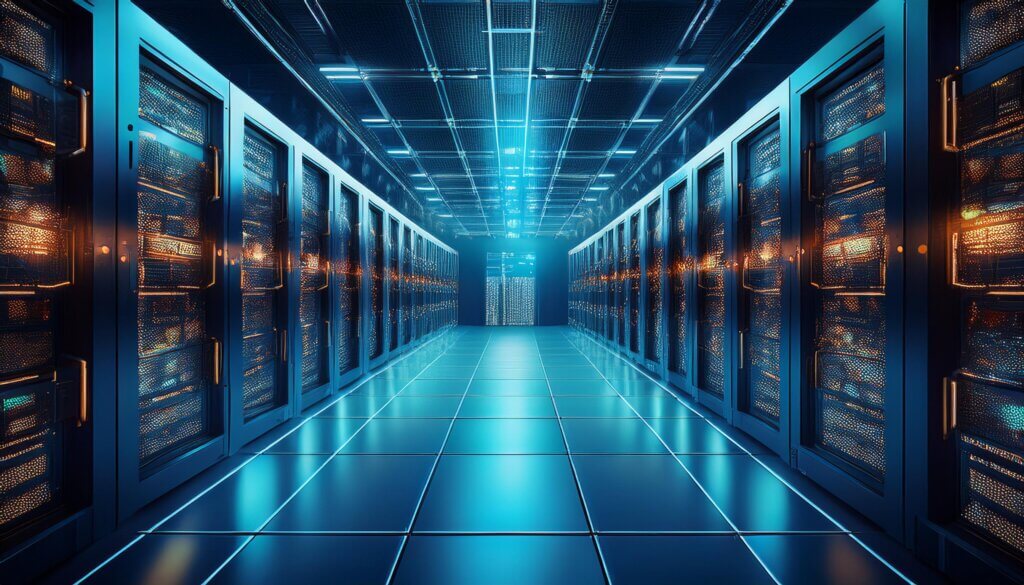
Brookhaven National Laboratory’s Scientific Data and Computing Center (SDCC) has reached a significant data milestone by surpassing 300 petabytes of stored information. The bulk of this data comes from experiments at the Relativistic Heavy Ion Collider (RHIC) and the ATLAS experiment at CERN’s Large Hadron Collider. These experiments generate massive datasets, collected from thousands of particle collisions occurring every second. SDCC uses an advanced tape-to-disk system to manage the data, ensuring access for researchers across the globe.
SDCC’s tape archive system is both cost-effective and energy-efficient. By leveraging tape storage, the center minimizes power consumption and heat production, which are significant concerns for large-scale data centers. Robots retrieve the tapes and mount the necessary data to disk when requested, offering researchers seamless access to millions of gigabytes of data. This setup supports ongoing and future projects, including the Electron-Ion Collider (EIC), expected to increase data demands tenfold by the 2030s.
Engineers at SDCC continue improving the facility’s capacity and efficiency, integrating artificial intelligence (AI) and machine learning (ML) for data monitoring and anomaly detection. These advancements are preparing SDCC to handle the ever-increasing demands of large-scale scientific experiments.
• 300 petabytes of stored data
• Supports data from RHIC and ATLAS experiments
• Uses tape-to-disk system for efficient data management
• Robots retrieve and mount data for global access
• Plans to expand for future projects like the Electron-Ion Collider
• AI and ML used for monitoring and anomaly detection
“We have data available on demand,” said Brookhaven Lab physicist Alexei Klimentov. “It’s stored on tape and then staged on disk for physicists to access when they need it, and this is done automatically.”