


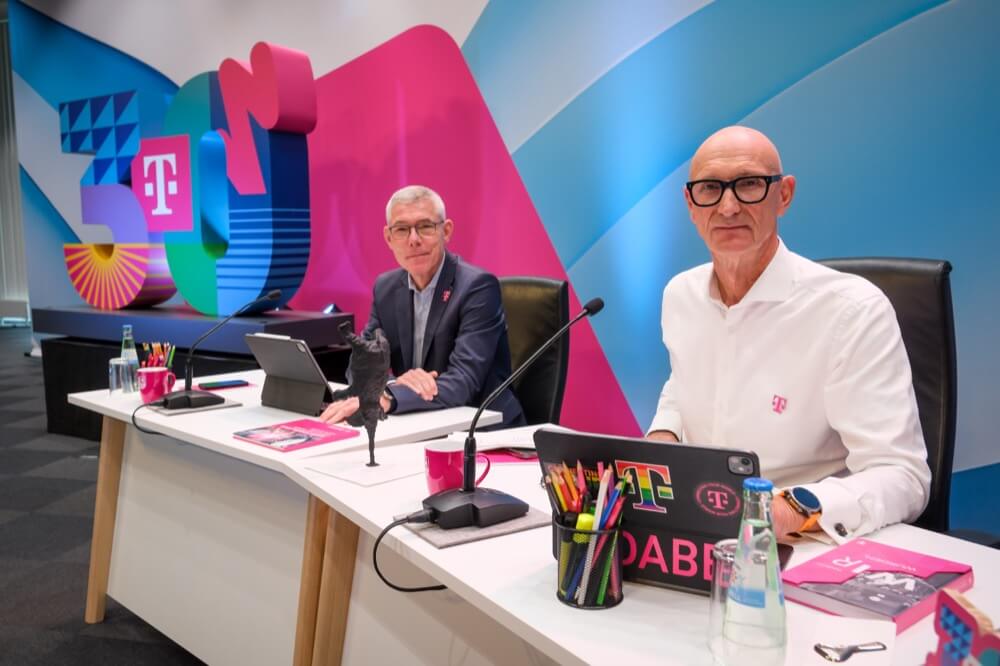
Deutsche Telekom raised its full-year 2025 financial guidance following a strong second quarter marked by subscriber gains, AI-driven operational efficiencies, and continued network investment across key markets. On an organic basis, Group revenue grew 4.0% year-over-year to €28.7 billion, and adjusted EBITDA AL rose 5.0% to €11.0 billion. Despite a quarterly decline in free cash flow AL due to timing, the company reported a 17.8% increase over the first half of the year, reaching €10.5 billion. Net profit climbed over 25% in Q2 to €2.6 billion.
CEO Tim Höttges attributed the strong performance to disciplined execution, customer-focused differentiation, and technology leadership. “Where others are shrinking, we are growing,” he said, citing above-market gains in mobile and fiber customers, as well as service revenue strength. Höttges emphasized that Deutsche Telekom is building infrastructure “more than all of our competitors combined” and leveraging its regional production model to avoid geopolitical headwinds from U.S.-EU trade tensions.
T-Mobile US remains the engine of growth, adding 1.7 million postpaid customers in Q2, including 830,000 phone subscribers, and raising its full-year customer forecast by 500,000. The company closed its acquisitions of Metronet and UScellular and now holds a 52.1% stake in T-Mobile US. Deutsche Telekom also sold portions of its 3.45 GHz and 800 MHz spectrum for cash and strategic low-band holdings, strengthening its network economics.
Germany saw steady FTTH growth with 137,000 additions in Q2 and now passes 11.1 million homes. Despite losing 20,000 broadband lines, the company added 185,000 branded mobile contract customers and rolled out new unlimited plans. Höttges acknowledged competitive pressures in Germany’s broadband market, calling for policy reforms to reduce red tape and accelerate fiber deployment, especially in apartment buildings (MDUs). He noted that alternative providers are scaling back fiber ambitions, with VATM now forecasting just 1.2 million new FTTH-capable homes in 2025, down from 2 million.
AI is central to Deutsche Telekom’s digital transformation. Höttges reported that AI now generates 10% of the company’s software code and is actively used in network operations and customer service. More than 30% of employees in Germany are using the internal AI assistant “Ask T,” while AI-driven chatbots handled 1.6 million service interactions in H1 2025. The company expects €800 million in AI-enabled savings outside the U.S. by 2027. It is also planning to launch a new AI smartphone in Europe and co-develop an industrial AI cloud with NVIDIA by 2026.
• Group organic revenue +4.0% YoY to €28.7B
• Group organic adjusted EBITDA AL +5.0% YoY to €11.0B
• Free cash flow AL +17.8% in H1 2025 to €10.5B
• Net profit up 25.2% YoY to €2.6B in Q2
• T-Mobile US Q2 postpaid net adds: 1.7M; raises 2025 forecast
• FTTH network reaches 11.1M homes in Germany
• CEO says AI will drive €800M in savings outside U.S. by 2027
• T-Systems Q2 order entry +20.5% YoY; focuses on healthcare, defense, AI
• New hybrid broadband product in Germany offers up to 500 Mbps
• Spectrum monetization boosts U.S. network flexibility
“Our growth motor is running smoothly. T-Mobile US plays a critical role in this,” said Tim Höttges. “We are increasingly investing in new growth areas like AI, APIs, and cloud infrastructure, while transforming our core services. This is how we stay ahead of the curve.”
🌐 Why it Matters: Deutsche Telekom continues to execute a dual-engine strategy: scale-driven growth in the U.S. via T-Mobile and infrastructure leadership in Germany and Europe. The shift toward AI as both an operational enabler and commercial offering signals a forward-looking pivot as traditional broadband margins come under pressure. With capital-intensive fiber rollouts and digital infrastructure initiatives underway, DT’s ability to deliver on revised guidance will be a key industry bellwether.