


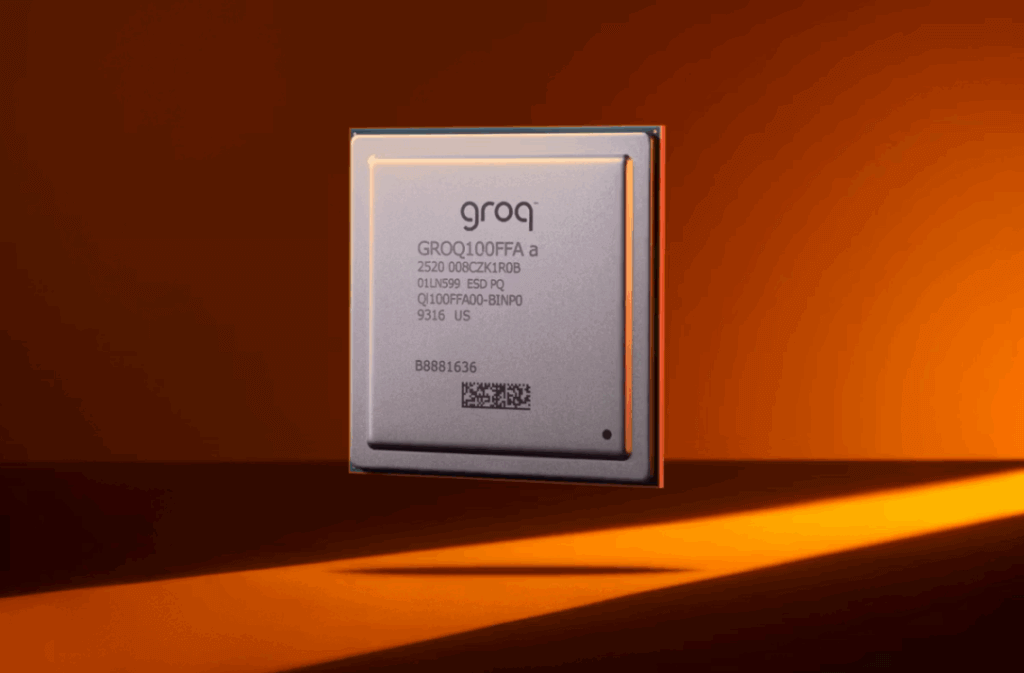
Groq secured $750 million in fresh financing at a $6.9 billion valuation, reinforcing its role in the U.S. AI technology stack. The round was led by Disruptive, with participation from BlackRock, Neuberger Berman, Deutsche Telekom Capital Partners, and a major West Coast mutual fund. Existing investors Samsung, Cisco, Altimeter, D1, 1789 Capital, ad Infinitum also participated.
Groq said its inference infrastructure now supports more than two million developers and Fortune 500 companies, with growing deployments in North America, Europe, and the Middle East. The funding coincides with a White House executive order promoting the export of U.S.-origin AI technology, positioning Groq as a central player in the global spread of AI inference platforms.
Disruptive contributed nearly $350 million of the total raise, citing Groq’s ability to build essential infrastructure for AI at scale. “Groq is building that foundation, and we couldn’t be more excited to partner with Jonathan and his team in this next chapter of explosive growth,” said Alex Davis, Founder and CEO of Disruptive.
• $750 million financing round led by Disruptive, joined by BlackRock, Neuberger Berman, Deutsche Telekom Capital Partners
• Post-money valuation: $6.9 billion
• Over two million developers and multiple Fortune 500 customers using Groq’s compute services
• Expansion underway across North America, Europe, and the Middle East
• U.S. executive order underscores Groq’s role in exporting the American AI Stack
“Inference is defining this era of AI, and we’re building the American infrastructure that delivers it with high speed and low cost,” said Jonathan Ross, Groq Founder and CEO.
🌐 Analysis
Groq was founded in 2016 by Jonathan Ross, who previously helped design Google’s Tensor Processing Unit (TPU). The company’s core innovation is the Language Processing Unit (LPU), a deterministic, massively parallel processor designed specifically for AI inference workloads. Unlike GPUs, which use complex scheduling and caches, the LPU emphasizes predictable performance and ultra-low latency by relying on a single, wide instruction stream and static dataflow architecture. This approach reduces overhead and enables Groq hardware to deliver high throughput at scale for generative AI and real-time applications.
Groq’s strategy pairs the LPU with GroqCloud, a cloud service that provides access to its inference hardware without requiring customers to manage infrastructure. This model has helped the company attract developers, enterprises, and government agencies seeking U.S.-built alternatives to GPU-centric clouds. Its current footprint includes data centers in North America, Europe, and the Middle East, with plans to expand further as demand for inference accelerates.
The company operates in a highly competitive environment. NVIDIA continues to dominate training and inference with its GPU platform, while rivals such as AMD, Intel, and startups like Cerebras, SambaNova, and Tenstorrent target different parts of the AI compute stack. Groq differentiates by focusing on inference-specific silicon and positioning itself as a cost-effective, deterministic alternative to GPU-based solutions. With this latest financing, Groq gains significant capital to scale manufacturing, expand GroqCloud, and deepen its role in the U.S. government’s vision of exporting a secure, American-built AI stack.
Groq is based on Mountain View, California.
🌐 We’re tracking the latest developments in AI infrastructure. Follow our ongoing coverage at: https://convergedigest.com/category/ai-infrastructure/