


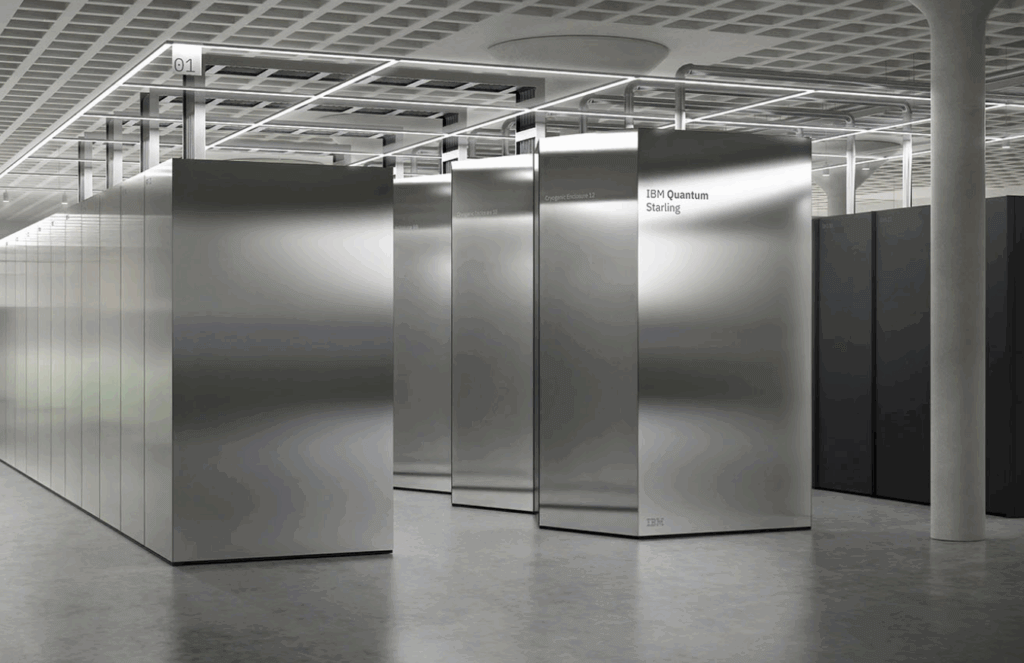
IBM has announced plans to build the world’s first large-scale, fault-tolerant quantum computer by 2029. The system, called IBM Quantum Starling, will be hosted at a new data center in Poughkeepsie, New York, and is expected to perform 100 million quantum operations using 200 logical qubits—making it 20,000 times more powerful than today’s quantum machines.
“IBM is charting the next frontier in quantum computing,” said Arvind Krishna, IBM Chairman and CEO. “Our expertise is paving the way for a large-scale, fault-tolerant quantum computer—one that will solve real-world challenges and unlock immense possibilities for business.”
Logical qubits are constructed from multiple physical qubits and are essential to correcting quantum errors at scale. IBM’s approach relies on quantum low-density parity check (qLDPC) codes, which reduce the number of physical qubits needed by up to 90% compared to traditional methods. Representing the full quantum state of Starling would require more memory than 10^48 of today’s supercomputers.
IBM’s new Quantum Roadmap outlines a path to scalable fault tolerance:
- Loon (2025) will test long-distance qubit connectors (C-couplers).
- Kookaburra (2026) introduces modular processors combining memory and logic.
- Cockatoo (2027) will link Kookaburra modules using L-couplers to form larger quantum systems.
- Starling (2029) will debut as IBM’s first fully fault-tolerant system.
- Blue Jay (post-2029) will extend capabilities to 2,000 logical qubits and 1 billion operations.
IBM also released technical papers describing how its architecture efficiently processes and decodes quantum instructions using classical computing. These advances enable practical quantum error correction without requiring unmanageable physical resources.
- Starling to deliver 200 logical qubits and 100M operations by 2029
- Uses qLDPC codes to cut error correction overhead by ~90%
- Modular architecture enables scalable fault-tolerant design
- New data center planned in Poughkeepsie, New York
- Future system Blue Jay to scale to 2,000 logical qubits and 1B operations