


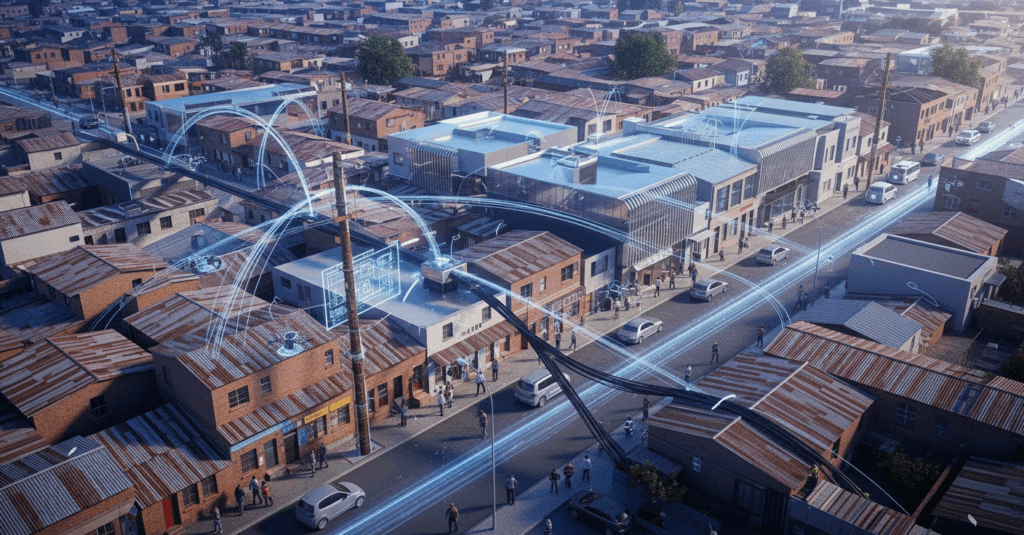
Nokia and fibertime are scaling fiber broadband access to reach an additional 400,000 homes across South Africa’s underserved townships and peri-urban communities. The rollout, part of fibertime’s plan to connect 2 million households by 2028, uses Nokia’s fiber and IP networking technologies to deliver affordable, high-speed internet—often to first-time broadband users. The initiative builds on previous deployments across Cape Town, Johannesburg, Gqeberha, Mangaung, and Stellenbosch.
Fibertime’s network combines Nokia’s Lightspan access nodes, Wi-Fi 6-enabled fiber access points, and the 7750 Wireless Access Gateway to create semi-mobile, township-wide connectivity. Users can stay online across their neighborhood under a single SSID, with service reaching speeds up to 950 Mbps. Fibertime’s flagship “5 Rand a Day” model offers uncapped, unthrottled fiber internet without contracts—activated through prepaid vouchers sold in local shops and banks.
To optimize operations and scale deployments, fibertime is also adopting Nokia’s Altiplano platform, Network Services Platform, and AI-driven Fiber Health Analyzer. These tools enable automated provisioning and early fault detection to ensure network reliability as new homes come online.
“Reliable broadband is critical for thriving communities—powering education, healthcare, and local economies,” said Sandy Motley, President, Fixed Networks at Nokia. “With our fiber and IP solutions, we’re changing that, bringing broadband services to thousands of customers at once, in regions once considered too difficult to serve.”
🌐 Analysis:
South Africa’s broadband landscape remains uneven, with rural and township areas lagging behind urban centers in connectivity and affordability. Projects like fibertime’s prepaid fiber model—leveraging Nokia’s scalable access platforms—address both infrastructure and economic barriers. While mobile broadband remains the dominant access method, expanding fiber into dense townships provides a foundation for stable, high-capacity access supporting education, small businesses, and e-government services. The challenge ahead will be sustaining affordability amid energy constraints and extending fiber into informal settlements where right-of-way and installation logistics are complex.