


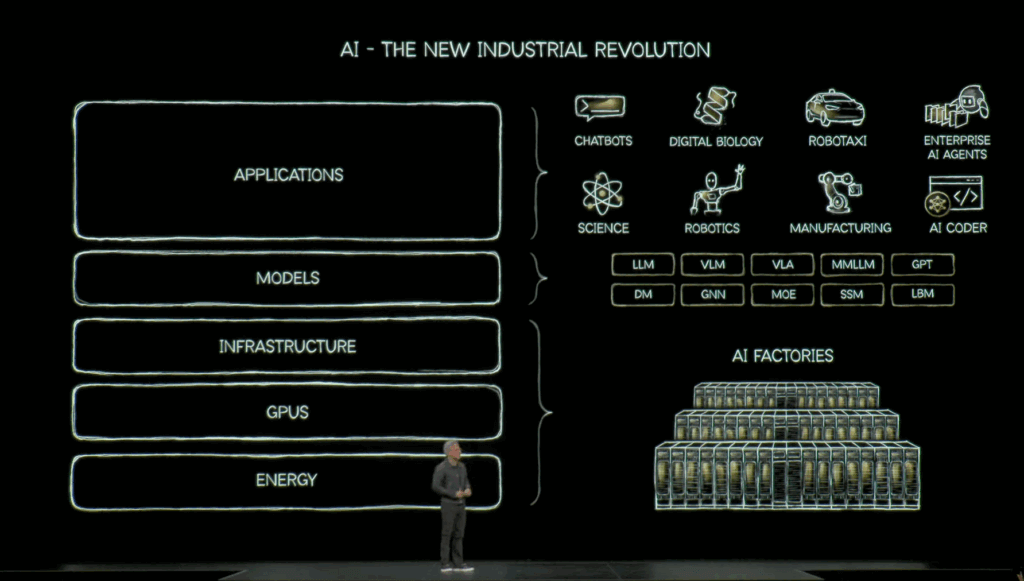
NVIDIA founder and CEO Jensen Huang set an ambitious national tone at GTC DC, unveiling new architectures that extend accelerated computing across AI data centers, 6G networks, and quantum computing. Framing the event as “America’s next Apollo moment,” Huang called for reindustrialization powered by AI infrastructure built in the United States, revealing that NVIDIA’s new GB200 Grace-Blackwell superchips are now being manufactured in Arizona and integrated into complete rack-scale AI systems assembled in Texas.
At the heart of Huang’s keynote was a sweeping vision of computing as the engine of national competitiveness. He announced NVIDIA ARC, a new “Aerial Radio Network Computer” co-developed with Nokia to power software-defined 6G base stations that integrate AI and accelerated computing. ARC combines Grace CPUs, Blackwell GPUs, and ConnectX networking to enable AI for RAN (radio optimization through reinforcement learning) and AI on RAN(edge inference and robotics clouds deployed at base stations). Huang said, “Telecommunications is the backbone of our economy and national security. This partnership helps America lead again in wireless technology.”
In a second major leap, NVIDIA introduced NVQLink, a high-speed interconnect directly linking quantum processors with NVIDIA GPUs. The new NVQLink architecture, combined with the open CUDA-Q software platform, enables hybrid quantum-classical supercomputers to perform real-time quantum error correction and co-simulation. Eight U.S. Department of Energy (DOE) national laboratories — including Brookhaven, Fermi, Berkeley, Los Alamos, Oak Ridge, Pacific Northwest, Sandia, and MIT Lincoln Laboratory — will use NVQLink to advance quantum-AI integration. The DOE also announced plans with NVIDIA to deploy seven new GPU-based AI supercomputers to accelerate national science and quantum research.


Partners contributing to NVQLink include quantum hardware builders Alice & Bob, Anyon Computing, Atom Computing, Diraq, Infleqtion, IonQ, IQM Quantum Computers, ORCA Computing, Oxford Quantum Circuits, Pasqal, Quandela, Quantinuum, Quantum Circuits, Inc., Quantum Machines, Quantum Motion, QuEra, Rigetti, SEEQC and Silicon Quantum Computing — as well as quantum control system builders including Keysight Technologies, Quantum Machines, Qblox, QubiC and Zurich Instruments.
NVIDIA further detailed its AI Factory concept — purpose-built gigawatt-scale data centers designed as token-producing industrial systems. Using the new Omniverse DSX digital twin environment, partners such as Jacobs, Siemens, Schneider Electric, and Bechtel can co-design compute density, thermals, and power infrastructure before deployment. A reference site in Virginia will demonstrate DSX optimization for NVIDIA’s Vera Rubin AI factory system, based on GB200 racks interconnected by NVLink 72 and Spectrum-X Ethernet, delivering over 130 Tbps of all-to-all bandwidth. Each rack is fully liquid-cooled and cable-free, reflecting NVIDIA’s extreme co-design philosophy across chips, systems, and networks.
Huang described two “platform transitions” reshaping the industry: the move from general-purpose to accelerated computing and from human-coded to AI-driven software. He said NVIDIA now has visibility into more than $500 billion in cumulative Blackwell-generation orders through 2026, highlighting an industry-wide shift toward AI-optimized infrastructure. Beyond data centers, NVIDIA is extending its ecosystem to CrowdStrike for AI cybersecurity, Palantir for data analytics, and Uber for next-generation autonomous mobility using the company’s new Drive Hyperion robo-taxi platform.
• NVIDIA ARC with Nokia to power 6G AI-driven radio access networks
• NVQLink interconnect for hybrid quantum-GPU supercomputing
• DOE collaboration for seven new AI supercomputers across national labs
• Grace-Blackwell rack-scale systems manufactured and assembled in the U.S.
• Omniverse DSX digital twin framework for designing AI factories
• Spectrum-X and NVLink 72 networking delivering 130 Tbps rack connectivity
“Our industry is at a new inflection point — accelerated computing and AI are converging into the infrastructure of the future,” said Jensen Huang. “This is America’s next Apollo moment.”
🌐 Analysis: NVIDIA’s GTC DC announcements reinforce its end-to-end control of the AI computing stack, from silicon and networking (Blackwell, Spectrum-X, NVLink) to national-scale infrastructure design (DSX). The ARC partnership with Nokia marks a major U.S. re-entry into wireless leadership ahead of 6G. NVQLink’s adoption by DOE labs positions NVIDIA at the nexus of quantum-classical hybrid computing.

