


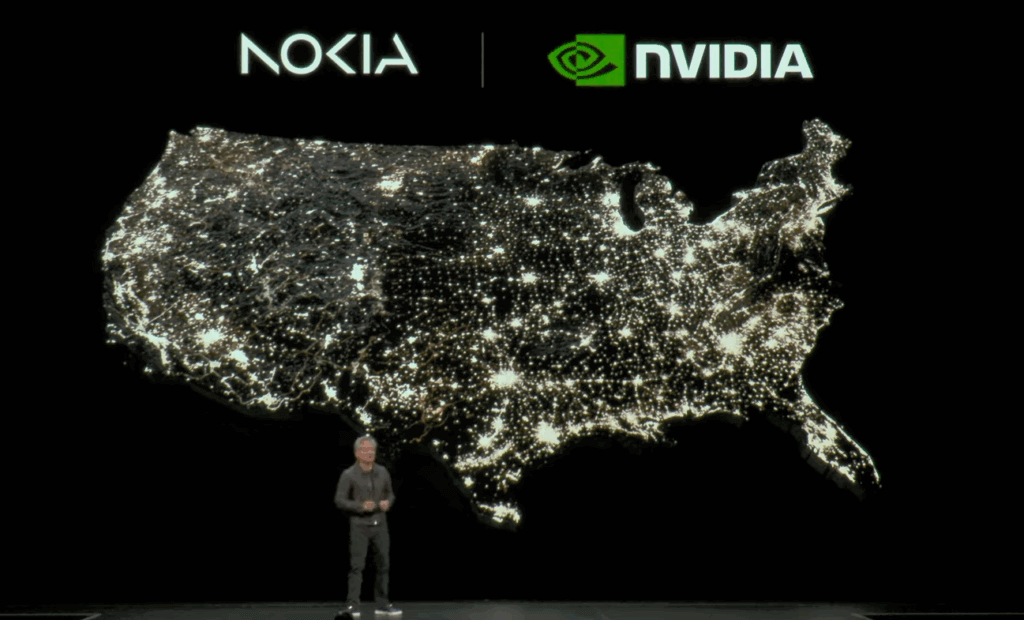
Nokia and NVIDIA announced a landmark strategic partnership combining Nokia’s telecom and networking expertise with NVIDIA’s accelerated computing and AI architecture to drive the transition from 5G to AI-native 6G. The alliance is backed by a $1.0 billion equity investment from NVIDIA, giving it a 2.9% ownership stake in Nokia through a directed share issuance of 166.39 million shares at $6.01 per share.
Building the AI Platform for 6G
Announced during NVIDIA GTC in Washington, D.C., the collaboration establishes a foundation for AI-RAN—a new class of software-defined, GPU-accelerated radio access networks capable of jointly hosting RAN and AI workloads. Nokia will integrate NVIDIA’s ARC (Aerial RAN Computer) platform and AI Aerial software stack into its RAN portfolio to enable AI-native 5G-Advanced and 6G networks.
NVIDIA founder and CEO Jensen Huang described the initiative as “a generational platform shift that empowers the United States to regain global leadership in telecommunications infrastructure,” emphasizing that AI-RAN will merge compute, connectivity, and sensing into one intelligent system. Nokia CEO Justin Hotard added that the partnership “puts an AI data center into everyone’s pocket,” reshaping how networks process intelligence from the core to the edge.
NVIDIA AI Aerial Architecture
At the heart of the partnership is NVIDIA AI Aerial™, a full-stack suite of accelerated computing platforms, libraries, and tools designed to build, train, simulate, and deploy AI-native wireless networks:
- Sionna – An open-source, GPU-accelerated 5G/6G research library for training and testing PHY and MAC layer models, featuring differentiable link-level and system-level simulations plus a high-speed ray tracer.
- Aerial Framework – A Python/MATLAB environment that generates CUDA-accelerated pipelines for 5G and 6G, integrating directly into NVIDIA RAN computer runtimes.
- Aerial CUDA-Accelerated RAN (cuPHY, cuMAC) – Production-grade software-defined RAN components for L1/L2 layers, optimized for low-latency, real-time execution.
- Aerial Omniverse Digital Twin – Uses NVIDIA Omniverse™ to simulate large-scale, photorealistic wireless networks—from single towers to city-wide deployments—for testing, training, and optimization prior to field rollout.
This stack enables telcos and developers to progress from AI model training to live RAN deployment on a unified hardware and software platform.


ARC Hardware Family for AI-RAN Deployment
The NVIDIA Aerial RAN Computer (ARC) family, as outlined on the company’s website, provides modular, telco-grade hardware for deploying AI-RAN at scale:
- ARC-Compact – An energy-efficient, high-performance platform for distributed RAN sites, optimized for RAN-centric workloads.
- ARC-1 – A modular AI-RAN system for centralized or high-density sites, supporting flexible D-RAN and C-RAN architectures.
- ARC-Pro – The flagship 6G-ready platform integrating connectivity, computing, and sensing, powered by Blackwell RTX PRO GPUs. ARC-Pro enables seamless software upgrades from 5G-Advanced to 6G without hardware replacement.
Nokia plans to embed ARC-Pro within its AirScale baseband and anyRAN architectures—allowing operators to evolve existing deployments to AI-RAN and co-locate AI inference services with RAN workloads at the edge.
Ecosystem and Early Deployments
The collaboration extends beyond the RAN layer to the data center:
- T-Mobile U.S. will conduct AI-RAN field trials in 2026, focusing on efficiency and performance gains for mobile users.
- Dell Technologies will provide PowerEdge servers as the compute foundation for Nokia’s AI-RAN systems, ensuring scalable, low-touch upgrades.
- Nokia and NVIDIA will integrate Nokia SR Linux with NVIDIA Spectrum-X Ethernet for AI fabric deployments, apply Nokia telemetry and fabric management to NVIDIA AI clusters, and explore incorporating Nokia optical networking technologies into NVIDIA’s AI infrastructure.
These initiatives aim to unify RAN, edge, and data center AI, paving the way for a fully software-defined, AI-native 6G era.
Future Outlook and Nokia’s investor call
Nokia’s $1 billion funding boost accelerates its pivot toward trusted connectivity for the AI supercycle. Together, Nokia and NVIDIA intend to make AI-driven optimization a standard part of next-generation networks—enhancing spectral efficiency, power utilization, and user experience for billions of AI-enabled devices, from drones to AR/VR glasses.
During Nokia’s investor call on Tuesday, CEO Justin Hotard and CFO Marco Wirén framed the NVIDIA partnership as a defining moment in the evolution of network architecture. They emphasized that the deal is non-exclusive, centered on co-innovation rather than dependency, and aligned with Nokia’s disciplined capital allocation strategy. Hotard described the shift toward AI-native anyRAN as the move “from connecting people to connecting intelligence,” with a near-term goal of field trials in 2026 and commercial AI-RAN deployment by 2027. Wirén reiterated that proceeds from NVIDIA’s $1 billion investment will be directed toward accelerating strategic initiatives—including AI-based RAN software, trusted connectivity, and data-center integration—without altering Nokia’s existing framework for shareholder returns.
Top 10 Nokia Executive Takeaways
- The partnership represents a fundamental shift from 5G to AI-native networks, enabling infrastructure that processes intelligence rather than just transporting data.
- The agreement is non-exclusive, allowing Nokia and NVIDIA to co-innovate while maintaining flexibility to collaborate with other ecosystem partners.
- Nokia’s anyRAN software will evolve into an AI-native architecture, integrating NVIDIA’s ARC-Pro accelerated computing platform for next-generation RAN performance.
- The AI-RAN model transitions Nokia toward a software-first business approach, emphasizing recurring software upgrades instead of hardware refresh cycles.
- The rollout roadmap includes early demonstrations in 2025, field trials with T-Mobile US in the first half of 2026, and commercial availability targeted for late 2027.
- Nokia expects to align its AI-RAN releases with NVIDIA’s GPU roadmap, leveraging product generations such as Blackwell and Rubin for sustained performance gains.
- Operators will be able to adopt new AI-RAN capabilities through software updates, giving them flexibility in timing hardware upgrades.
- The $1 billion investment will be deployed under Nokia’s existing capital allocation framework, prioritizing organic growth, selective M&A, dividends, and buybacks.
- The collaboration is positioned as a strategic step to strengthen Western leadership in 6G and AI infrastructure innovation.
- Nokia and NVIDIA plan to expand cooperation in AI networking, including SR Linux on Spectrum-X and potential integration of Nokia optical interconnect technologies.