


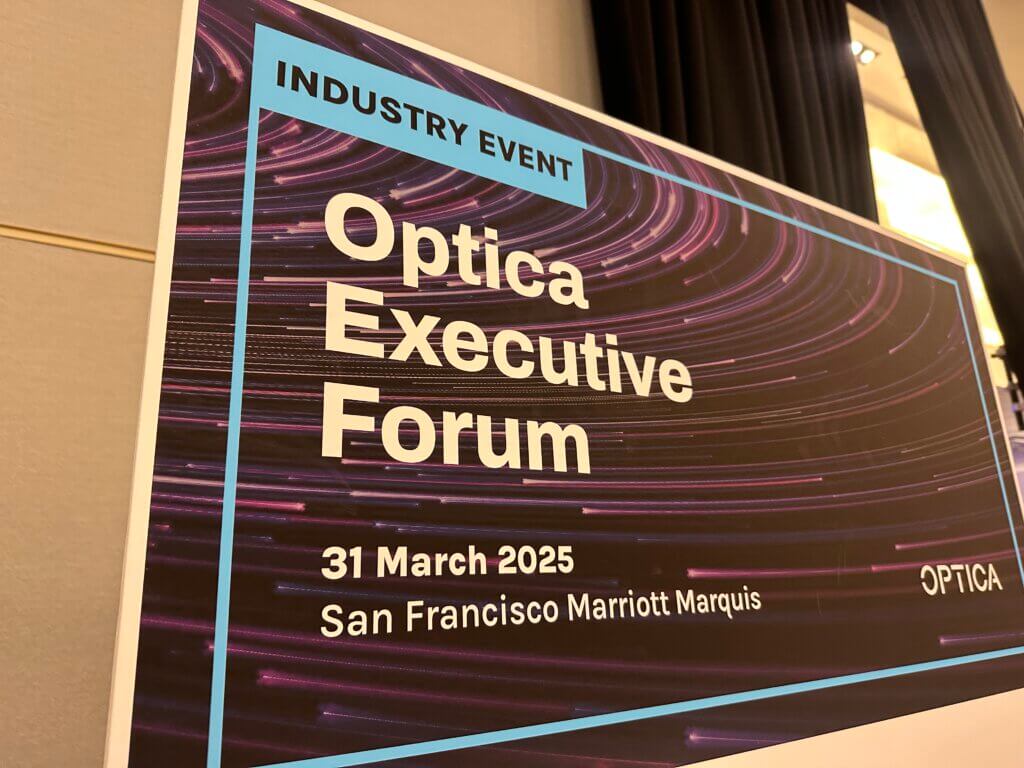
At the 2025 Optica Executive Forum in San Francisco, industry leaders from MACOM, Marvell, Broadcom, and Astera Labs gathered to tackle one of the defining challenges of next-generation data centers: the shift from copper to optical interconnects, and where co-packaged optics (CPO) fit into that evolution. Titled “The Evolution from Copper to Optical – Where is the Line?” and moderated by Mark Filer, the session spotlighted how rising AI compute demands are driving a reevaluation of power, density, and reliability tradeoffs across data center infrastructure.
While copper still dominates ultra-short reach connectivity within racks, and pluggable optics remain the workhorse of scale-out data center fabrics, the panelists agreed that CPO represents the future of high-performance interconnect—particularly for scale-up GPU clusters where traditional modules are hitting their thermal and density limits. As AI clusters move toward 1 million XPUs, panelists argued that CPO is no longer a science experiment, but a practical, deployable technology. Broadcom, in particular, shared detailed updates on its CPO shipments, system-level reliability testing, and power savings—highlighting 40% energy efficiency gains versus DSP-based pluggables.
Key Points from the Panel:
Ryan Latchman, MACOM:
• Outlined the performance tiers of copper: DAC (~1m), ACC (~3m), AEC (~4m at ~20W).
• Compared copper solutions to optics like LPO (~10W), LRO (~20W), and fully retimed pluggables (~30W) at 1.6T.
• Noted that CPO and NPO provide power and density advantages by shortening electrical trace lengths and eliminating faceplate constraints.
• Observed that beyond ~3 meters, the performance-per-watt calculus starts to shift decisively toward optics—especially CPO.
Loi Nguyen, Marvell:
• Framed CPO as an essential enabler of AI-scale infrastructure, particularly for building 1M-XPU clusters across large campuses.
• Emphasized that the optical fanout required for scale-out cannot be sustained by copper alone.
• Introduced “coherent-lite” optics as a solution for 10–40 km interconnects between data center buildings—potentially complementing CPO in a broader optical hierarchy.
• Stressed that while pluggables will continue to scale via ecosystem momentum, CPO is emerging as the best option for energy-constrained, high-density designs.
Manish Mehta, Broadcom
• Delivered the most concrete update on CPO progress:
• Broadcom shipped more CPO units in Q1 2025 than in all of 2024.
• Expects 7× CPO volume growth year-over-year.
• Demonstrated 40% power savings versus DSP-based pluggables and 25% better than LPO in full 64-port system tests.
• Shared results from rigorous system-level reliability testing:
• 50,000+ hours of HTOL,
• Mechanical shock and vibration testing,
• Dust ingress mitigation with new protective designs.
• Highlighted CPO’s scalability: multi-engine packages delivering up to 100T bandwidth on a single die, ideal for emerging 25T–100T GPU IO needs.
Adit Narasimha, Astera Labs:
• Called for a more nuanced framework: copper and optics, not copper vs. optics.
• Agreed CPO is uniquely positioned to bridge the gap between passive copper and bulky pluggables.
• Urged the industry to evaluate CPO in terms of performance-per-TCO and RAS (reliability, availability, serviceability)—not just raw speed or cost.
• Warned that optics must continue to improve reliability and ease-of-deployment before fully supplanting copper in mission-critical scale-up roles.
Q&A Highlights:
• Perf/TCO as the Guiding Metric:
•• CPO’s ability to collapse multiple optical engines into a single ASIC package dramatically improves perf/TCO.
• Cooling and Thermal Readiness:
• Liquid cooling is now mainstream for CPO systems; immersion cooling may follow in 3–5 years.
• Broadcom demonstrated robust thermal management via integrated heat sinks on both ASICs and optical engines.
• Reliability and Qualification:
• CPO is no longer in the experimental phase.
• Vendors are achieving full-box reliability test coverage and planning >200,000 hours of system-level HTOL by year-end.
• Future Adoption and Ecosystem:
• Panelists emphasized the importance of field experience—getting CPO into early deployments now is critical to broader adoption later.
• Customers, particularly hyperscalers and AI platform developers, are shaping the demand curve and influencing CPO design targets.
• Architectural Outlook:
• CPO is becoming essential to scale-up interconnects where traditional modules can’t meet bandwidth or power density targets.
• In the long run, a hybrid optical stack—combining pluggables, LPO, CPO, and coherent-lite—is likely to emerge depending on reach, power, and deployment model.
Addendum: Acronyms Explained
Here’s a reference guide to key acronyms and terminology used during the panel discussion:
• DAC (Direct Attach Copper): A passive copper cable without active signal conditioning; lowest power but limited reach.
• ACC (Active Copper Cable): A copper cable with linear equalization; improves reach over DAC but still relies on the host for signal recovery.
• AEC (Active Electrical Cable): A copper cable with digital signal processing (DSP) in the cable ends to retime and regenerate signals.
• LPO (Linear Pluggable Optics): A low-power optical transceiver that avoids full DSP-based retiming; ideal for power-sensitive applications.
• LRO (Linear Receive Optics / Half-Retimed): A variant where only the transmit or receive direction is retimed, balancing power and performance.
• CPO (Co-Packaged Optics): Optical engines integrated with the host ASIC or switch, eliminating long copper traces and faceplate modules for better power, density, and signal integrity.
• NPO (Near-Packaged Optics): Optics placed near—but not directly co-packaged with—the ASIC, offering some flexibility while preserving power savings.
• XPU: Generic term for modern processors (e.g., CPU, GPU, NPU, DPU) used in AI and compute-heavy infrastructure.
• DSP (Digital Signal Processor): Chip used in AECs and optical modules to restore signal quality, especially over longer distances.
• TCO (Total Cost of Ownership): Sum of all capital and operational costs over a system’s lifecycle.
• Perf/TCO: A performance-to-TCO ratio; a way of measuring how efficiently a technology delivers performance relative to its total cost.
• HTOL (High Temperature Operating Life): A test that simulates long-term component aging by exposing hardware to sustained elevated temperatures.
• RAS (Reliability, Availability, Serviceability): Metrics crucial for system uptime, fault tolerance, and ease of maintenance—especially in mission-critical AI deployments.
• WDM (Wavelength Division Multiplexing): Optical multiplexing technique that sends multiple wavelengths down a single fiber to increase capacity.
• MSA (Multi-Source Agreement): A set of industry standards that ensures interoperability among transceivers and modules from different vendors.