


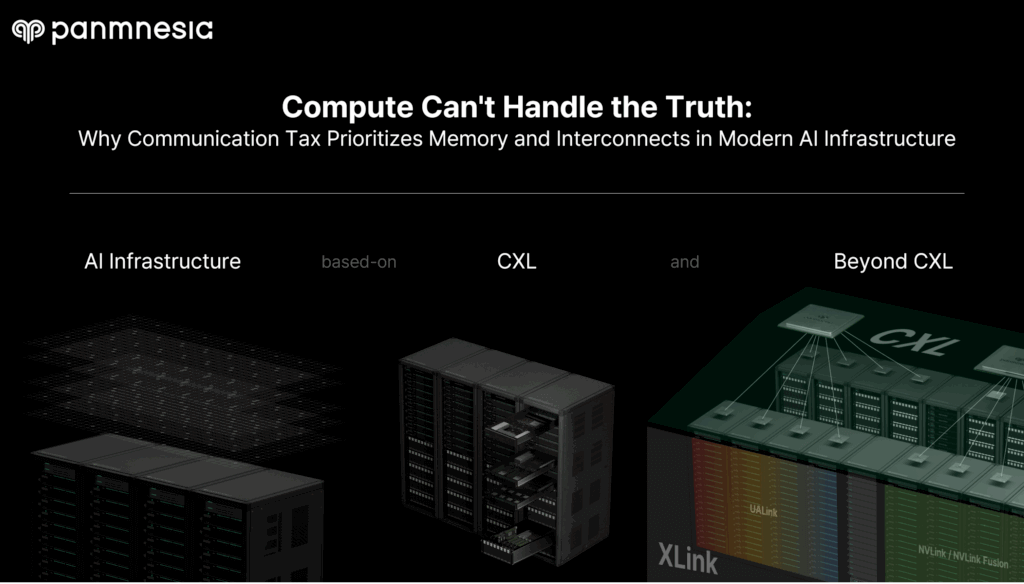
Panmnesia, a South Korean innovator in memory and interconnect technologies, released a technical report detailing a new AI infrastructure architecture that integrates Compute Express Link (CXL), NVLink, Ultra Accelerator Link (UALink), and High Bandwidth Memory (HBM). The report, titled “Compute Can’t Handle the Truth”, analyzes current challenges in AI workloads and proposes a modular, communication-efficient architecture optimized for large-scale AI models.
The core thesis emphasizes that communication—not compute—is the limiting factor for modern AI scalability. Panmnesia’s approach abandons rigid GPU-centric models in favor of CXL composability, enabling automatic cache coherence and dynamic memory expansion. The company’s CXL 3.0-compliant prototype system, built using in-house CXL IPs and switches, has shown performance gains in applications like RAG and DLRM.
Looking beyond CXL, Panmnesia proposes a hybrid architecture known as the CXL-over-XLink Supercluster, combining CXL’s scalability with low-latency accelerator fabrics like NVLink, NVLink Fusion, and UALink. This allows for a more flexible and performant data center design tailored to the needs of generative AI and recommendation engines. The architecture also anticipates integration with HBM and silicon photonics for further bandwidth and energy efficiency.
- Panmnesia introduces “CXL-over-XLink Supercluster” combining NVLink, UALink, and CXL
- Targets AI model bottlenecks in memory bandwidth and synchronization latency
- Deploys CXL 3.0 prototype with in-house IPs and switches
- Validates performance gains on RAG and recommendation AI workloads
- Envisions future integration with HBM and photonic interconnects
- Actively engaged in UALink Consortium, PCI-SIG, CXL Consortium, and OCP
“We will continue to lead efforts to build better AI infrastructure by developing diverse link solutions and sharing our insights openly,” said Dr. Myoungsoo Jung, CEO of Panmnesia.
🌐 Why It Matters: Panmnesia’s architecture reflects an industry-wide pivot from compute-centric scaling to communication-optimized infrastructure. By unifying CXL with emerging accelerator links like UALink and NVLink, Panmnesia offers a blueprint for heterogeneous, high-bandwidth AI clusters. This is especially relevant as workloads like LLMs and RAG demand increasingly disaggregated and memory-rich systems.