


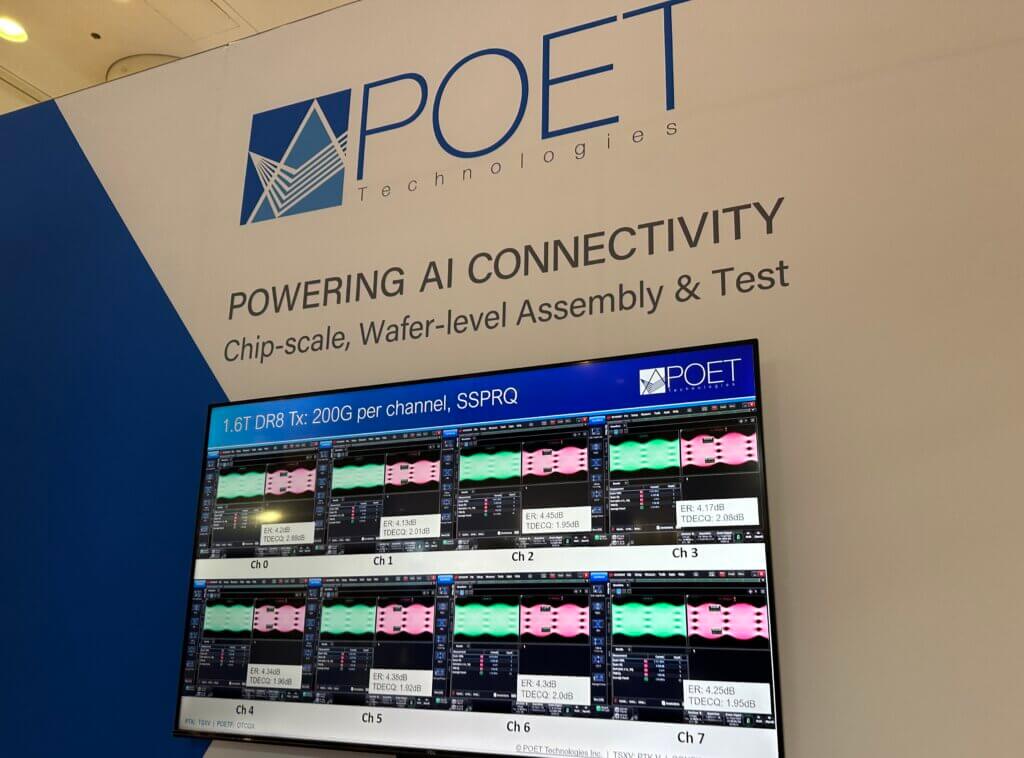
POET Technologies and Quantum Computing Inc. (QCi) have formed a strategic partnership to co-develop 400G/Lane thin-film lithium niobate (TFLN) modulator-based 3.2Tbps optical engines aimed at accelerating the next era of computing and AI infrastructure. The collaboration combines POET’s Optical Interposer™ platform with QCi’s TFLN integrated photonics to create chip-scale solutions capable of meeting the performance demands of hyperscale data centers.
The companies expect to complete the first 400G/Lane TFLN modulator in the second half of 2026. The project will be funded by POET and is designed to enable data transfer rates exceeding 3.2Tbps per engine—doubling the speed of current high-end networking components. TFLN materials offer high electro-optic efficiency and thermal stability, enabling lower power and higher-density integration for co-packaged optics (CPO) and pluggable transceivers.
The global market for 3.2T modules, spanning both pluggable and CPO form factors, is forecast to reach nearly USD $12 billion by 2030, according to LightCounting’s Ethernet Optics: Cloud, Enterprise and Telecom report (September 2025).
• Collaboration targets 400G/Lane performance using TFLN integrated photonics
• 3.2Tbps optical engine to support AI, data center, and hyperscale interconnects
• POET funds development; completion expected in 2H 2026
• TFLN offers higher bandwidth, lower power, and wafer-scale manufacturability
• 3.2T optical module market projected to reach $12 billion by 2030
“The work we are doing with QCi is among the efforts that keep POET at the forefront of AI connectivity development,” said Dr. Suresh Venkatesan, Executive Chairman and CEO of POET Technologies. “A 400G/Lane optical modulator that incorporates TFLN will be a radical step forward for the industry.”
🌐 Analysis:
The POET–QCi partnership underscores the growing convergence between high-speed optics and quantum photonics as the industry pushes toward 400G/Lane and 3.2T interconnects. TFLN has emerged as a leading candidate for next-generation modulators due to its linearity and low voltage operation. This collaboration positions POET alongside emerging TFLN innovators such as Ayar Labs, HyperLight, and Liobate Technologies, all racing to enable optical I/O architectures for AI-scale computing.
🌐 We’re tracking the latest developments in networking silicon. Follow our ongoing coverage at: https://convergedigest.com/category/semiconductors/
🌐 We’re launching the “Data Center Networking for AI” series on NextGenInfra.io and inviting companies building real solutions—silicon, optics, fabrics, switches, software, orchestration—to share their views on video and in our expert report. To get involved, send a note to jcarroll@convergedigest.com or info@nextgeninfra.io.