


Presented at PECC 2025, Sunnyvale, CA, October 2025
At the recent Photonics and Emerging Computing Conference (PECC) in Sunnyvale, Mark Thompson, Chief Technologist at PsiQuantum, outlined how the company’s silicon photonics breakthroughs are paving the way for the world’s first large-scale, fault-tolerant quantum computer—and how these same technologies could one day transform AI data center infrastructure.
Quantum Systems That Resemble Data Centers


Thompson began by drawing a parallel between PsiQuantum’s quantum systems and AI data centers, noting that “from my perspective, the quantum computer we’re building looks a lot like an AI data center.” Founded in 2016, PsiQuantum has grown to over 500 employees and recently raised $1 billion in its latest funding round, valuing the company at $7 billion. Its mission is singular: to build a scalable, error-corrected quantum computer that can outperform classical supercomputers—by exponential margins.
Whereas current systems with a few hundred qubits are still outperformed by iPhones on useful tasks, Thompson explained, the path to utility-scale computing requires millions of high-quality qubits operating coherently. “Scaling is the challenge,” he said, “but photonics gives us the unique ability to address manufacturability, connectivity, and cryogenic operation at scale.”
Building the Quantum Photonic Stack
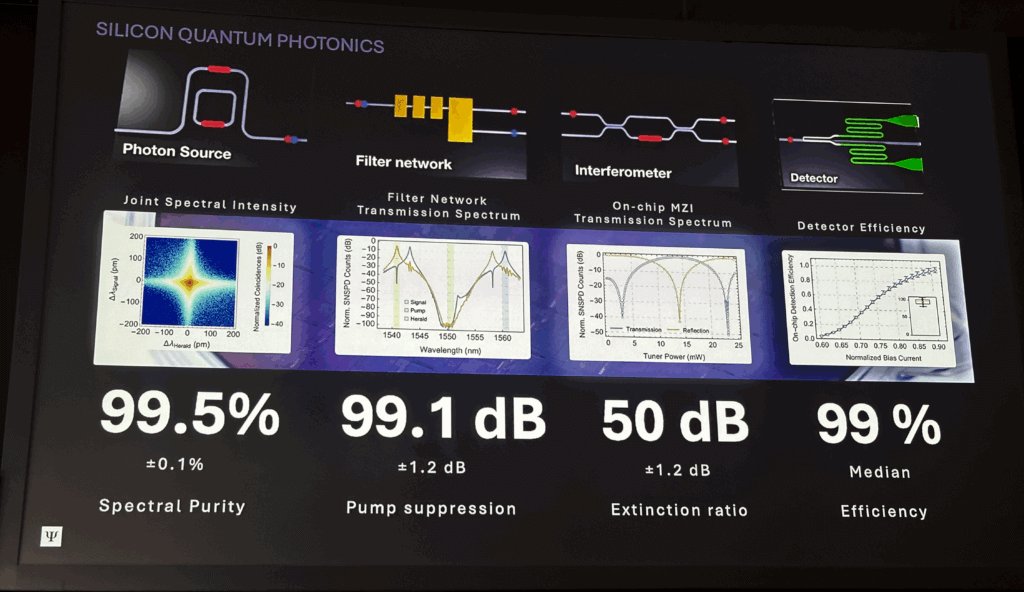
PsiQuantum’s approach leverages photon-based qubits, enabling distributed, modular architectures interconnected by optical fibers—akin to how cloud data centers scale. The company has built a fully integrated photonic stack that encompasses photon generation, manipulation, and detection with near-perfect efficiency.
To achieve this, PsiQuantum formed a long-term partnership with GlobalFoundries, running more than 4,000 wafers through the foundry’s advanced CMOS photonics lines. Each wafer undergoes over 900 process steps and incorporates more than 40 photonic layers. The result: record-breaking performance with single-qubit fidelities approaching 99.999%, and two-qubit fidelities exceeding 99.9%.
Thompson detailed further innovations:
- Ultra-low-loss silicon nitride waveguides achieving <0.1 dB/m loss for routing and delay lines
- Edge couplers reaching ~65 millidecibel losses—99% coupling efficiency to fiber
- Barium titanate (BTO)-based fast optical switches providing 20 GHz modulation with <0.1 dB insertion loss
These capabilities required PsiQuantum to build the world’s first 300 mm MBE tool for depositing high-quality BTO films, located in San Jose and fully fab-compatible for seamless integration with GlobalFoundries’ process flow.
Toward Utility-Scale Quantum Computing
The company is now transitioning from scientific demonstration to systemization and scaling—constructing cryogenic modules capable of housing thousands of photon generators and interconnects. Strategic build-out sites are already underway in Illinois and Australia, including a new facility near Chicago that broke ground with Illinois Governor J.B. Pritzker.
“Our differentiator,” Thompson concluded, “is that we’re not reinventing entire industries—we’re leveraging the semiconductor ecosystem, fiber optics, and existing cryogenic infrastructure to move fast.”


Analysis
PsiQuantum’s presentation underscored the growing convergence between quantum computing and AI infrastructure. Its reliance on advanced photonics, precision wafer processing, and data-center-like modular scaling places it in a unique position to influence both quantum and classical compute architectures. The company’s collaboration with GlobalFoundries signals how deeply semiconductor manufacturing is becoming entwined with next-generation computing paradigms—potentially redefining not just quantum performance, but how we build and interconnect the compute fabrics of the future.

