


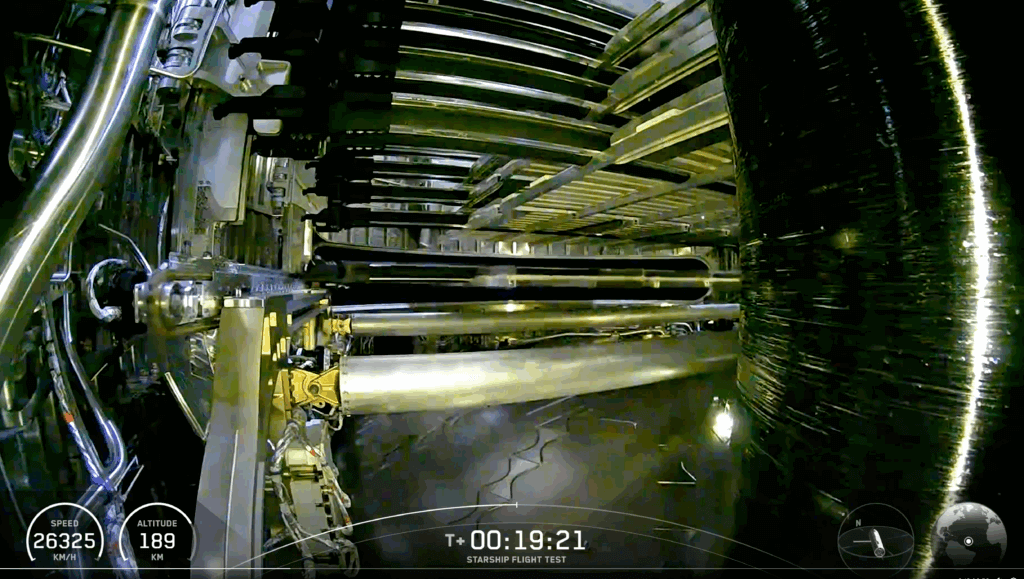
SpaceX moved closer to a radical expansion of Starlink’s global network on August 26, when Starship’s tenth test flight successfully demonstrated a “PEZ” satellite deployment system. The upper stage released eight mock Starlink satellites on a suborbital trajectory, validating a payload door and dispenser designed to deploy dozens of spacecraft in rapid sequence. This capability sets the stage for Starlink’s largest leap in capacity since the project’s launch.
The upcoming Starlink V3 satellites weigh roughly 1,900 kg each, about 3.3 times heavier than the V2 Mini models currently launched on Falcon 9, which weigh approximately 575 kg. Each V3 unit is designed to deliver about 1 Tbps of downlink and up to 4 Tbps of combined RF and optical inter-satellite capacity. With Starship capable of carrying up to 60 V3 satellites in a single mission, a single launch could add 60 Tbps of throughput to the constellation. By comparison, a Falcon 9 launch of ~20–22 V2 Minis adds roughly 2 Tbps. The shift represents an order-of-magnitude increase in Starlink’s ability to scale.
SpaceX envisions Starship becoming the workhorse of Starlink’s continued buildout, potentially deploying hundreds of V3 satellites per month once flight cadence stabilizes. The PEZ-style dispenser—so named because satellites are pushed out sequentially like candy—enables Starship to empty its payload bay rapidly, reducing deployment complexity. If Starship achieves full reusability and a high flight cadence, this system could allow SpaceX to bring thousands of terabits of new bandwidth online annually, setting Starlink apart from any rival constellation in terms of both scale and economics.
- Starship test flight 10 validated PEZ dispenser with eight mock Starlink satellites on a suborbital trajectory
- Starlink V3 satellites: ~1,900 kg each, ~3.3 times heavier than V2 Mini models (575 kg), 1 Tbps downlink, 4 Tbps total capacity
- Starship capacity: Up to 60 V3 satellites per launch (~60 Tbps of new throughput per flight)
- Capacity comparison: Falcon 9 launches add ~2 Tbps; Starship adds 30× more per flight
- Strategic impact: Enables exponential growth of Starlink constellation capacity and coverage
🌐 Analysis: Starship’s PEZ system transforms Starlink’s scaling model from incremental to exponential. By combining heavier V3 satellites with mass deployment capability, SpaceX positions Starlink as the first truly global, multi-Tbps LEO network. The strategy mirrors hyperscaler buildouts in data centers—capacity ramps rapidly once platform bottlenecks are solved. Competitors like Amazon’s Project Kuiper, planning 3,236 satellites, and OneWeb, targeting enterprise markets, will face pressure to match not just coverage but raw throughput, a challenge without a comparable heavy-lift, reusable launch system.