


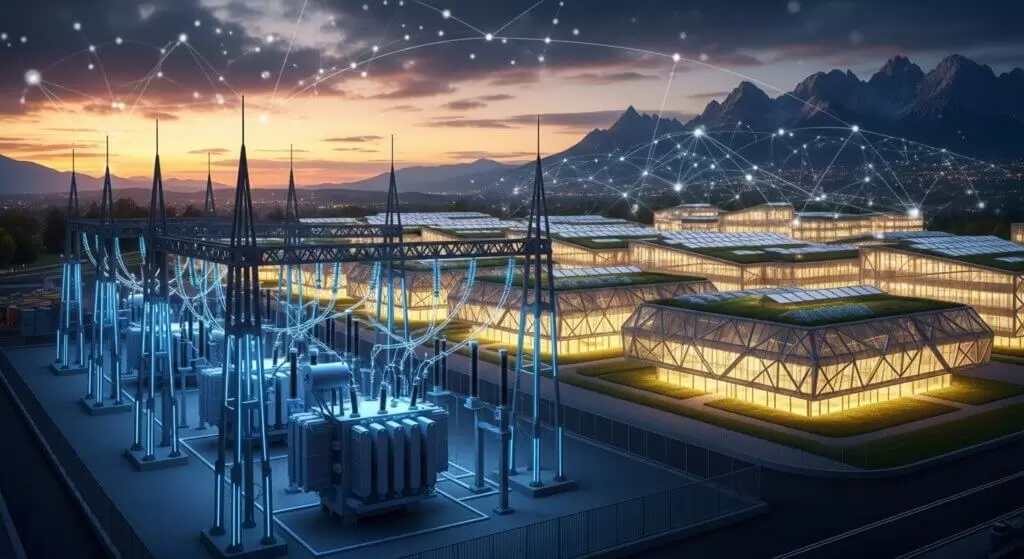
The era of generative AI has transformed the traditional data center into an “AI Factory” — an industrial-scale facility designed to train, refine, and deploy massive machine-learning models continuously. This escalation in compute density has created a crisis in power delivery: racks that now draw kilowatts will soon require megawatts. To meet these loads, NVIDIA and a growing ecosystem of partners are driving adoption of an 800-volt direct-current (VDC) architecture. The concept, now under active development within the Open Compute Project (OCP), has drawn participation from hyperscalers, component suppliers, and power-infrastructure vendors alike.
At the 2025 OCP Global Summit, the foundation introduced its Open Data Center for AI initiative, including a facilities-level Power Distribution Project focused on transitioning data centers to low-voltage DC (LVDC ≤ 1,500 VDC) for high-power racks. While NVIDIA remains the main catalyst, companies such as Delta Electronics, LITEON Technology, and Schneider Electric have already announced compatible 800 VDC systems — signaling an industry-wide evolution rather than a single-vendor effort.
I. Why 48 V Systems Have Reached Their Limits
Conventional 48 / 54 V DC power systems, originally designed for telecom, no longer scale to the compute densities demanded by AI infrastructure. Operators now face what many describe as a performance-density trap.
- Supplying a one-megawatt rack at 54 V requires more than 18,000 A of current, with copper busbars exceeding 200 kg per rack. NVIDIA estimates that a one-gigawatt campus could consume hundreds of thousands of tons of copper if scaled this way.
- AI workloads swing rapidly between idle and full load, forcing oversized components and stressing local utility grids.
- Multiple AC/DC and DC/DC conversion stages add heat, reduce usable rack space, and increase maintenance complexity.
By raising the distribution voltage to 800 V DC, current levels drop sharply, reducing copper use and conversion losses while improving overall efficiency and reliability.
II. Technical Comparison: 48 V vs 800 VDC
| Feature | Traditional 48 / 54 V Architecture | New 800 VDC Architecture | Result |
|---|---|---|---|
| Distribution voltage | 48 / 54 V DC or 415–480 V AC | 800 V DC | Lower current and heat loss |
| Power conversion chain | Multiple stages (AC→DC at facility, DC/DC in rack) | Single stage (AC→800 V DC then local step-down) | ≈ 5 % better end-to-end efficiency |
| Copper requirement | Thick busbars for high current | Thinner conductors | ≈ 45 % less copper used |
| Rack capacity | Up to 200 kW per rack | 1 MW or more per rack | Higher compute density |
| Reliability & maintenance | Many PSUs and conversion points | Central rectification and simpler power path | Maintenance cost cut up to 70 % |
By converting medium-voltage AC (≈ 13.8 kV) directly to 800 V DC at the perimeter, redundant conversion stages are removed and cable losses are reduced. NVIDIA reports roughly 85 percent more power through the same conductor size compared with 415 V AC distribution.
III. How the 800 VDC Architecture Works
NVIDIA’s Kyber rack architecture is the first system built natively for 800 V DC, supporting dense GPU clusters such as Rubin Ultra and NVL144. The design centralizes conversion at the facility edge and delivers high-voltage DC end-to-end.
- Facility conversion: Medium-voltage AC (≈ 13.8 kV) is rectified to 800 V DC using solid-state transformers (SSTs).
- Distribution: The 800 V DC bus feeds rows of racks through high-voltage busways.
- Sidecar modules: Schneider Electric and Delta have unveiled modular sidecar pods with integrated storage, rated to ≈ 1.2 MW per row (Delta reports ≈ 98.5 % efficiency).
- Final conversion: Compact 64:1 DC/DC modules near the GPU step 800 V down to 12 V, freeing rack volume for compute and cooling.
NVIDIA demonstrated an 800 V sidecar at GTC 2025 powering a Kyber rack with 576 Rubin Ultra GPUs — a setup that would be physically impractical under legacy 54 V designs. The blueprint also envisions battery and supercapacitor storage at both row and facility levels to buffer AI load volatility and protect the grid.
IV. Key Participants in the 800 VDC Ecosystem
| Sector | Organizations | Role | Recent Activity |
|---|---|---|---|
| Semiconductors & Devices | Infineon, Navitas, Texas Instruments, STMicroelectronics, onsemi, Renesas | Supplying GaN and SiC switches, controllers, and high-voltage monitoring ICs | Infineon and Navitas announced co-development with NVIDIA; ST debuted a 12 kW board validated by NVIDIA. |
| Infrastructure & Power Systems | ABB, Schneider Electric, Vertiv, Delta, Hitachi Energy, LITEON | Developing rectifiers, busways, sidecar modules, and SST-based conversion gear | ABB partnered with NVIDIA on 1 MW rack and gigawatt-scale campus R&D; Vertiv targets H2 2026 launch; Delta and Schneider showcased 1.2 MW units (OCP 2025). |
| Standards & Certification | OCP Foundation, IEC Working Group, UL Labs | Defining voltage ranges, connectors, and safety protocols for LVDC ≤ 1,500 V | OCP Power Distribution Project formally launched in 2025 for AI facility power standards. |
| Deployment & Hyperscalers | Microsoft, Oracle Cloud Infrastructure, CoreWeave, Foxconn, Lambda Labs | Testing 800 VDC clusters in AI factories and OCP reference sites | Foxconn plans to implement the architecture at its Kaohsiung-1 AI center (OCP 2025 reference). |
| Energy Storage & Grid Integration | Tesla Megapack, Fluence, Eaton Grid Storage, Powin Energy | Providing megawatt-scale battery systems and controllers for load smoothing | OCP partners testing row-level and facility-level battery integration. |
V. Business Impact and Industry Outlook
NVIDIA projects about five percent higher end-to-end efficiency, 45 percent less copper use, and maintenance savings of up to 70 percent. At gigawatt scale, these gains translate into hundreds of megawatts of power savings and tens of millions of dollars in operational reductions each year. The architecture also simplifies integration of battery energy storage and paves the way for microgrid operations where renewables and storage tie directly into the DC bus.
VI. The Big Picture: Open Questions and Global Implications
The rise of 800 VDC represents one of the most significant changes in data-center engineering in decades. In the United States, gigawatt-class projects such as OpenAI and Oracle’s Stargate campus in Michigan, Amazon’s Virginia expansions, and Google’s TPU zones in Iowa are redefining how energy interfaces with compute. At this scale, a one-percent efficiency gain represents millions in annual power savings and significant carbon reductions.
Early adopters of 800 VDC could gain an edge through denser compute footprints, lower energy overheads, and reduced cooling requirements. For colocation operators, a standardized DC backbone may enable multi-tenant AI clusters without custom AC feeds. The technology also aligns with sustainability targets by cutting losses and material usage while facilitating integration of battery storage and renewables.
Yet the transition raises critical questions for the next phase of AI infrastructure:
- When will large-scale deployments move beyond pilot phases — 2026 or 2027?
- Will colocation and enterprise operators adopt 800 VDC, or will it remain limited to hyperscalers until costs decline?
- Can regulators in Europe and Asia harmonize with U.S. LVDC standards (≤ 1,500 VDC) for global interoperability?
- Are megapack-scale battery systems sufficiently available and certified for direct 800 VDC integration?
- Will OCP, IEC, and UL converge on a common specification for connectors and safety or fragment into proprietary variants?
- How can legacy 48 V and 415 V facilities transition — incremental retrofits or complete re-engineering?
- As AI campuses draw gigawatt-scale loads, how will utilities coordinate grid interconnections and demand response?
If these challenges are met, the data center of the future will look radically different — a DC-native environment with fewer power shelves, tighter energy integration, and denser compute bays. Entire supply chains — from switchgear and power electronics to semiconductor packaging and cooling systems — will reorient around this new voltage domain. For now, 800 VDC remains in early adoption, but with OCP standardization and vendor alignment accelerating, it is poised to become the default power architecture for megawatt-class AI factories in the latter half of this decade.
The implications extend beyond hyperscalers. As government, financial, and industrial organizations pursue AI supercomputing infrastructure of their own, the ability to reduce losses, save space, and lower cooling costs through DC-native power distribution will become a competitive differentiator. Regions investing in AI capacity — including North America, Europe, and East Asia — are likely to see new clusters designed entirely around 800 VDC as part of national digital infrastructure strategies.
“Through this innovative approach, NVIDIA is able to optimize the energy consumption of our advanced AI infrastructure, supporting both sustainability and the performance required for next-generation workloads,” said Gabriele Gorla, Vice President of System Engineering at NVIDIA.
The transition to 800 VDC is not merely a technical upgrade — it represents a rethinking of how energy, compute, and sustainability intersect. Just as fiber replaced copper for bandwidth, and liquid cooling displaced air for thermal efficiency, high-voltage DC may soon replace AC as the defining electrical backbone of the AI era. Whether it reaches full adoption will depend on how quickly the industry can align on standards, safety, and grid coordination — but the trajectory is clear: the world’s most powerful data centers are preparing to run on direct current.
🌐 We’re tracking the latest developments in networking silicon. Follow our ongoing coverage at ConvergeDigest.com.
🌐 We’re launching the Data Center Networking for AI series on NextGenInfra.io — inviting companies building real solutions in silicon, optics, fabrics, switches, software, and orchestration to share their views in video interviews and our expert report. Contact: jcarroll@convergedigest.com or info@nextgeninfra.io.