


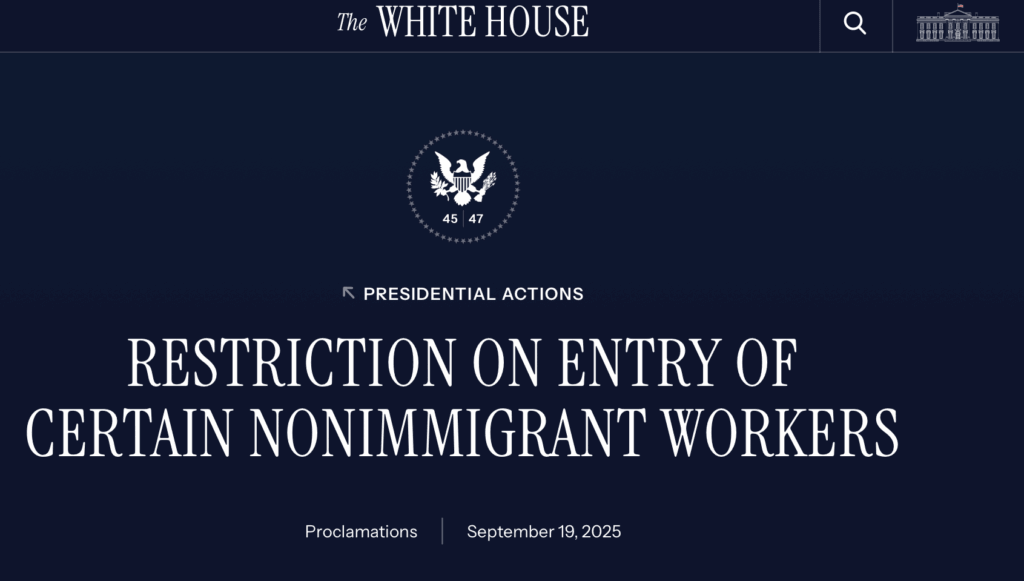
President Donald Trump on September 19, 2025 signed a proclamation raising the cost of filing new H-1B visa petitions to $100,000 per visa. The order applies only to petitions filed after 12:01 AM ET on September 21, 2025 and does not affect existing H-1B visa holders, already-filed petitions, or validly issued visas. The change disproportionately impacts India, which accounts for roughly 71% of all H-1B visa holders, many of them engineers working in Silicon Valley and across the U.S. tech sector.
The new fee structure replaces the prior filing costs, which consisted of a $215 registration fee plus several employer surcharges that typically totaled in the low thousands. In past decades, certain training and fraud prevention surcharges reached around $1,000, but none approached the six-figure level now mandated. Under the proclamation, employers must submit the $100,000 payment alongside each new petition for foreign workers in specialty occupations.
The administration justified the measure by citing rising reliance on foreign labor in U.S. STEM fields. Between 2000 and 2019, the number of foreign STEM workers in the U.S. doubled from 1.2 million to 2.5 million, while overall STEM employment grew 44.5 percent, according to their figures. In computer and math occupations, the foreign share of the workforce climbed from 17.7 percent to 26.1 percent. Officials argued that IT outsourcing firms in particular have manipulated the H-1B system to hire lower-paid foreign workers in place of Americans, sometimes requiring laid-off U.S. employees to train their replacements. The proclamation cites studies linking H-1B usage to suppressed wages and job losses for American graduates, as well as investigations into visa fraud and other abuses by outsourcing companies.
For Silicon Valley, which depends on H-1Bs for specialized engineering roles in cloud, semiconductor, and networking infrastructure, the impact is immediate for future hiring. Networking firms in particular face higher barriers to bringing in experts in optical systems, ASIC design, and high-capacity routing software—skills already scarce in the U.S. While existing employees on valid H-1Bs can continue to work and travel, startups and mid-sized firms looking to expand teams will be forced to weigh steep visa costs against offshoring or delaying projects. Larger tech companies may absorb the added costs, but smaller firms could see constrained access to talent, potentially slowing innovation in advanced networking and data center technologies.
- H-1B visa fee for new petitions rises from roughly $215 registration + surcharges to $100,000
- Previous fees never exceeded a few thousand dollars in total
- Effective September 21, 2025; existing visa holders and pending petitions are exempt
- Networking and semiconductor engineering roles could be hit hard
- Smaller startups face greater risk than large, diversified tech firms
🌐 Analysis: By targeting only new petitions, the policy creates a sharp dividing line between existing and future H-1B holders. For Silicon Valley, this preserves the current workforce but raises steep barriers for scaling teams with new international talent.