


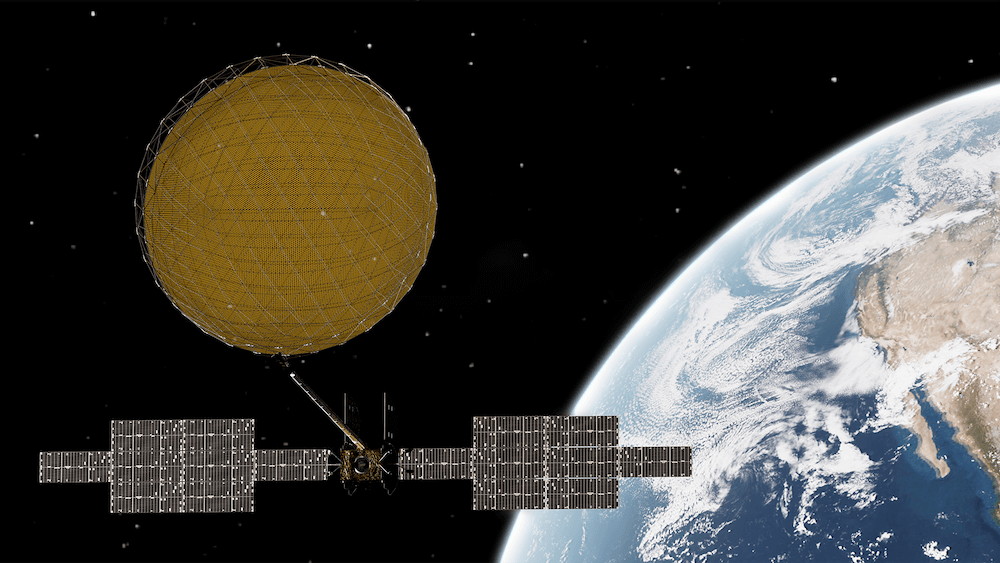
ViaSat-3 F2 opened a new chapter for high-capacity GEO broadband tonight as a United Launch Alliance Atlas V 551 lifted the satellite from Cape Canaveral. The spacecraft—the second in Viasat’s global ViaSat-3 constellation—will deliver its highest-density coverage over North and South America, targeting residential broadband, mobility, government, and enterprise networks.
ViaSat-3 F2 rides on Boeing’s 702X platform and is designed for terabit-class throughput, powered by a fully digital payload capable of real-time beamforming and dynamic allocation of Ka-band spectrum. Once in service, the satellite will serve as the company’s new high-capacity anchor over the Western Hemisphere, complementing earlier Ka-band satellites (ViaSat-1, ViaSat-2, WildBlue-1) and providing substantial backhaul headroom for Viasat’s mobility and government contracts.
ViaSat-3 F1 (for EMEA), launched in 2023, experienced a reflector deployment anomaly that significantly limited usable capacity but remains operational in a reduced-service mode. The third satellite—ViaSat-3 F3 for the Asia-Pacific region—remains under development. Together, the system is engineered to enable persistent, reconfigurable GEO coverage at a scale that was previously unattainable in fixed-beam architectures.
A High-Power GEO Platform Built for Digital Payloads
ViaSat-3 F2 uses Boeing’s 702X all-electric platform, built for very large digital payloads and high power delivery. The satellite is expected to weigh roughly 5,500–6,400 kg at launch depending on configuration. The platform uses electric propulsion for orbit-raising and station-keeping and carries a small chemical propulsion system for attitude control and contingency maneuvers.
Key design attributes include:
- All-electric propulsion to maximize payload mass and in-orbit lifespan
- Large deployable solar arrays rated above 20 kW of payload power (Viasat has previously cited 25+ kW as the target design envelope for the ViaSat-3 program)
- Software-defined processors enabling beamforming, spatial multiplexing, and flexible channelization
- High-density Ka-band front-end operating across standard ITU Ka-band allocations
The 702X platform’s high DC power availability and thermal envelope were critical for supporting ViaSat-3’s large digital signal-processing chains and extensive active antennas.
Digital Payload Architecture and Capacity Allocation
Viasat designed ViaSat-3 as a software-defined GEO broadband system, departing from fixed transponders in favor of flexible, packet-aware digital routing. The architecture supports:
- Dynamic spot-beam formation and placement
- Real-time power and bandwidth reallocation across the footprint
- Adaptive coding and modulation (ACM) across thousands of channels
- Software-controlled traffic steering between gateways, beams, and service regions
Each ViaSat-3 satellite is engineered for 1 Tbps+ class throughput, with actual delivered capacity depending on operational factors such as link budget, atmospheric conditions, and gateway loading. Unlike earlier satellites that set fixed beam contours, ViaSat-3 can push capacity density toward high-demand areas—including busy IFC corridors, cruise routes, and urban clusters—while reducing power and bandwidth in regions with lower activity.
Targeted Applications Across the Americas
ViaSat-3 F2 is designed to support multiple operating segments with a single, highly multiplexed GEO platform:
- Residential broadband: Higher peak rates and improved spectral reuse allow Viasat to increase service tiers and reduce contention ratios in rural markets.
- Aviation IFC: The Americas host the densest global IFC traffic pattern; ViaSat-3 F2 expands headroom for the company’s major airline customers.
- Maritime: Cruise lines and commercial shipping continue to demand multi-hundred-Mbps links; flexible beam placement is particularly beneficial in shifting maritime traffic zones.
- Enterprise and energy: Mining, agriculture, and offshore energy operations depend on persistent high-capacity backhaul for IoT and private network data.
- Government and defense: Ka-band GEO capacity with reconfigurable beams supports ISR backhaul, mobility, and contingency communications.
- 5G/edge backhaul: High-capacity GEO can extend mobile coverage or serve as a resilient alternate path for remote edge sites and disaster-response deployments.
Across these segments, the digital payload allows Viasat to dynamically distribute bandwidth without reconfiguring hardware or fixed beam patterns—an important shift for GEO economics.
Commissioning Timeline
Following separation, ViaSat-3 F2 will begin a multi-month commissioning process:
- Electric orbit-raising to GEO altitude
- Solar array and antenna deployments
- Bus subsystem verification
- Digital payload calibration and beam mapping
- Gateway integration and traffic-loading tests
Commercial service activation is expected after the spacecraft completes beam-to-gateway validation and final network handover.
ViaSat-3 F2 — Technical Specifications
| Satellite Bus | Boeing 702X all-electric GEO platform |
| Launch Vehicle | ULA Atlas V 551 |
| Launch Mass | ~5,500–6,400 kg (configuration dependent) |
| Mission Life | 15+ years (design) |
| Orbit | Geostationary, 79° West (Americas) |
| Propulsion |
Primarily electric (xenon Hall-effect) for orbit raising & station-keeping; Minimal chemical thrusters for attitude control and contingencies |
| Payload Power | 20–25+ kW (large deployable solar arrays) |
| Frequency Bands |
Ka-band uplink: 27.5–28.1 GHz, 29.1–29.5 GHz Ka-band downlink: 17.7–18.3 GHz, 19.3–19.7 GHz |
| Throughput Class | Terabit-class (>1 Tbps engineered capacity) |
| Payload Type |
Fully digital, software-defined payload with: – real-time beamforming – flexible channelization – adaptive routing & traffic steering |
| Coverage | North America, South America, Caribbean, flight corridors over Western Hemisphere |
| Primary Use Cases |
Residential broadband • Aviation IFC • Maritime • Government & defense • Enterprise 5G/edge backhaul • Energy & remote industrial operations |