by Heather Broughton, Sr. Director of Service Provider Marketing, NETSCOUT
Operators will ‘scale or fail’ to meet the 5G demand in 2019
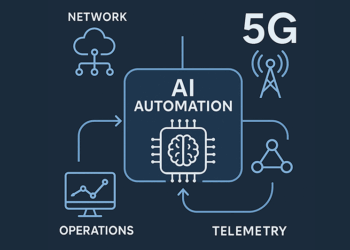
5G will be faster, smarter and more efficient than 4G, but in order to meet demand and to support new architectures, networks will have to scale. While most of the scale in the core network will be cloud and software-based, there will still be a need for hardware and equipment at the network edge, and in a 5G environment there will be a lot more equipment. In fact, the number of cell sites will increase dramatically to support and propagate the higher frequency bands that will transmit 5G data traffic over the air. This is when network management tools will come into their own. In 2019 we will see the deployment of automated networks driven by software, and controlled by virtual machines and artificial intelligence.
Network automation and orchestration are by-products of virtualisation and will add another layer of complexity. However, they are also integral to the rollout and sustainability of 5G networks, particularly as network topologies will change to accommodate a combination of small cell and macro cell sites. Small cells in particular will form the bulk of the new RAN (radio area network) and they are expected to increase cellular networks threefold.
 If network engineers think they have enough issues to deal with today maintaining 4G/LTE networks, then they may be in for a shock as 5G networks are gradually rolled out. In fact, without having total visibility of these more complex and expansive networks, 5G in the RAN is going to become extremely difficult to manage. If the number of cells were to double or triple, not only would network engineering teams need to have the full confidence in their network management tools to make sure the network is running optimally, but they would also be faced with one heck of a job troubleshooting hundreds, potentially even thousands of cells if an issue arose.
In 2019, carriers will be scrutinising costs per cell site as they look to invest in new infrastructure. They will look to offset any costs by implementing intelligent and automated systems that can support 5G networks. However, carriers need assurances that these systems are providing them with the right information about the uptime and performance of their new networks. The only way to achieve this will be to have complete visibility of these complex new architectures. Having a window into this multi-layered and virtualized environment, and being able to extract smart data in near real-time, will be essential for the ongoing management of new 5G networks.
2019 – The year carriers get to grips with 5G security
The benefits of 5G are clear; the new communications standard will offer carriers and their enterprise customers faster network speeds and performance, ultra-low latency and greater efficiencies. General discussion around carrier trials and deployments tends to focus on increased speeds and the new innovations that 5G will enable, but security rarely comes up. That’s all about to change with 5G security set to become a big issue for the industry and a major talking point in 2019.
To date, it appears that 5G security has almost been treated as an afterthought, rather than a critical aspect of network development. However, behind the scenes this is an issue that the carriers take very seriously. The situation for carriers has altered dramatically, because in a 5G domain, the attack surface becomes much greater. Consequently, the number of opportunities for malicious players to exploit vulnerabilities increases. This is partly due to the adoption of virtualized network infrastructures that will allow carriers to scale and meet the demands of 5G, but also because 5G networks will be configured to support a wide variety of industrial and business use cases. This means that going forward, carriers will be responsible for managing mission-critical systems and devices, in addition to handling high volumes of sensitive data. In a 5G environment, there will be a strong emphasis on securing smart factories, automated production lines and fleets of driverless cars.
The network security stakes get a lot higher
As new 5G network architectures are based on virtualization and distributed cloud models, and a containerized environment to support workloads and applications, it’s apparent that carriers have to deal with a whole new set of complexities. Existing security protocols will need to be scrapped and replaced with robust systems and procedures that account for this new complex environment and the burgeoning 5G value chain; that includes applications developers, device manufacturers, cloud service providers and the carriers themselves. A new built-in resilience is required to limit the attack landscape and to reduce the risk of malicious attacks and perimeter breaches. A pervasive security model that offers comprehensive insight on both service performance management and security offers the best solution to address 5G security. It enables service providers to extract ‘smart data’ that is collected and processed at the source from legacy, virtual and hybrid cloud environments. It’s the closest carriers and their customers will ever get to implementing ‘holistic security’ across their entire IT estate.