Antonio Neri, President and CEO of Hewlett Packard Enterprise, took the stage at HPE Discover 2025 in Las Vegas to mark the company’s 10th anniversary and unveil its bold strategy for the AI era. In a keynote centered around “Agentic AI,” Neri outlined how AI is rapidly transforming enterprise IT—moving beyond simple tools to intelligent, autonomous agents that continuously optimize business operations. “AI is no longer just a tool. It is an active, engaged workforce, managing real-time decisions across the enterprise,” Neri stated.
Neri introduced HPE GreenLake Intelligence, a new Agentic AI framework designed to simplify hybrid IT operations. The platform features a mesh of intelligent agents—powered by domain-specific large language models—that collaborate in real time across compute, storage, networking, and software domains. These agents proactively monitor infrastructure, resolve issues, optimize performance, and reduce costs. “This is not surface-level automation—this is deep, system-wide intelligence,” Neri emphasized.

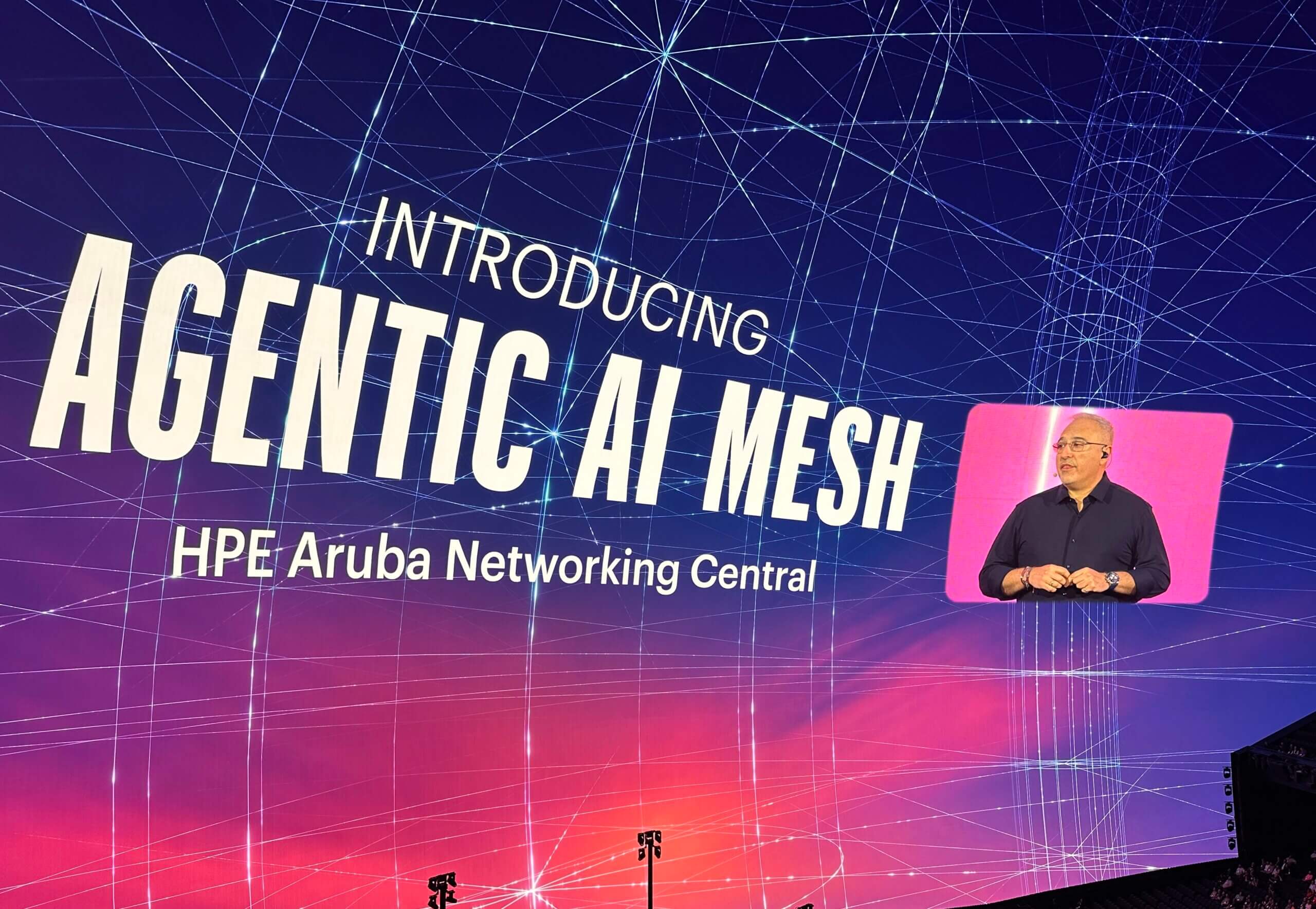
The keynote also highlighted Aruba Central’s new Agentic AI Mesh, bringing reasoning-based AI agents into network management. These AI-driven enhancements allow networks to adapt and optimize autonomously, with continuous learning to improve performance and security over time. Neri cited examples from customers such as Carnival Cruise Line and Inter Miami CF, demonstrating how AI-powered networks can transform user experiences—from cruise ships at sea to smart stadiums.
To power the AI-driven enterprise, Neri also unveiled enhancements to HPE Alletra MPX10,000 storage and HPE Private Cloud AI offerings—both designed for AI-centric workloads and seamless integration with Agentic AI frameworks. With this strategy, HPE aims to position AI not just as a workload, but as a foundational layer across the modern IT stack.
- HPE introduced GreenLake Intelligence, a new Agentic AI framework for hybrid IT
- Aruba Central gains Agentic AI Mesh for self-optimizing, self-healing network management
- HPE Alletra MPX10,000 storage upgraded for AI data pipelines with real-time metadata enrichment and MCP (Message Control Protocol) support
- HPE Private Cloud AI expanded with NVIDIA GB200 Grace Hopper and Blackwell GPUs for next-gen AI workloads
- New partnerships highlighted with Carnival Cruise Line, Inter Miami CF, Deloitte, and Skild AI for real-world Agentic AI applications
“We are moving beyond AI that simply analyzes and recommends, toward an intelligent Agentic AI workforce,” Neri concluded. “Together with our customers, we are unlocking new possibilities for the AI-driven enterprise.”
Q&A with Antonio Neri, CEO, Hewlett Packard Enterprise
Emerging Technologies: Photonics, Co-Packaged Optics, and Quantum
Looking ahead three to five years, in terms of emerging technologies—like co-packaged optics, silicon photonics, quantum computing—what technologies do you see as really transformative for HPE and your customers?
Antonio Neri (HPE):
“It’s going to be all of the above. If you think about supercomputing, for example, we already use photonics in some of our high-end systems. But the opportunity now is to commercialize that across more of the portfolio—particularly in AI data centers. There is a massive opportunity to bring photonics into AI fabrics, to power the scale and performance that customers need.”
“I’m also really excited about what we can do by bringing compute to the fabric—combining high-performance optics with the right compute and networking to power new AI architectures. That’s one reason I’m so enthusiastic about our acquisition of Juniper—because their optics and networking platforms will complement our compute and storage very well. Together, this is going to be a huge opportunity for us to lead in AI data centers.”
“On quantum, we take a pragmatic view. We partner with companies like IonQ, but quantum today solves very specific problems. The scalability, cost, and error correction challenges are still significant. So in the next three to five years, I see quantum being used as an accelerator—alongside classical supercomputing—targeted at particular workloads.”
“We are also exploring ways to combine quantum and photonics to accelerate particular types of problems. Where the gravity of the compute is focused on a specific domain, this combination can help solve problems faster and more efficiently.”
Virtualization Market and HPE Morpheus
Question:
How do you see the virtualization market evolving—especially given the current changes in the ecosystem, and your positioning with HPE Morpheus?
Antonio Neri (HPE):
“For a long time people said, ‘Everything is going to containers’ or ‘Everything is moving to public cloud.’ That is not what’s happening. We will continue to live in a highly virtualized world, because enterprises want choice. They want alternatives to the incumbents, especially VMware, which today still holds about 60% of the market.”
“At the same time, they want simplicity, they want integrated management, and they want better cost control. That’s why we built Morpheus—to give customers a unified cloud operating model that works across on-premises and public cloud. It lets you choose where workloads run best, and whether that’s on our hypervisor or others, we support it.”
“We also give customers the tools—automation, content platforms, bare metal provisioning—delivered as software or through GreenLake Private Cloud Business Edition. And with our Juniper integration, we’ll soon have SDN integrated directly into the orchestration stack.”
“These transitions take years. Replatforming enterprise apps is costly and complex. Customers need the flexibility to modernize at their own pace. That’s what Morpheus provides—an open, flexible, and cost-effective path forward.”
AI Systems Evolving from Supercomputing
Question:
How do you view the role of AI systems evolving out of traditional supercomputing, as these advanced systems increasingly find broader enterprise applications?
Antonio Neri (HPE):
“AI systems are supercomputers. The only difference is that they are built with a specific architecture optimized for AI workloads—heavily using accelerators like GPUs.”
“The supercomputing world traditionally focused on simulation and modeling. What we’re seeing now is those same high-performance platforms being adapted for AI—whether it’s for faster inference, better prediction, or handling massive data sets.”
“Even in traditional HPC workloads, AI is now being used as a way to enhance simulations—helping predict outcomes faster, optimizing results, and using data more effectively. So the line between AI infrastructure and supercomputing infrastructure is blurring very quickly.”
“In fact, if you look at what we’re doing with systems like Frontier and El Capitan, those are now AI-class systems in every sense. And that’s why AI is now becoming central to how advanced computing evolves—not just in the enterprise, but also in scientific and industrial domains.”