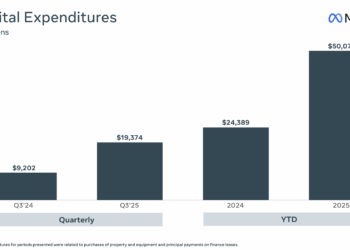
Meta posted revenue of $47.5 billion in Q2 2025, up 22% year-over-year, with operating income rising 38% to $20.4 billion and net income climbing 36% to $18.3 billion. Daily active people across its Family of Apps reached 3.48 billion, while ad impressions grew 11% and average price per ad increased 9%. Capital expenditures surged to $17.0 billion in the quarter, driven by investment in AI-focused infrastructure.
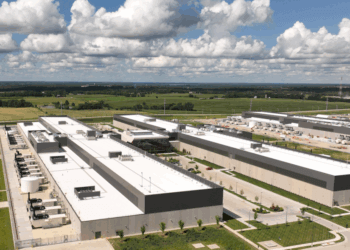
CEO Mark Zuckerberg said Meta is assembling “multi-gigawatt clusters” to train next-generation models and advance its vision of “personal superintelligence.” The Prometheus cluster, set to debut in 2026, will exceed 1GW of compute, with the larger Hyperion cluster planned to scale to 5GW. Meta is also progressing on Llama 4.1 and 4.2 while standing up Meta Superintelligence Labs under Alexandr Wang, Nat Friedman, and Shengjia Zhao .
Meta highlighted five AI-driven business priorities: improved advertising performance, richer user experiences, business messaging, Meta AI personal assistants, and AI-enabled devices. In advertising, AI-powered recommendation models drove 5% higher conversions on Instagram and 3% on Facebook. Generative AI ad creative tools are now used by nearly 2 million advertisers. In business messaging, Meta is testing AI-powered customer service agents in markets such as Mexico and the Philippines. Meta AI already has over 1 billion monthly active users, with WhatsApp queries as the main driver. Ray-Ban Meta smart glasses and new Oakley AI glasses continue to see accelerating sales .
- Revenue: $47.5B, +22% YoY
- Net Income: $18.3B, +36% YoY
- Operating Margin: 43%
- Ad impressions: +11% YoY; Average price per ad: +9% YoY
- Daily Active People: 3.48B (+6% YoY)
- CapEx: $17.0B in Q2; FY25 CapEx outlook $66–72B
- Meta AI: >1B monthly actives, expanding on WhatsApp and Facebook
- Superintelligence effort: Prometheus (1GW+) and Hyperion (5GW) AI clusters in development
“We’ve had a strong quarter both in terms of our business and community,” said Mark Zuckerberg. “I’m excited to build personal superintelligence for everyone in the world.”
CapEx and Infrastructure
- Q2 CapEx: $17.0B (servers, data centers, network) – nearly double Q2 2024.
- FY25 CapEx outlook: $66–72B, ~+$30B year-over-year at mid-point.
- 2026 CapEx: Expected to see another year of “similarly significant” dollar growth, with focus on GenAI training capacity and core AI workloads.
- Multi-GW AI clusters:
- Prometheus cluster (2026) – >1GW, billed as world’s first at that scale.
- Hyperion cluster – scaling to 5GW over several years.
- Additional “titan” clusters also in development.
- Capacity constraints: Meta admitted it is still compute-limited, balancing strategic AI and core AI. Efforts ongoing to expand data center footprint and improve workload efficiency.
- ROI considerations:
- Core AI (ads, recommendations) already shows strong measurable returns.
- GenAI/superintelligence ROI is longer-term, with monetization tied to the five pillars (ads, engagement, business messaging, Meta AI, AI devices).
- Financing: Most CapEx will be funded internally, though Meta is exploring co-development partnerships for data centers to reduce risk and provide flexibility.
🌐 Why it Matters: Meta is making one of the industry’s largest bets on AI infrastructure, with CapEx approaching hyperscaler levels. Its commitment to superintelligence — backed by multi-gigawatt clusters and top AI talent — positions Meta as both a technology leader and a heavy spender. The company’s ability to balance near-term ad monetization with long-term AI ambitions will be closely watched by competitors and regulators.