The explosive growth of cloud computing, artificial intelligence (AI), and high-performance computing (HPC) is pushing data center networks toward unprecedented bandwidth demands. As switch capacities leap from 25.6 Tbps to 51.2 Tbps and beyond, traditional pluggable optics face serious challenges in power, density, and signal integrity.
Co-Packaged Optics (CPO) is an emerging technology that addresses these bottlenecks by placing optical engines directly alongside switch application-specific integrated circuits (ASICs) within a single package. This shortens electrical paths, reduces power consumption, and enables denser, faster networks. For hyperscalers running AI clusters with hundreds of thousands of GPUs, CPO is more than an incremental upgrade—it represents a fundamental architectural shift.
The concept of CPO can be traced back more than a decade, when researchers and industry groups recognized that copper traces on switch motherboards could not keep pace with terabit-scale optical signaling. Initially, pluggable optical modules—SFP, QSFP, OSFP—served the industry well, scaling from 10G to 400G. But as 800G and 1.6T modules approached, the limitations became stark:
- Signal integrity degraded as electrical traces grew longer.
- Power per bit soared, often above 10 pJ/bit.
- Front-panel density limited how many ports could fit on a switch.
- Thermal issues increased as pluggable cages trapped heat at the faceplate.
The mission of CPO is to overcome these hurdles by co-packaging optics with switch silicon. The goals include:
- Lowering power, targeting below 5 pJ/bit through shortened electrical traces.
- Improving signal quality by minimizing loss, jitter, and crosstalk.
- Boosting density by removing bulky pluggable cages to support higher-radix switches.
- Enabling scalability for 51.2T, 102.4T, and beyond.
By the mid-2010s, organizations like the Optical Internetworking Forum (OIF), the Consortium for On-Board Optics (COBO), and companies such as Broadcom, Intel, and Marvell began exploring commercial CPO prototypes.
Key Technical Principles
Heterogeneous Integration
CPO integrates the switch ASIC with one or more optical engines (containing modulators, detectors, and drivers) on the same substrate. Advanced 2.5D and 3D packaging technologies—using silicon interposers, microbumps, and through-silicon vias (TSVs)—provide ultra-short, low-loss electrical connections.
Silicon Photonics
Most CPO implementations leverage silicon photonics, which enables waveguides, modulators, and photodetectors to be fabricated using CMOS-compatible processes. Light sources (lasers) are typically external continuous-wave lasers coupled into the package via fiber arrays.
Thermal Management
Because both ASICs and optics dissipate significant heat, cooling is a central challenge. Solutions range from advanced heat spreaders and thermal interface materials to liquid cooling and microfluidic channels embedded in the package.
Energy Efficiency
By eliminating long SerDes paths between ASICs and pluggables, CPO can cut power per bit by 30–50%. With data centers consuming about 2–3% of global electricity, these savings are economically and environmentally significant.
Form Factor
Unlike pluggables, CPO engines are not hot-swappable. They are tightly integrated, meaning that servicing a failure may require replacing the entire switch. This tradeoff between efficiency and serviceability is a central debate in the industry.
Applications and Network Switching Engines
CPO is most relevant for hyperscale data centers and AI/ML clusters, where networks must scale to hundreds of thousands of high-speed endpoints.
- AI/ML workloads: Training large language models and generative AI requires all-to-all, low-latency connectivity between GPUs and accelerators. CPO helps enable petabit-scale fabrics.
- Hyperscale cloud: Operators like Google, Meta, Amazon, and Microsoft face enormous costs from power-hungry optics; CPO reduces operational expenses and carbon footprint.
- Telecom and 6G: CPO could eventually serve fronthaul and backhaul networks where latency and efficiency are paramount.
- Exascale HPC: Scientific supercomputers require ultra-dense optical interconnects, well-matched to CPO’s capabilities.
Broadcom’s Bailly CPO Implementation
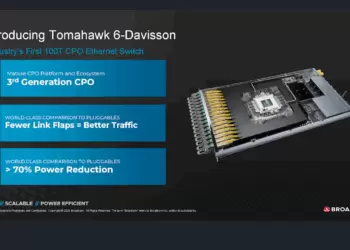
Broadcom is one of the leaders in CPO commercialization. Its Bailly CPO platform, introduced in 2025, integrates optics with its 51.2T Tomahawk and Jericho switch families. Bailly provides:
- A standardized CPO architecture for hyperscalers.
- Support for external laser sources (ELS) to improve reliability.
- Automated fiber attach processes to reduce assembly complexity.
- Demonstrated 30–40% power savings per bit over pluggables.
Broadcom positions Bailly as essential for scaling networks to 102.4T and beyond, particularly for AI workloads that require ultra-dense connectivity.
Andy Bechtolsheim’s Objections
Not everyone in the industry agrees with CPO’s inevitability. Andy Bechtolsheim, Arista co-founder and chief architect, has argued that:
- Serviceability is a critical weakness—pluggables can be replaced in seconds, while a failed CPO engine may require replacing an entire expensive switch.
- Improved pluggable designs (such as 1.6T OSFP modules) can continue scaling for years.
- Operational costs of failures could outweigh the energy savings of CPO, especially for operators with massive installed bases.
Bechtolsheim’s objections highlight a real tension: hyperscalers may accept the risks of CPO for efficiency, while enterprises and telecom operators may prefer the flexibility of pluggables.
Standards Development
Standardization is essential to avoid vendor lock-in and ensure interoperability.
- OIF (Optical Internetworking Forum): Published a CPO framework defining electrical and management interfaces, optical coupling methods, and thermal requirements.
- COBO (Consortium for On-Board Optics): Focused on detachable on-board optics, influencing serviceability debates in CPO.
- IEEE: Provides electrical signaling standards (such as 802.3ck for 100G/lane).
- Industry consortia: Groups like the CPO Consortium and OIF PlugFests help align vendors on interoperable solutions.
Standards are still evolving, with maturity expected by the late 2020s to support 1.6T+ signaling.
Government initiatives have boosted CPO indirectly through semiconductor and photonics funding:
- DARPA PIPES program funded co-packaging research for HPC and defense.
- ARPA-E COHERENT program targeted 80% energy reduction in data center interconnects via optical packaging.
- CHIPS and Science Act (U.S., 2022) allocated billions for semiconductor R&D, including heterogeneous integration and silicon photonics.
- Europe’s Horizon Europe funds advanced photonics and packaging research.
- Japan and China both invest heavily in silicon photonics manufacturing capacity.
CPO’s alignment with energy efficiency mandates makes it attractive for policymakers seeking greener data centers.
Despite progress, challenges remain:
- Thermal management: Cooling 1 kW/cm² heat densities is complex and costly.
- Manufacturing yields: Sub-micron fiber alignment and heterogeneous integration reduce yields and raise costs.
- Serviceability: Failures may require replacing entire switches, unlike pluggables.
- Ecosystem immaturity: Only a few vendors currently offer CPO platforms.
- High upfront costs: R&D for a single CPO platform can exceed $500M.
These barriers mean adoption will likely be phased—hyperscalers first, broader operators later.
Current Implementations (2025)
- Broadcom Bailly CPO: Integrated with 51.2T switches, targeting AI networks.
- NVIDIA: Developing CPO-enabled fabrics for GPU clusters, with more than 200 Tbps bandwidth demonstrated.
- Marvell: Custom AI accelerators featuring CPO for optical scale-out.
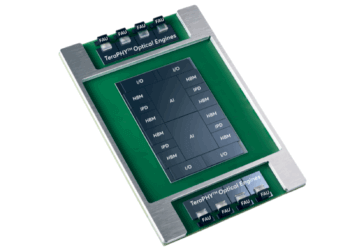
- Ayar Labs: Offering TeraPHY optical chiplets, demonstrating modular CPO with ring resonator technology.
- Cisco and Intel: Prototypes of hybrid CPO/pluggable systems.
- Startups such as Genuine Optics: Showcasing full CPO modules at OFC 2025.
Forecasts predict the CPO market reaching more than $500M by 2030, with strong adoption in AI-driven hyperscale data centers.
Path Forward
The roadmap for CPO includes:
- Hybrid architectures: Early deployments may mix pluggables and CPO within a switch.
- Integrated lasers: Future generations may integrate lasers directly into the package.
- 3D packaging advances: Moving from 2.5D to 3D stacking for even higher density.
- Serviceability innovations: Detachable optics or modular replacements may emerge to address Bechtolsheim’s concerns.
- AI-optimized fabrics: CPO will underpin AI-RAN and agentic AI clusters requiring exabyte-scale bandwidth.
- 6G and beyond: By the 2030s, CPO is expected to dominate both cloud and telecom interconnects.
Conclusion
Co-Packaged Optics represents a pivotal evolution in how networks are built. By co-locating switch ASICs and optics, CPO offers dramatic improvements in energy efficiency, density, and scalability.
Yet its journey is not without debate. Broadcom’s Bailly CPO demonstrates the technology’s readiness for hyperscale AI workloads, while Arista’s Andy Bechtolsheim raises valid concerns about serviceability and cost. The tension between efficiency and maintainability will shape CPO’s adoption curve.
In the near term, hyperscalers will drive CPO deployments, while other operators cautiously evaluate. Long term, as standards mature and solutions evolve, CPO is likely to become the backbone of exascale data centers and 6G networks.