NTT has set a new benchmark in optical networking by demonstrating 160 Tbps transmission over more than 1,000 km of standard single-mode fiber. The breakthrough hinges on opening a previously unused long-wavelength region, newly defined as the “X band” around 1,700 nm, and expanding the usable transmission bandwidth to 27 THz. This spectrum is more than 6.7 times wider than conventional optical systems that rely on C and L bands.
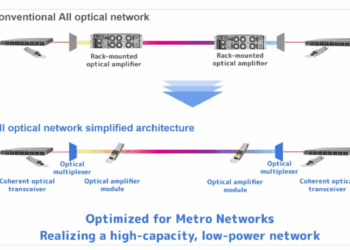
The achievement was enabled by a new class of ultra-wideband optical repeaters that integrate PPLN (periodically poled lithium niobate) based wavelength band conversion technology. These devices allow signals in conventional bands to be efficiently shifted into the U and X bands, where optical amplification has historically been difficult. NTT combined this with inter-channel stimulated Raman scattering (ISRS), a nonlinear effect within the fiber that redistributes optical power from shorter wavelengths to longer ones. By deliberately using ISRS, NTT counteracted the steep fiber losses at 1,700 nm and made long-haul transmission in the X band feasible.
In testbed trials, the company demonstrated 180 WDM channels spanning the S, C, L, U, and X bands. Each channel was modulated at 144 Gbaud PCS-QAM, delivering terabit-scale data rates. Transmission capacity reached 189.5 Tbps over 560 km between Tokyo and Nagoya, and 160.2 Tbps over 1,040 km—enough to span the Tokyo-Osaka corridor. These results surpass NTT’s previous 800 km, 115.3 Tbps demonstration and represent the world’s largest transmission bandwidth and capacity achieved with existing single-mode fiber. The repeater design also maintained 80 km spacing between optical amplifiers, consistent with deployed terrestrial systems.
Beyond raw capacity, the work demonstrates how nonlinear effects—typically seen as limiting factors in fiber—can be harnessed to extend usable spectrum. NTT’s approach effectively turns the S through X bands into a contiguous amplification region, a total of 27 THz. This supports a more than tenfold increase in throughput without replacing fiber infrastructure, a critical consideration as AI workloads, 8K streaming, and immersive applications strain backbones worldwide.
- Achieved 160.2 Tbps over 1,040 km and 189.5 Tbps over 560 km
- First successful use of the “X band” at ~1,700 nm for long-haul transmission
- Developed ultra-wideband repeater combining S, C, L, U, and X bands into 27 THz
- Harnessed ISRS to reduce fiber losses in long-wavelength regions
- Expanded beyond prior 115.3 Tbps/800 km record on installed single-mode fiber
- Demonstrated practical 80 km repeater spacing for long-haul terrestrial use
“By expanding the usable spectrum into the X band, we have shown that existing fiber infrastructure can deliver more than ten times the capacity of conventional systems while supporting long-distance routes,” NTT stated.


🌐 Analysis: This development strengthens Japan’s leadership in the IOWN initiative, where ultra-wideband optical transport is seen as a cornerstone for 6G. NTT’s method of band conversion and ISRS management could shape next-generation repeaters for transcontinental and subsea networks. Rival labs, including Nokia Bell Labs, Infinera, and NEC, are pursuing spectrum expansion in different ways—such as extending into the E-band or refining C+L operation—but NTT’s introduction of the X band sets a new technical precedent. This could accelerate a shift in long-haul transport design from maximizing spectral efficiency to widening usable spectrum on existing fiber.
NTT’s decision to extend into the X band contrasts with other leading approaches in the industry:
- C+L superchannels: Many operators have focused on maximizing efficiency within the conventional C and L bands by deploying denser constellations, higher baud rates, and tighter channel spacing. Nokia and Ciena, for instance, have demonstrated >1 Tbps per wavelength within C+L, but total bandwidth remains limited to ~9 THz.
- E-band trials: Some research groups have pushed into the E-band (~1,360–1,460 nm), a shorter-wavelength region historically avoided due to higher water-peak absorption. Advances in fiber processing have reduced loss, but this approach requires specialized low-water-peak fiber.
- Hollow-core fiber: BT, Lumenisity (now part of Microsoft), and others are exploring hollow-core designs that dramatically reduce latency and extend usable bandwidth by confining light in air rather than glass. While promising, hollow-core fiber requires new deployments, not re-use of installed infrastructure.
- Multi-core and multi-mode fibers: Parallel approaches increase spatial capacity by deploying multiple cores or modes in a single fiber. This boosts total throughput but requires a new generation of spatial-division multiplexing amplifiers and couplers.
🌐 We’re tracking the latest developments in networking silicon. Follow our ongoing coverage at: https://convergedigest.com/category/semiconductors/