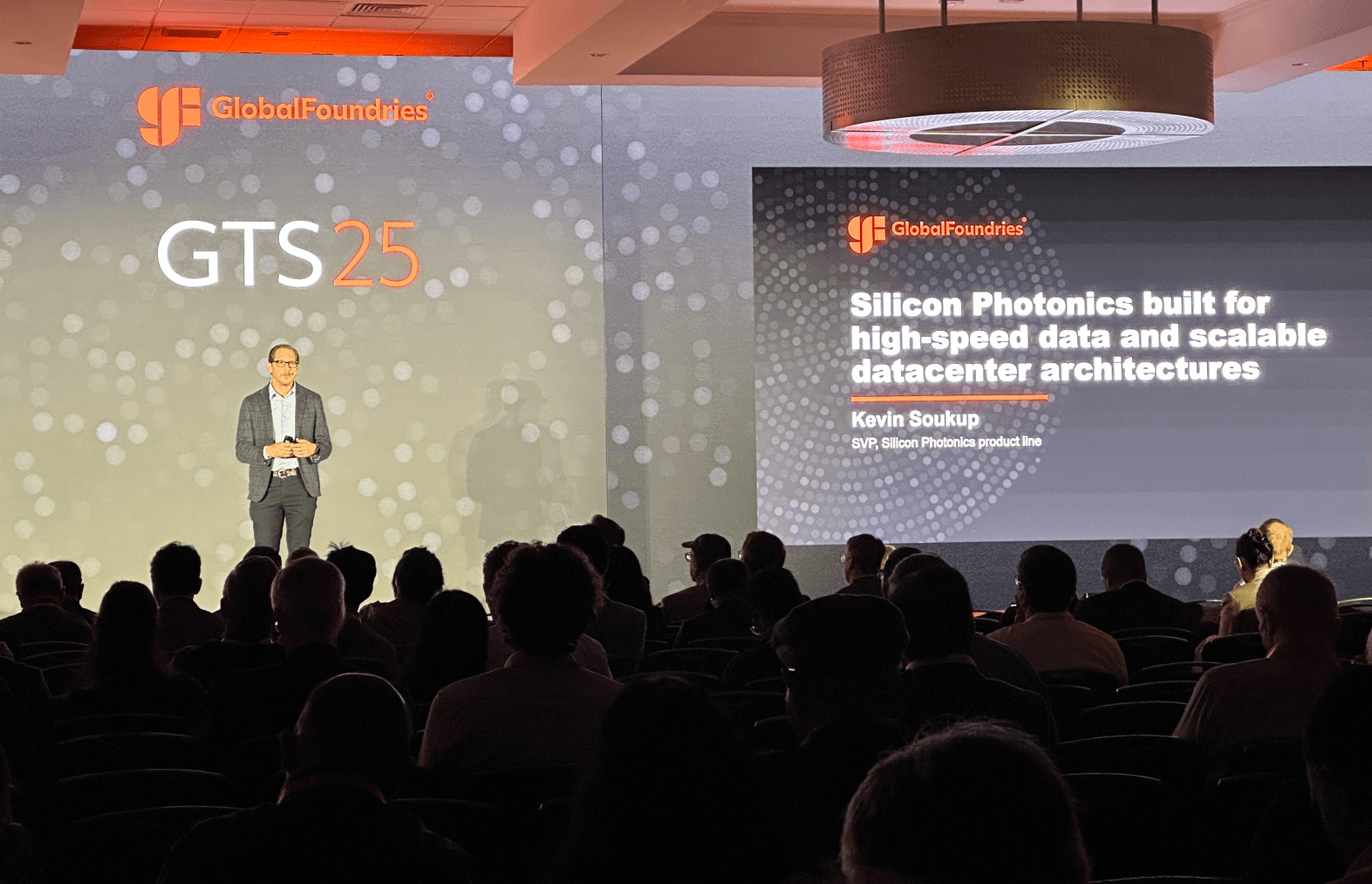
GlobalFoundries elevated its silicon photonics platform to a standalone product line and doubled investment in the technology, said Kevin Soukup, Senior Vice President, during his keynote at the company’s GTS2025 event in Santa Clara on August 28. He compared the state of adoption to Tesla’s “launch mode”—ready to accelerate into high-volume deployment.
Soukup pointed to three converging pressures driving demand for silicon photonics inside data centers: explosive growth in data, the rise of AI and large language models with trillions of parameters, and soaring power consumption. He warned that by 2030, global data center power use could double, with AI data centers in the U.S. alone consuming 10–15% of national electricity. At the same time, many custom ASICs sit idle up to 75% of the time, waiting for data movement between processors. “Silicon photonics cuts power consumption and latency while enabling scale-out and scale-up architectures across GPUs and ASICs,” he said.
GlobalFoundries outlined a roadmap that spans three key optical connectivity approaches:
- Pluggable transceivers: traditional optical modules that plug into network switches, widely used today for data center interconnects.
- Linear pluggable optics (LPO): a simplified version where digital signal processing is shifted from the optical module onto the host ASIC, reducing power and latency.
- Co-packaged optics (CPO): the most advanced form, where optical engines are integrated directly into the switch or compute package, minimizing electrical traces and enabling massive GPU-to-GPU scale.
GF expects 400 Gbps per lane pluggables in test by year-end, with prototypes in 2026 and volume shipments in 2027. For CPO, the focus shifts toward advanced packaging, multi-fiber connections, detachable optical interfaces, and stacking photonic and electronic ICs. Soukup emphasized that GlobalFoundries has built the ecosystem for volume scaling, including a new Advanced Photonics Packaging Center (APPC) in Malta, New York, capable of end-to-end optical module delivery in a secure domestic location.
| Approach | Description | GF Roadmap |
|---|---|---|
| Pluggable Optics | Standard optical modules inserted into switches/routers | 200 Gbps/lane available today; 400 Gbps/lane in test by end of 2025; prototypes in 2026; volume in 2027 |
| Linear Pluggable Optics (LPO) | Moves DSP from module to host ASIC for lower power and latency | GF supporting near-term deployments with ecosystem partners |
| Co-Packaged Optics (CPO) | Optical engines integrated directly into switch/compute packages | Focus on advanced packaging, multi-fiber connectivity, and detachable interfaces; APPC Malta enabling end-to-end module builds from 2026+ |
- GF has elevated silicon photonics to a dedicated product line, doubling investment.
- Data growth, AI models, and power demand are the primary adoption drivers.
- Roadmap spans pluggables, LPO, and CPO—each addressing different stages of scaling.
- 400 Gbps per lane pluggables in testing by year-end, volume by 2027.
- Advanced Photonics Packaging Center in Malta enables secure U.S. manufacturing.
“We’re ready to scale with you. This is no longer a question of if, but when. And the answer is—the time is now,” said Soukup.
🌐 Analysis: GlobalFoundries’ decision to support pluggables, LPO, and CPO reflects the uncertainty among hyperscalers about how quickly to move toward co-packaged optics. By keeping all options on the table, GF is positioning itself as a flexible supplier to cloud providers who may adopt different strategies depending on timing, workloads, and ecosystem readiness. Intel and Broadcom are also pushing aggressively into LPO and CPO, while Marvell is investing in DSP-driven pluggables. The industry is now entering a critical phase where hyperscalers must choose optical architectures that balance scale, efficiency, and deployment risk.
🌐 We’re tracking the latest developments in networking silicon. Follow our ongoing coverage at: https://convergedigest.com/category/semiconductors/