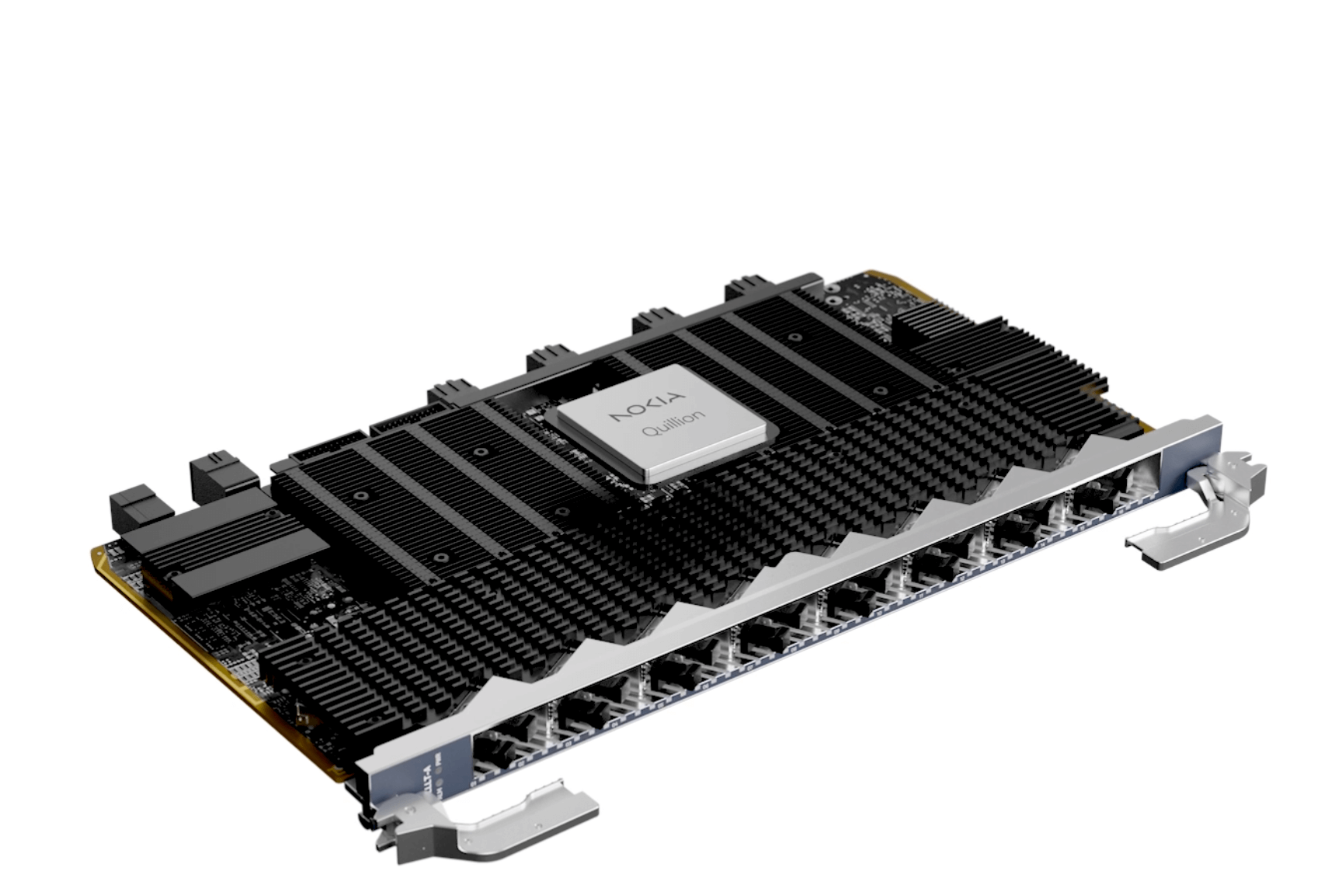
Nokia introduced the world’s first 50G Passive Optical Network (PON) solution engineered for post-quantum-secure enterprise connectivity. The new platform, built on Nokia’s Lightspan MF and powered by its Quillion chipset, enables operators already deploying 10G or 25G PON to seamlessly upgrade to 50G without replacing existing infrastructure. The 25G/50G combination allows service providers to extend their residential FTTH networks to enterprise and industrial users, avoiding the cost and complexity of parallel fiber builds.
The new line card on Lightspan MF supports multiple generations of PON—including GPON, XGS, 25G, and 50G—while maintaining backward compatibility with existing optics. Nokia designed it to deliver massive bandwidth, high reliability, and built-in quantum-safe encryption to protect against future threats from quantum computing. Advanced AI features optimize performance and maintain six-nines (99.9999%) availability. Enterprises can also deploy fully redundant PON architectures to ensure uninterrupted operation, even in the event of fiber cuts or component failures.
Colt Technology Services has already trialed Nokia’s 50G PON system, confirming its performance and readiness for next-generation enterprise workloads such as AI, cloud computing, and data-intensive analytics. The joint demonstration validated that existing 10/25G fiber infrastructure can be upgraded for higher capacity and stronger security without major network redesign.
• Supports 50 Gb/s downstream and 25 Gb/s or 50 Gb/s upstream rates
• Delivers quantum-safe encryption and secure key exchange
• Provides full redundancy with no single point of failure
• Supports GPON, XGS-PON, 25G, and 50G PON in one line card
• Built on Nokia’s Quillion chipset and Lightspan MF platform
“With 25G and eventually 50G PON, we can offer enterprises access to ultra-fast, reliable connectivity for cloud, AI, and data-intensive applications—delivered seamlessly over our existing fiber network,” said Vivek Gaur, Vice President Engineering, Colt Technology Services.
🌐 Analysis: Nokia’s introduction of a 50G PON solution marks a major step toward unifying broadband and enterprise optical access under a single, quantum-secure platform. The company’s approach leverages its Quillion chipset and multi-PON flexibility to enable operators to scale capacity incrementally while addressing future cybersecurity needs. Rival vendors such as Huawei and ZTE have also previewed 50G PON trials, but Nokia’s early availability and integration with Lightspan MF position it strongly for commercial rollouts in enterprise and industrial markets.