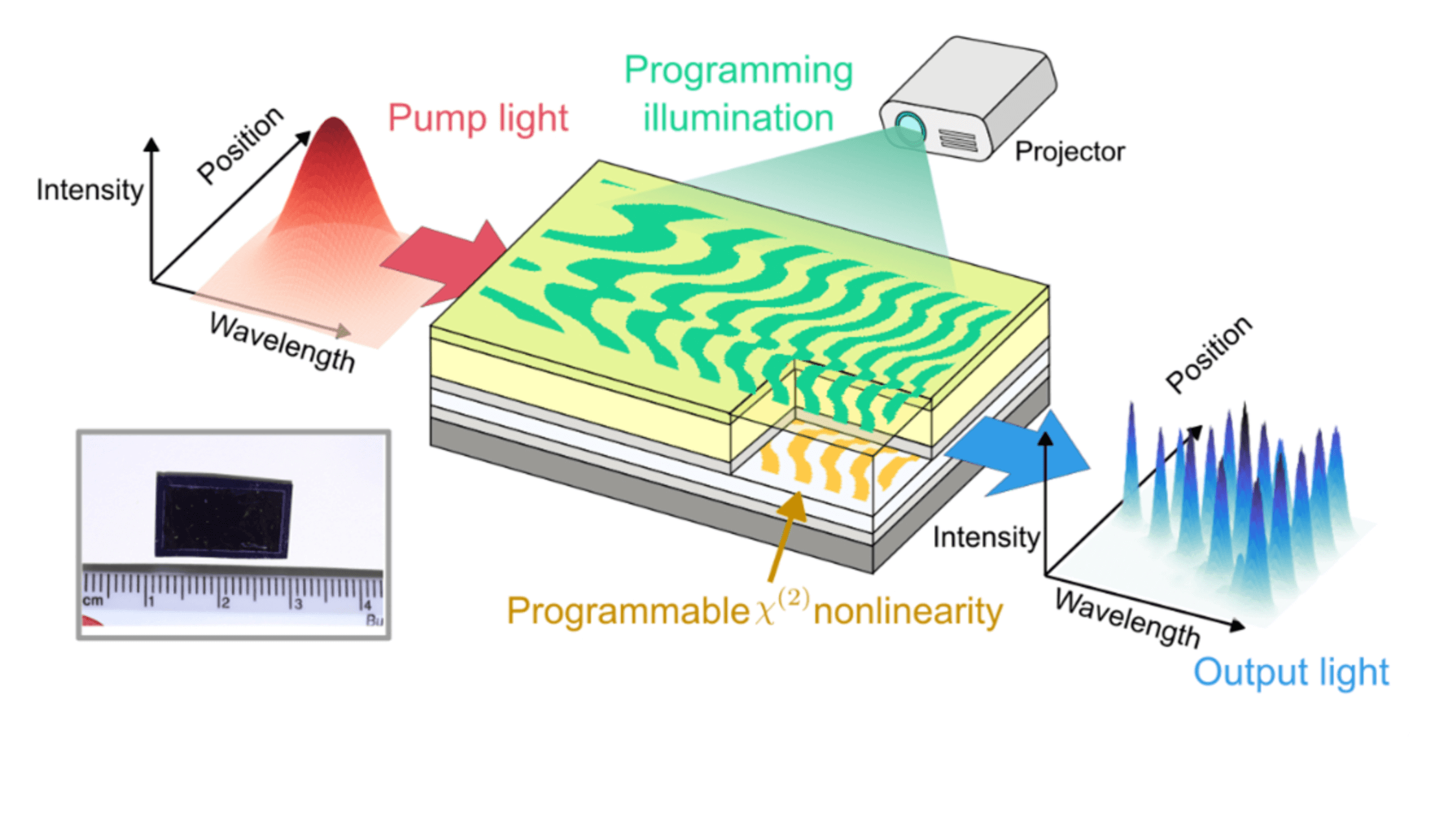
NTT Research, in collaboration with Cornell University and Stanford University, has developed the world’s first programmable nonlinear photonic waveguide, a milestone that could reshape optical and quantum computing. Detailed in Nature, the research demonstrates how a single silicon-nitride chip can dynamically reconfigure its nonlinear-optical properties using structured light, replacing the traditional “one device, one function” paradigm that has long limited photonics design and scalability.
By projecting different light patterns onto the chip, researchers dynamically programmed nonlinear-optical functions such as arbitrary pulse shaping, tunable second-harmonic generation, and holographic generation of structured light. This real-time reconfigurability also enabled the device to self-correct for fabrication errors and adapt to environmental fluctuations—capabilities critical for scaling optical and quantum systems. The work, led by NTT Research scientist Ryotatsu Yanagimoto under Cornell’s Peter L. McMahon, represents a fundamental advance in the control of light–matter interactions at chip scale.
Beyond research labs, programmable nonlinear photonics could impact high-growth sectors such as quantum computing, telecommunications, and advanced manufacturing. In data and telecom networks, tunable light sources and programmable waveform generators could enhance 5G, 6G, and future optical communication systems. For quantum architectures, the technology enables reconfigurable quantum frequency converters and light sources that simplify design and improve efficiency. The work also points to applications in precision sensing, imaging, and scientific instrumentation.
• First programmable nonlinear photonic waveguide demonstrated jointly by NTT Research, Cornell, and Stanford
• Device switches between multiple nonlinear-optical functions using structured light
• Results published in Nature on October 8, 2025 (print edition: November 13, 2025)
• Potential applications include optical computing, quantum networks, 6G infrastructure, and reconfigurable light sources
• Approach could improve manufacturing yields and reduce cost by eliminating the need for multiple fixed-function devices
“These results mark a departure from the conventional paradigm of nonlinear optics, where device functions are permanently fixed during fabrication,” said Ryotatsu Yanagimoto, scientist at NTT Research. “For the first time, a path forward has been created to apply nonlinear optics to large-scale optical circuits and reconfigurable quantum systems.”
🌐 Analysis: NTT Research’s programmable waveguide introduces a new model for adaptive photonics, aligning with industry trends toward reconfigurable optical hardware for AI and quantum computing. The breakthrough complements ongoing work at PSIQuantum, Lightmatter, and Ayar Labs, all seeking scalable optical processing platforms. If commercialized, NTT’s approach could lower costs and accelerate integration of nonlinear optics in data centers and quantum networks.
 | Converge Digest and NextGenInfra.io are bringing together the leaders shaping AI-driven data center networks—from optics and fabrics to silicon and orchestration.
Explore how the industry is re-architecting the network for the AI era through exclusive video interviews,
expert reports, and collaboration opportunities. |