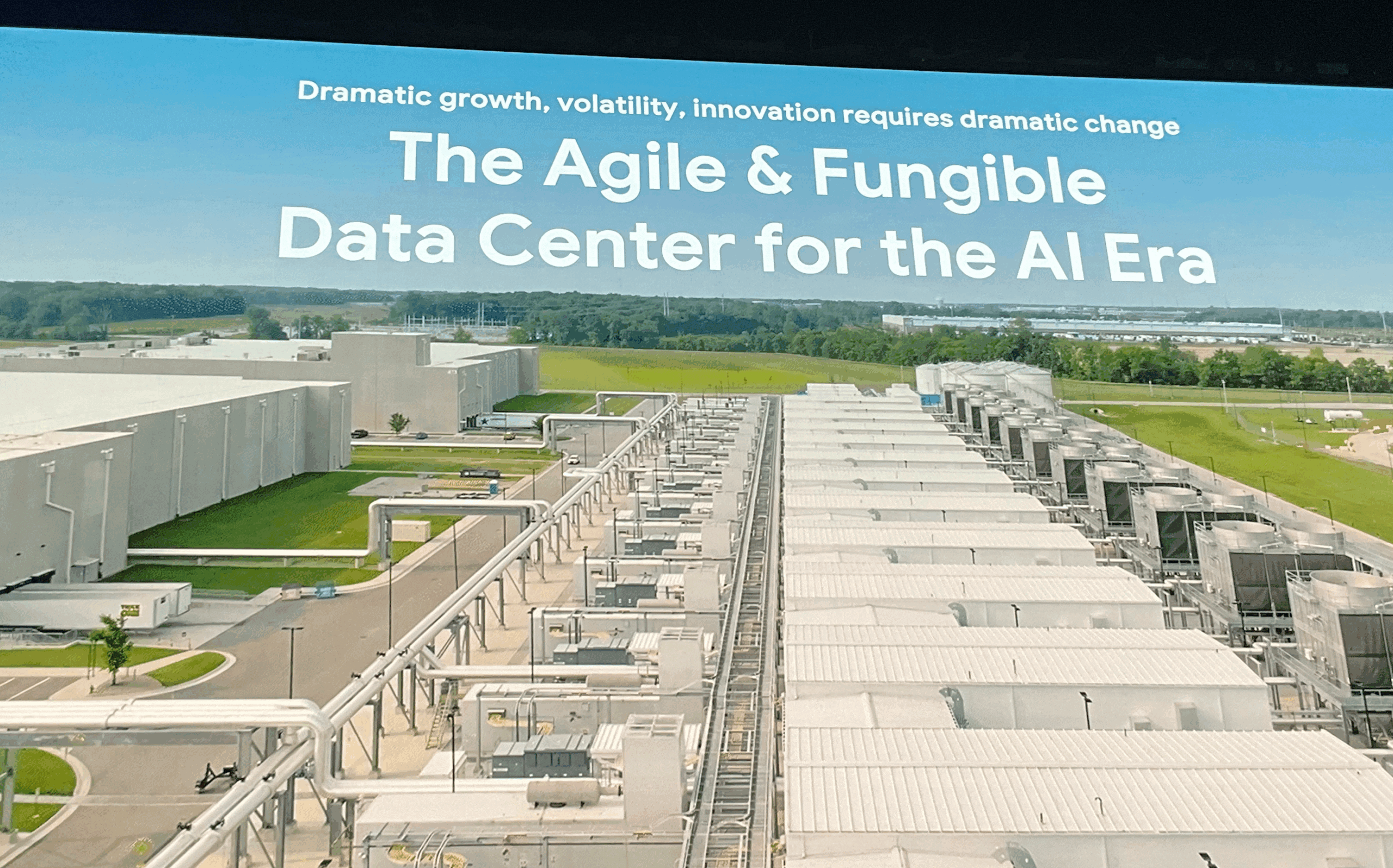
Google’s Partha Ranganathan returned to the main stage at the OCP Global Summit with a sweeping keynote titled “Agile AI Architectures: Designing the Fungible Data Center for the AI Era.” Speaking to an audience of over 11,000 attendees, Ranganathan framed the current moment as “the beginning of an intelligence revolution” — one poised to reshape every layer of computing, from silicon and systems to sustainability and scientific discovery.
He described how AI now permeates Google’s consumer and enterprise ecosystem, from Gemini-powered features in Search, YouTube, and Pixel devices to AI-driven agents in Google Cloud transforming industries like finance, retail, and life sciences. Beyond business, he highlighted AI’s growing role in science, citing AlphaFold’s Nobel-winning contributions to protein folding and breakthroughs in materials, weather prediction, and even nuclear fusion.
Ranganathan likened AI researchers to “space explorers discovering new worlds,” while the OCP community and system designers are “building the rockets that power them there.” He outlined Google’s “AI Hypercomputer” architecture — a holistic, vertically integrated system co-designed from custom silicon (TPUs) through compilers, frameworks, and orchestration layers, achieving 10–100x improvements in performance and efficiency over the past decade.
Yet, he warned that exponential growth in AI workloads — 15× more accelerator use and 37× more machine learning data within 18 months — demands a radical rethinking of how data centers are built and operated. The next phase, he said, must embrace agility and fungibility as first-class design principles.
- Agile and Fungible Data Centers Initiative:
Google, OCP, hyperscalers, and industry partners are collaborating to standardize architectures for the “fungible” AI data center — modular, interoperable, and adaptive across compute, cooling, networking, and sustainability domains. - Power Innovations – Project Mount Diablo:
Progress toward 400V unified architectures and disaggregated power delivery systems, introducing solid-state transformers and microgrid standards that enable data centers to become both consumers and suppliers of grid power. - Cooling Advances – Project Deschutes:
Rapid adoption of Google’s state-of-the-art liquid cooling design contributed to OCP earlier this year. Multiple vendors now showcase innovations based on this standard across the OCP Expo floor. - Standardized Interfaces Across Systems:
Push for common layouts, telemetry frameworks, and metatronic standards across server halls, third-party colos, and hyperscale environments — including security alignment through OpenTitan and Caliptra roots of trust. - Sustainability Metrics for AI:
Google introduced a new methodology for measuring the carbon, electricity, and water footprint of AI workloads. A single Gemini query, he noted, consumes “less than five drops of water and about nine seconds of TV viewing in equivalent energy.” - AI for AI in System Design:
A new frontier where AI assists in chip and system design, exemplified by Google’s AlphaChip, which automates place-and-route optimization to improve performance and efficiency. Ranganathan called this the next “moonshot” in computing design.
“We are at the cusp of an intelligence revolution,” Ranganathan concluded.
“Agile AI architectures — from power and cooling to security and sustainability — will form the foundation of the next great wave of AI innovation. Together, we can make this a truly fungible, adaptive, and intelligent data center era.”
🌐 We’re tracking the latest developments at OCP25 in San Jose. Follow our ongoing coverage at: https://convergedigest.com/tag/ocp25/
🌐 We’re launching the “Data Center Networking for AI” series on NextGenInfra.io and inviting companies building real solutions — silicon, optics, fabrics, switches, software, orchestration — to share their views on video and in our expert report. To get involved, send a note to jcarroll@convergedigest.com or info@nextgeninfra.io.