November 11, 2025 – Dallas, Texas
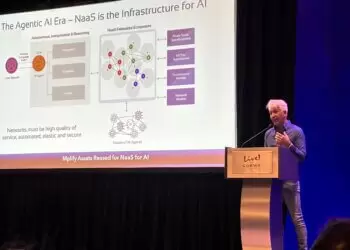
Mplify (formerly MEF), the global alliance uniting network, cloud, and cybersecurity organizations, opened its Global NaaS Event (GNE 2025) in Dallas with a message: Network-as-a-Service (NaaS) is emerging as the foundation of the AI infrastructure era. The organization released a new market brief, “NaaS: The Automated Network Supply Chain for Agentic AI,” that reframes connectivity as the decisive factor in the race to build next-generation AI systems.
As AI transitions from generative to agentic intelligence—where systems reason, plan, and act continuously—Mplify argues that static, provider-specific networks cannot keep pace. “If you’re a provider and not enabling NaaS, you risk being left behind in the AI era,” said Pascal Menezes, CTO of Mplify. “Agentic AI is redefining how networks are built and operated. Connectivity, compute, and intelligence must operate as one system—automated, secure, and federated across domains.”
The report positions NaaS as the automation and certification layer connecting data centers, clouds, and edge environments into a single programmable ecosystem. NVIDIA forecasts that inference demand will rise a billionfold as AI reasoning becomes continuous, pushing the limits of today’s network architectures. Mplify warns that without automation, interoperability, and standardized assurance, even trillion-dollar investments in compute and data centers will underdeliver.
Building the Network for Thinking Machines
Mplify highlights a massive industrial buildout already underway. McKinsey estimates $6.7 trillion in global data-center investment by 2030, with $5.2 trillion tied to AI workloads. Omdia projects AI-related network traffic will jump from 79 exabytes per month in 2025 to 820 exabytes by 2030. The bottleneck, according to Mplify, is shifting decisively from compute to connectivity.
To match the distinct stages of AI development, the report defines connectivity tiers that link training, inference, and agentic reasoning workloads:
• Training: 400G–1.6T wavelength services for high-capacity, low-latency model synchronization.
• Inference: Deterministic Carrier Ethernet (10G–400G+) with strict performance SLAs (<3 ms latency, 99.999% uptime).
• Agentic AI: Hybrid architectures combining wavelengths, Carrier Ethernet, and broadband for continuous agent-to-agent coordination.
Mplify’s new Carrier Ethernet for AI Certification sets a benchmark for network performance and automation readiness, ensuring symmetrical bandwidth, frame delay of ≤3 ms, and frame loss below 0.001%. Providers earning this certification demonstrate measurable readiness for reasoning-scale workloads and multi-provider federation.
Four Pillars of the NaaS Framework
Connectivity for AI – Carrier Ethernet, wavelengths, and Carrier Ethernet-over-Broadband form the backbone of the new AI fabric. Mplify members are automating these domains through open APIs and lifecycle orchestration to deliver real-time, deterministic performance across providers.
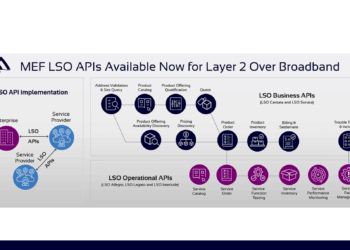
Automation for AI – Mplify’s Lifecycle Service Orchestration (LSO) APIs and new Domain-Specific Languages (DSLs) will enable AI agents to directly request, configure, and manage network services. This agent-to-network interaction—powered by the Model Context Protocol (MCP)—turns connectivity into a programmable supply chain for reasoning systems.
Cybersecurity for AI – Certified Zero Trust, SASE, and Security Service Edge (SSE) components form a standardized protection framework across distributed environments. Mplify’s roadmap introduces quantum-safe Carrier Ethernet and wavelength services using post-quantum cryptography and quantum key distribution to secure AI data flows well into the next decade.
Revenue Services for AI – The report outlines new monetization models including GPU-as-a-Service and AI Model-as-a-Service, allowing service providers to offer compute and inference capabilities through standardized, automated interfaces.
Mplify also points to sovereign AI as a rising priority, estimating a $1.5 trillion market for national-scale AI networks. Roughly 30 programs worldwide now require domestically controlled connectivity to enforce data residency, cybersecurity, and operational autonomy.
“Agentic AI is driving the most significant transformation in network architecture in decades,” said Stan Hubbard, Principal Analyst at Mplify. “Providers adopting certified, standards-based NaaS components are becoming the strategic infrastructure partners enabling this next phase of AI growth.”
Other Highlights from GNE 2025
Mplify Redefines Carrier Ethernet Certification for the AI Era
Mplify announced a major evolution of its flagship Carrier Ethernet certification program, introducing two complementary profiles: Carrier Ethernet for Business and Carrier Ethernet for AI. The latter validates network readiness for AI-intensive, real-time workloads such as distributed training, inference, and edge GPU coordination.
“AI is redefining what networks must deliver,” said Daniel Bar Lev, Chief Product Officer at Mplify. “With the Carrier Ethernet for AI certification, we’re extending a proven foundation into the AI era—enabling deterministic, automated, and intelligent networks that power the next generation of NaaS and agentic AI applications.”
The existing MEF 3.0 certification now becomes Mplify Carrier Ethernet for Business certification, maintaining validity without retesting. A Carrier Ethernet-over-Broadband certification is also planned to extend standardized performance assurance over PON, DOCSIS, and 5G fixed wireless access. The Carrier Ethernet for AI certification launches in early 2026.
Mplify’s Enterprise Leadership Council Issues Automation Manifesto
At GNE, Mplify’s Enterprise Leadership Council (ELC) released a new manifesto titled “Accelerating Enterprise Connectivity and Automation through LSO APIs.” It calls on service providers to adopt standardized, machine-readable APIs to replace manual interactions that slow digital transformation.
The ELC urged the industry to implement Mplify Business and Operational APIs for quoting, ordering, maintenance, and cybersecurity alerts; support end-to-end automation through NaaS Payloads; and pursue certification for interoperability.
A key milestone accompanied the manifesto: the approval of the Circuit Impairment & Maintenance (CIM) Service API as a global standard—Mplify’s fastest standardization to date. The CIM API enables real-time fault isolation and performance visibility across multi-provider environments.
“The approval of the CIM Service API shows how fast our ecosystem can move when enterprises and providers work toward a shared goal,” said Sunil Khandekar, Chief Enterprise Development Officer, Mplify. “This is a clear signal that the industry is uniting behind open automation and standardized APIs to power the next era of NaaS.”
Mplify Appoints New Co-CEOs
Mplify also announced a leadership transition, naming Daniele Mancuso (Sparkle) and Franck Morales (Orange Wholesale International) as Co-Chief Executive Officers, succeeding founder Nan Chen, who becomes Chairman Emeritus.
Under a new governance model, the Co-CEOs will strengthen collaboration between the Board and Mplify’s executive team while advancing priorities in automation, AI-ready networking, and ecosystem growth.
“Nan guided Mplify’s evolution into the collaborative force it is today,” said Debika Bhattacharya, Chair of the Board and Chief Technology Solutions Officer at Verizon Business. “As our industry evolves, Mplify will remain agile and true to the vision Nan created.”
Chen will be honored at the NaaS Excellence Awards Gala with the newly established Founders’ Innovation Award recognizing his decades of leadership in advancing Carrier Ethernet, LSO APIs, and the NaaS movement.
🌐 Analysis
Mplify’s initiative reframes networking as an active element in AI reasoning, not just a transport layer. By merging automation, certification, and security under one standards body, the alliance extends its long-running Carrier Ethernet and LSO legacy into the agentic AI era. The Dallas launch aligns with similar ecosystem efforts by GSMA, TM Forum, and the Linux Foundation, but Mplify’s focus on quantum-safe security and sovereign frameworks adds a geopolitical dimension as nations pursue infrastructure autonomy for AI.
🌐 We’re tracking the latest developments in AI infrastructure and network automation. Follow our ongoing coverage at: https://convergedigest.com/category/ai-infrastructure/