Zayo has completed construction of its new Umatilla–Prineville–Reno (UPR) long-haul fiber route — a 622-mile (1,001 km) corridor linking key AI and cloud hubs across Oregon, California, and Nevada. The new inland route establishes a high-capacity backbone for the western U.S., designed specifically for AI, cloud, and hyperscale workloads.
Built with SMF-28 fiber, multiple conduits, and 13 Zayo-owned ILAs, the UPR line offers low latency and high fiber count to support distributed AI clusters and large-scale data exchange between regional compute centers. It provides a diverse alternative to the congested I-5 corridor and extends carrier-grade access to several underserved communities. The project was partially funded through the NTIA’s Middle Mile Grant Program, reflecting federal and private investment alignment on U.S. AI infrastructure expansion.
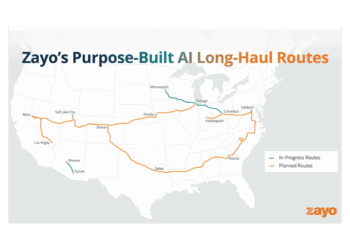
Zayo plans to build an additional 5,000 route miles of long-haul fiber by 2030, reinforcing its goal of addressing capacity bottlenecks as AI and data-center traffic surge. The company operates more than 19.5 million fiber miles and connects 1,700 on-net data centers, supporting hyperscalers, neoclouds, and enterprise customers across 400 markets worldwide.
• 622-mile Umatilla–Prineville–Reno (UPR) long-haul corridor completed
• First direct inland fiber path linking Oregon, California, and Nevada
• Purpose-built for AI and cloud workloads with multiple conduits and 13 ILAs
• Funded in part by NTIA’s Middle Mile Grant Program
• Part of Zayo’s 5,000-mile long-haul expansion goal by 2030
“While others plan, we’re building the infrastructure that makes AI possible,” said Bill Long, Chief Product and Strategy Officer at Zayo. “Without connectivity, data centers and AI factories are just expensive refrigerators: cold boxes of compute with no way for data to get in or out.”
🌐 Analysis:
Zayo’s completion of the UPR route strengthens the emerging “AI corridor” across the western U.S., linking Oregon’s growing data-center hub in Umatilla, the expanding AI infrastructure near Prineville, and Reno’s developing compute and logistics ecosystem. The route’s inland design mitigates risks associated with coastal fiber congestion and environmental exposure. With the NTIA’s middle-mile funding and Zayo’s broader 5,000-mile expansion plan, the company is positioning itself as a key enabler of distributed AI infrastructure and multi-region data transport—complementing similar fiber and edge investments by Lumen, Google Fiber, and hyperscale operators.