• Home
  • Events Calendar
  • Blueprint Guidelines
  • Privacy Policy
  • Subscribe to Daily Newsletter
  • NextGenInfra.io
No Result
View All Result
Converge Digest
Friday, April 10, 2026
  • Home
  • Events Calendar
  • Blueprint Guidelines
  • Privacy Policy
  • Subscribe to Daily Newsletter
  • NextGenInfra.io
No Result
View All Result
Converge Digest
No Result
View All Result

Home » Microring Resonator Arrays Unlock Passive On-Chip Color Conversion

Microring Resonator Arrays Unlock Passive On-Chip Color Conversion

November 16, 2025
in Optical
A A

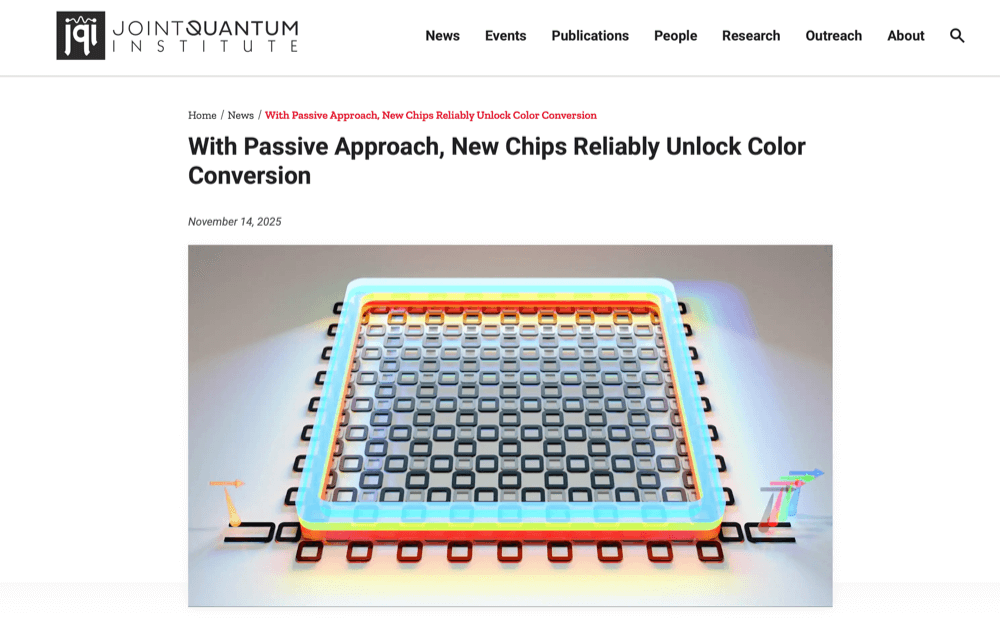
Researchers at the Joint Quantum Institute (JQI) have demonstrated a new class of photonic chips built from arrays of microring resonators that passively convert a telecom-band laser into red, green, and blue light—achieving second, third, and fourth harmonic generation without active tuning. The work, published in Science, shows that a “two-timescale” resonator architecture enables frequency-phase matching across chips without embedded heaters or iterative fabrication tweaks.

The device uses hundreds of tightly coupled microrings that support two distinct circulation paths: fast light cycling inside individual rings and slower propagation around a larger “super-ring” formed by the entire array. The interplay of these two resonant timescales greatly increases the odds of satisfying nonlinear frequency-phase matching conditions that normally require nanometer-level tolerances. When illuminated with ~190 THz (≈1600 nm) input light, all six chips tested from a single wafer produced stable second (red), third (green), and fourth (blue) harmonics.

Unlike single-ring devices—which require high-precision engineering and active compensation through embedded micro-heaters—the array-based architecture generated harmonic output across a broader input range and operated purely passively. The researchers also observed the emergence of additional sidebands around each harmonic at higher input powers, consistent with earlier work on nested frequency-comb generation using similar resonator arrays.

• Device: Arrays of microring resonators with dual timescales for passive frequency-phase matching

• Input: ~190 THz (~1600 nm) telecom laser

• Output: second (≈380 THz), third (≈570 THz), and fourth (≈760 THz) harmonics—red, green, blue

• Fabrication: Six chips on one wafer all produced multi-harmonic output

• Comparison: Single-ring devices required heaters and only yielded narrow-band SHG in one of three tested

• Applications: On-chip light sources, precision metrology, frequency conversion, nonlinear optical computing

“We have simultaneously relaxed these alignment issues to a huge degree, and also in a passive way,” said lead author Mahmoud Jalali Mehrabad. “We don’t need heaters; we don’t have heaters. They just work. It addresses a long-standing problem.”

🌐 Analysis:

This result strengthens the case for scalable, reproducible nonlinear photonics—a crucial requirement for integrated metrology systems, frequency-comb sources, and early quantum-network hardware. The passive robustness is notable when compared with earlier frequency-conversion platforms from industry and academia that depend on thermal tuning or complex feedback loops. JQI’s microring-array architecture provides a new pathway for manufacturable on-chip light sources at wavelengths where conventional lasers are unavailable.


ShareTweetShare
Previous Post

GUC and Ayar Labs Partner on CPO for Hyperscale ASICs

Next Post

Celestica Rolls Out Ultra-Dense JBOD for AI Workloads

Jim Carroll

Jim Carroll

Editor and Publisher, Converge! Network Digest, Optical Networks Daily - Covering the full stack of network convergence from Silicon Valley

Related Posts

Cisco, G42, and AMD to Build AI Infrastructure in the UAE
AI Infrastructure

DigitalBridge Teams with KT for AI Data Centers in Korea

November 26, 2025
BerryComm Expands Central Indiana Fiber with Nokia
5G / 6G / Wi-Fi

Telefónica Germany Awards Nokia a 5-Year RAN Modernization Deal

November 26, 2025
AMD’s Compute + Pensando Network Architecture Powers Zyphra’s AI 
AI Infrastructure

AMD’s Compute + Pensando Network Architecture Powers Zyphra’s AI 

November 25, 2025
Bleu, the “Cloud de Confiance” from Capgemini and Orange
Clouds and Carriers

Orange Business Begins Migration of 70% of IT Infrastructure to Bleu Cloud

November 25, 2025
Dell’s server and networking sales rise 16% yoy
Financials

Dell Raises FY26 AI Infrastructure Outlook as AI Server Shipments Surge 150%

November 25, 2025
GlobalFoundries acquires Tagore Technology’s GaN IP
Optical

GlobalFoundries Acquires InfiniLink for Silicon-Photonics Expertise

November 25, 2025
Next Post
Celestica Launches 1.6TbE Data Center Switch Family

Celestica Rolls Out Ultra-Dense JBOD for AI Workloads

Categories

  • 5G / 6G / Wi-Fi
  • AI Infrastructure
  • All
  • Automotive Networking
  • Blueprints
  • Clouds and Carriers
  • Data Centers
  • Enterprise
  • Explainer
  • Feature
  • Financials
  • Last Mile / Middle Mile
  • Legal / Regulatory
  • Optical
  • Quantum
  • Research
  • Security
  • Semiconductors
  • Space
  • Start-ups
  • Subsea
  • Sustainability
  • Video
  • Webinars

Archives

Tags

5G All AT&T Australia AWS Blueprint columns BroadbandWireless Broadcom China Ciena Cisco Data Centers Dell'Oro Ericsson FCC Financial Financials Huawei Infinera Intel Japan Juniper Last Mile Last Mille LTE Mergers and Acquisitions Mobile NFV Nokia Optical Packet Systems PacketVoice People Regulatory Satellite SDN Service Providers Silicon Silicon Valley StandardsWatch Storage TTP UK Verizon Wi-Fi
Converge Digest

A private dossier for networking and telecoms

Follow Us

  • Home
  • Events Calendar
  • Blueprint Guidelines
  • Privacy Policy
  • Subscribe to Daily Newsletter
  • NextGenInfra.io

© 2025 Converge Digest - A private dossier for networking and telecoms.

No Result
View All Result
  • Home
  • Events Calendar
  • Blueprint Guidelines
  • Privacy Policy
  • Subscribe to Daily Newsletter
  • NextGenInfra.io

© 2025 Converge Digest - A private dossier for networking and telecoms.

This website uses cookies. By continuing to use this website you are giving consent to cookies being used. Visit our Privacy and Cookie Policy.
Go to mobile version