• Home
  • Events Calendar
  • Blueprint Guidelines
  • Privacy Policy
  • Subscribe to Daily Newsletter
  • NextGenInfra.io
No Result
View All Result
Converge Digest
Friday, April 10, 2026
  • Home
  • Events Calendar
  • Blueprint Guidelines
  • Privacy Policy
  • Subscribe to Daily Newsletter
  • NextGenInfra.io
No Result
View All Result
Converge Digest
No Result
View All Result

Home » Continuous-Wave Wavelength Division Multiplexing MSA gets underway

Continuous-Wave Wavelength Division Multiplexing MSA gets underway

June 24, 2020
in Optical
A A

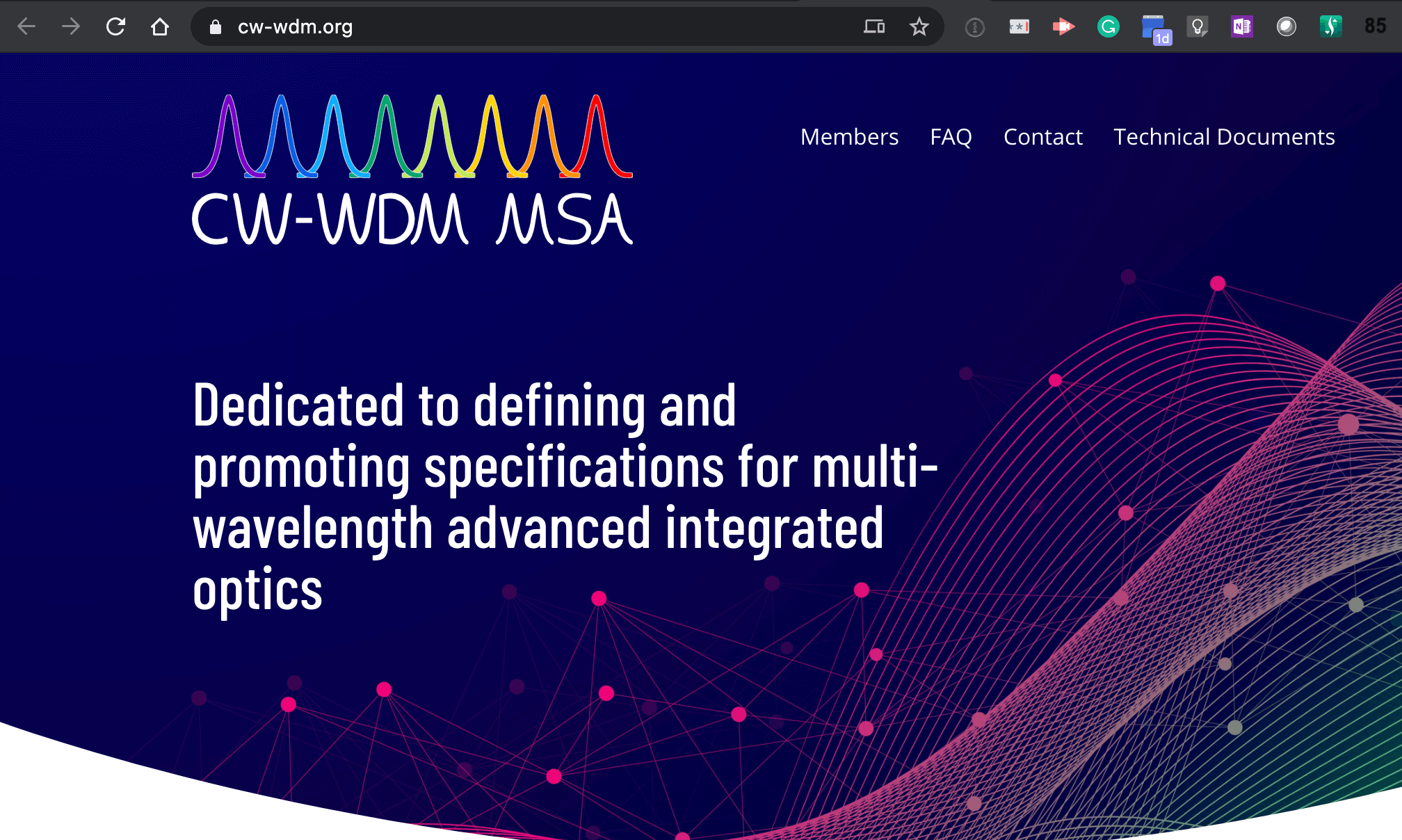
A new Continuous-Wave Wavelength Division Multiplexing Multi-Source Agreement (CW-WDM MSA) consortium has been established to define and promote specifications for multi-wavelength advanced integrated optics.

The CW-WDM MSA said it will solely focus on specifying the laser source instead of the full communications link, and is not targeted at any specific application. Such an approach allows developers to fully optimize optics to their customers’ requirements without interoperability constraints while simultaneously creating a large business opportunity for laser source suppliers.

Currently, IEEE and MSA standards specify four WDM interfaces. Emerging advanced integrated optics applications, such as silicon photonics (SiPh) based high-density co-packaged optics, optical computing, and AI, are expected to move to 8, 16, and 32 wavelengths. Standardizing higher wavelength counts is a crucial part of an emerging ecosystem which is enabling a leap in efficiency, cost, and bandwidth scaling compared to current technology. Increasing the number of wavelengths, while staying in the O-band and aligning with ITU and IEEE standards, allows developers and suppliers to leverage their strategic investments in the current generation of optical products to accelerate time to market of next generation products.

Promoter Members of the CW-WDM MSA are Arista Networks, Ayar Labs, CST Global, imec, Intel, Lumentum, Luminous Computing, MACOM, Quintessent, Sumitomo Electric, and II-VI.

In addition, several Observer Members have signed on to be briefed on the development of the standard to enable early technology development based on the new specifications. Observer Members are AMF, Axalume, Broadcom, Coherent Solutions, Furukawa Electric, GlobalFoundries, Keysight Technologies, NeoPhotonics, NVIDIA, Samtec, Scintil Photonics, and Tektronix.

“Laser sources have been the critical building block of fiber optic communications, and standardizing their specifications has been key to the success of telecom and datacom optics,” said Chris Cole, Chair of the CW-WDM MSA. “ITU-T established complete baselines for DWDM and CWDM grids. The IEEE then specified subsets of these grids for high volume data center applications, starting with 40G and 100G Ethernet optics. The CW-WDM MSA will similarly leverage ITU-T and IEEE standards to specify 8, 16 and 32 wavelength grids in O-band for emerging advanced datacom and computing optics. With the definition of multiple grid sets, the MSA will enable developers to choose what is optimum for their application, while allowing laser suppliers to only have to invest in one technology platform.”

“We support and encourage consortiums like the CW-WDM MSA Group in order to accelerate important technical innovations,” said Christopher Berner, Head of Compute at OpenAI. “OpenAI must be on the cutting edge of AI capabilities and low latency, high bandwidth optical interconnect is a central piece of our compute strategy to achieve our mission of delivering artificial intelligence technology that benefits all of humanity.”

https://cw-wdm.org/

Tags: MSAOpticalWDM
ShareTweetShare
Previous Post

Equinix adds $142 million extension to Dallas Infomart

Next Post

Deutsche Telekom tests Mavenir’s 5G core

Staff

Staff

Related Posts

Microsoft Inks 5-Year, Multi-Billion Deal with KT to Drive AI in Korea
Optical

Open RAN xHaul and IPoDWDM Solutions Take Center Stage

February 27, 2025
Ribbon Communications Secures $385 million credit facility
Optical

Ribbon Completes DWDM Deployment for Bharti Airtel

October 27, 2024
Tech Update video: Ayar Labs’ Optical I/O Chiplets
Optical

ECOC24 video: What’s Next for Optical DSPs? 1.6T and Beyond

September 24, 2024
NTT Achieves Less Than 1ms Latency, Below 1μs Jitter at 400Gbps
Optical

NTT Achieves Less Than 1ms Latency, Below 1μs Jitter at 400Gbps

April 12, 2024
#OFC24: A New Class of Silicon Photonics for AI Data Centers
Video

Big Power Savings with 800G Linear Receive Optics

April 4, 2024
AFL acquires Optical Telecom for DAS expertise
Optical

Fujikura’s AFL to build fiber manufacturing factory in Poland

October 18, 2023
Next Post
Deutsche Telekom tests Mavenir’s 5G core

Deutsche Telekom tests Mavenir's 5G core

Please login to join discussion

Categories

  • 5G / 6G / Wi-Fi
  • AI Infrastructure
  • All
  • Automotive Networking
  • Blueprints
  • Clouds and Carriers
  • Data Centers
  • Enterprise
  • Explainer
  • Feature
  • Financials
  • Last Mile / Middle Mile
  • Legal / Regulatory
  • Optical
  • Quantum
  • Research
  • Security
  • Semiconductors
  • Space
  • Start-ups
  • Subsea
  • Sustainability
  • Video
  • Webinars

Archives

Tags

5G All AT&T Australia AWS Blueprint columns BroadbandWireless Broadcom China Ciena Cisco Data Centers Dell'Oro Ericsson FCC Financial Financials Huawei Infinera Intel Japan Juniper Last Mile Last Mille LTE Mergers and Acquisitions Mobile NFV Nokia Optical Packet Systems PacketVoice People Regulatory Satellite SDN Service Providers Silicon Silicon Valley StandardsWatch Storage TTP UK Verizon Wi-Fi
Converge Digest

A private dossier for networking and telecoms

Follow Us

  • Home
  • Events Calendar
  • Blueprint Guidelines
  • Privacy Policy
  • Subscribe to Daily Newsletter
  • NextGenInfra.io

© 2025 Converge Digest - A private dossier for networking and telecoms.

No Result
View All Result
  • Home
  • Events Calendar
  • Blueprint Guidelines
  • Privacy Policy
  • Subscribe to Daily Newsletter
  • NextGenInfra.io

© 2025 Converge Digest - A private dossier for networking and telecoms.

This website uses cookies. By continuing to use this website you are giving consent to cookies being used. Visit our Privacy and Cookie Policy.
Go to mobile version