Google is working on a “Super PON” architecture that could improve the economics of fiber-to-the-home deployments, said Claudio DeSanti, Architect at Google Fiber, speaking last week at ADTRAN’s Broadband Business Solutions event in Huntsville, Alabama.
Google’s foray into last mile fiber access networks dates back to 2010 when it announced plans to challenge the incumbent telcos and MSOs in the U.S. with a Google-branded and delivered gigabit broadband and TV service. Google Access picked Kansas City for its first deployment and opened a public comment process to identify future rollout locations. Nearly 1,100 communities across the country expressed interest in participating in the Google project and nearly 200,000 individuals submitted comments.
DeSanti presented the timeline that eventually took Google Access to 11 cities
 Then, in October 2016, the Google Fiber project officially hit the pause button. Craig Barratt, who was CEO of Access, stepped down. The said it would continue rolling out in the cities in it was already present, but that is was pausing operations and laying off workers in many cities where it had once anticipated deploying an FTTH network. Google said its effort had spurred AT&T and others to get serious about FTTH, while holding out the possibility of reentering the market if and when new technology options became available.

De Santi said the major lessons learned from this undertaking were that building infrastructure is complex, especially the lengthy permitting process that varies from city to city, and that last mile construction and outside plant costs represent the bulk of spending, mostly because of labor. Google found aerial FTTH to be prohibitively expensive due to policy restrictions of pole sharing with utility companies.
 Regarding future rollouts, DeSanti said Google is now taking a more practical perspective on running the business for profit and sustainability.
In February 2018, Dinesh (Dinni) Jain ws been appointed CEO of Access, the new name for the Google Fiber and Webpass business. Jain most recently served as Chief Operating Officer of Time Warner Cable.
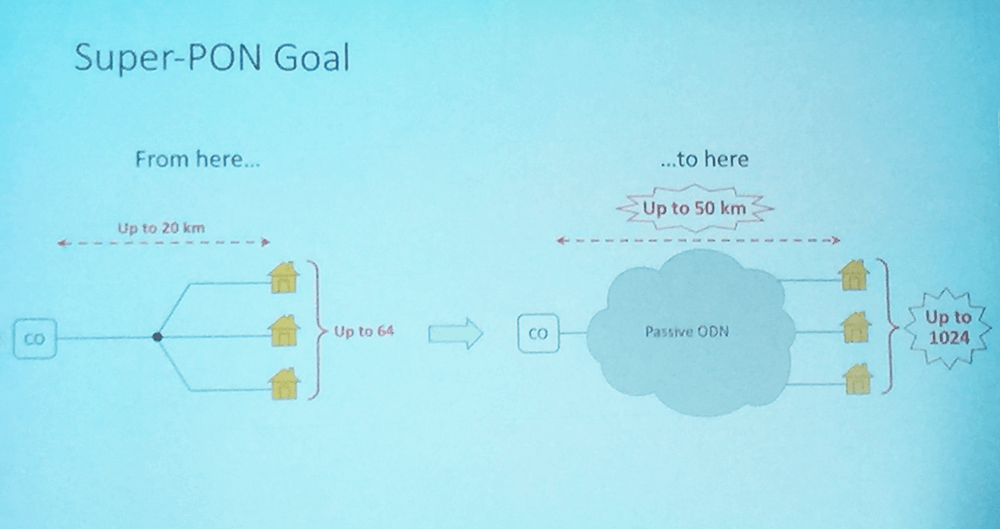
DeSanti said the Super-PON architecture that his team is developing could be a game changer for several reasons. First, it targets a 50 km reach from the Central Office to the subscriber, rather than the 20km target of the current technology. The longer reach is achieved with amplification. This means a larger serving area per CO, and few COs needed to cover a whole city. For a mid-sized U.S. metropolitan area, the current PON architecture requires Google to operate 16 COs. The Super PON might need as few as 3 COs to do the same job. These CO could also be CDN distribution points. No active equipment is deployed outside the CO. It operates over a passive ODN.
Second, the Super PON targets up to 1,024 subscribers, up significantly from the maximum 64-subscriber split available on its current technology. With Super PON, DWDM is used to multiplex multiple channels over a single feeder fiber. DeSanti said few fibers would be needed to support the same number of customers, enabling the deployment of small cables (12-48 fiber cables versus 432-fiber cables). The advantage of smaller cables is that micro-trenching techniques can be used, cutting the time and cost of deployment. Repairs to a fiber cut could also be handled much faster for a 24-fiber cable (under 2 hours) versus 8-hours to repair a 432-fiber cable.
DeSanti noted that Super PON standardization began in January 2018 with a presentation at the New Ethernet Applications group of IEEE 802.3. Last month, IEEE 802.3 approved the formation of a Super PON Study Group. In parallel, Super PON has also been presented to both ITU-T and FSAN, possibly as an NG-PON2 extension. Google has a pre-standard implementation deployed in the field.
An open question is whether Super PON economics leads Google to unpause its Access ambitions.