The first financial reports of 2018 from semiconductor conductor companies have started to arrive. Intel reported very strong results for the fourth quarter of 2017, as did Microsemi (see below). The figures are encouraging for the networking and telecommunications businesses as well given that nearly every system-on-chip solution ends up in a device that is network connected. The more end-user devices, the more nodes on the network, and the data tsunami continues to grow.
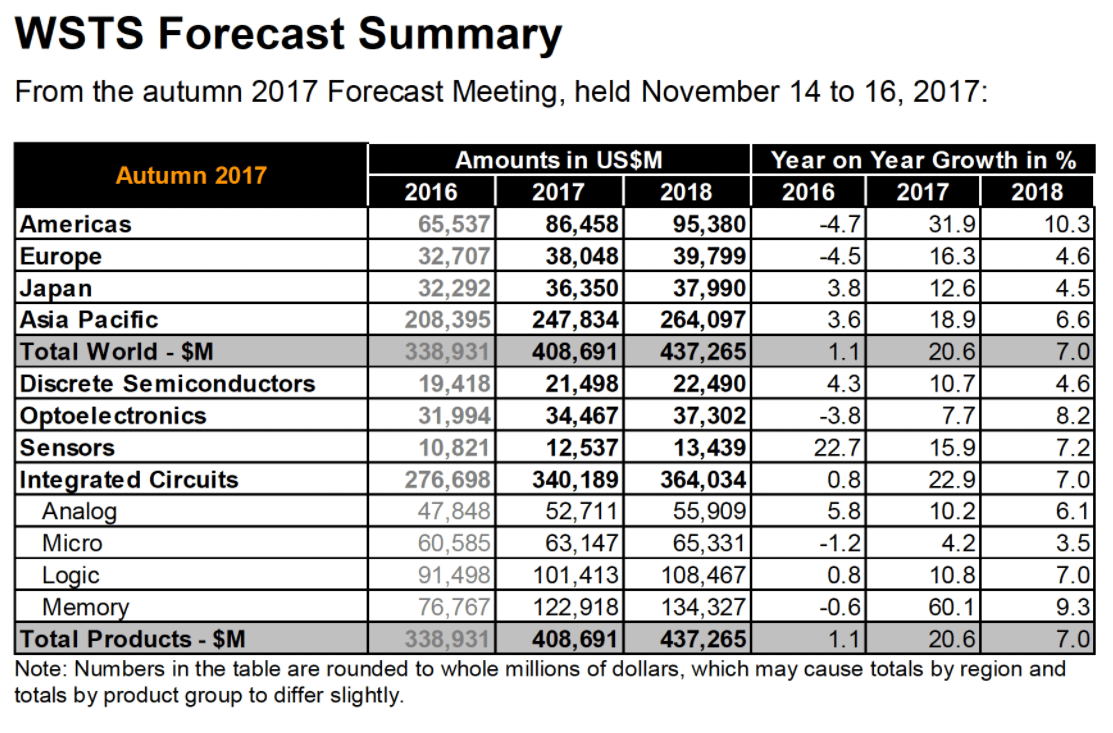
Last week, Gartner updated its forecast of worldwide semiconductor revenue, predicting a total $451 billion in 2018, an increase of 7.5 percent from $419 billion in 2017, The new figure is nearly double the 4 percent growth rate that the firm had predicted earlier. The reason for the increased optimism are “more favourable market conditions”, especially for DRAM and NAND memory. Gartner sees the possibility of price increases for some semiconductor categories during 2018, which in turn would put pressure on margins for system vendors and smartphone manufacturers.

Gartner is predicting other categories will grow at a 4.6% clip in 2018, including field-programmable gate array (FPGA), optoelectronics, application-specific integrated circuits (ASICs), nonoptical sensors and application-specific standard products (ASSPs). This analysis comes from Gartner’s newly published “Forecast Analysis: Electronics and Semiconductors, Worldwide, 4Q17 Update.
“Favorable market conditions for memory sectors that gained momentum in the second half of 2016 prevailed through 2017 and look set to continue in 2018, providing a significant boost to semiconductor revenue,” said Ben Lee, principal research analyst at Gartner. “Gartner has increased the outlook for 2018 by $23.6 billion compared with the previous forecast, of which the memory market accounts for $19.5 billion. Price increases for both DRAM and NAND flash memory are raising the outlook for the overall semiconductor market.”
This momentum has also been reported by The Semiconductor Industry Association (SIA) which found that worldwide sales of semiconductors reached $37.1 billion for the month of October 2017, an increase of 21.9 percent from the October 2016 total of $30.4 billion and 3.2 percent more than September’s total of $36.0 billion. Simply put, October was global semiconductor industry’s largest-ever monthly sales total.
“The global semiconductor market continued to grow impressively in October, with sales surpassing the industry’s highest-ever monthly total and moving closer to topping $400 billion for 2017,” said John Neuffer, president and CEO, Semiconductor Industry Association. “Market growth continues to be driven in part by high demand for memory products, but combined sales of all other semiconductor products were up substantially as well, showing the breadth of the market’s strength this year.”
Intel builds on its data centre strength
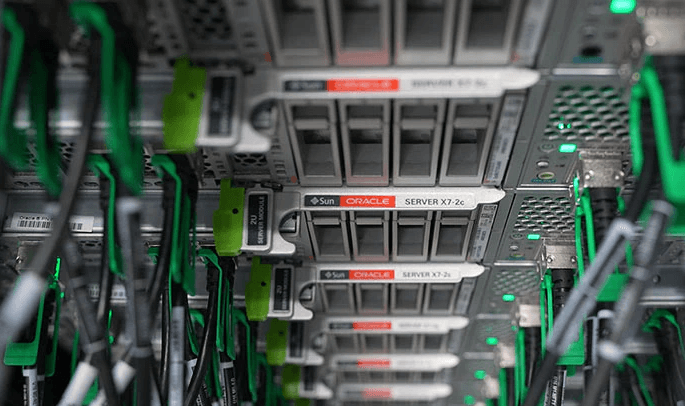
Despite the PC market continuing its long-term decline due to consumers not replacing traditional home PCs, Intel is telling the financial community that 2018 will be another record year. Its earnings report highlights its Data Center Group as the leading growth driver for Q4 2017.
DCG’s revenue was up 20%. This breaks down as follows: cloud segment was up 35%, communications service provider revenues were up 16%, enterprise was up 11%, and adjacency revenue was up 35%. Overall unit volume was up 10%. The new Xeon Scalable server processors, which were launched in July, are ramping well.
With all of the new data centre construction underway pretty much in every major metro, it is easy to see how Intel’s cloud sales were up so strongly. Many are wondering if the recently disclosed security vulnerabilities in Intel CPUs will hurt its business. With the (buggy) firmware patches seen as only a temporary fix, there is a distinct possibility that the operators of cloud data centres will choose to retire the current crop of processors earlier than expected once redesigned silicon hits the market. In that case, the refresh cycle for CPUs in cloud data centres could be brought forward. Intel will still be the leading supplier, even if customers are annoyed or infuriated by the silicon bug, and this would benefit Intel financially rather than hurt it. It’s too early to say this will play out, and industry forecasts have no data at this point.
Growing prospects for semiconductors in 2018 forward
Data centres
Smartphones
5G infrastructure
IoT
Bluetooth and Wi-Fi
Automotive segment
Ethernet ICs
AI, machine learning, and machine vision
Memory