SK Telecom, South Korea’s leading mobile operator by market share, is one of the big players to watch on the global stage for early 5G commercialisation. In fact, a race is on with local rivals KT and LG Uplus to have the first 5G service running in time for the 2018 Winter Olympics, which will be hosted in Pyeongchang, South Korea in February 2018 – only seven months away. Of course, 5G standards are not complete and won’t be in time for the Winter Olympics, which means that network planners will be rushing to show off systems that have barely been tested. Sceptics will say that 5G demos at Pyeongchang are likely to be very limited in their footprint and perhaps only 4.5G rather than truly next gen. However, SK Telecom has a track record of being first with many networking technologies, extending back to its earliest days in CDMA.
Background
South Korea’s mobile market is one of the most mature in the world. There are three dominant mobile operators: SK Telecom (approximately 49% share), KT and LG Uplus. Mobile penetration has exceeded 110% for years. The majority of users are on subscription-based plans, rather than prepaid, and churn is relatively light compared to other countries.
SK Telecom, part of the SK Group conglomerate (chaebol), was founded in 1984 and has a CDMA network architecture heritage. For its most recently reported fiscal quarter, SK Telecom posted revenue of KRW 4.234 trillion, operating income of KRW 410.5 billion, basically flat from a year earlier, and net income of KRW 583.5 billion, up 2.1 %YoY. As of the end of March 2017, SK Telecom had 21.65 million LTE subscribers, representing a 10.9% YoY growth, and taking up 72.6% of the company’s total mobile subscriber base of 29.83 million. ARPU was KRW 34,927 ($31.04), down 2.9% YoY. SK Telecom also operates the Cyworld social network and virtual reality service as well as the Nate-on messaging application.
First in Carrier Aggregation
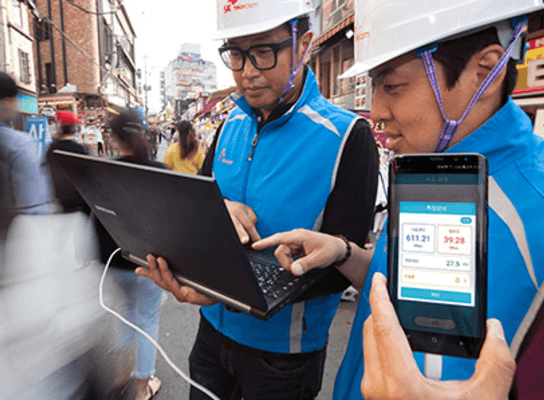
 This week, SK Telecom announced the launch of LTE-A Pro service, which it described as the last stage of LTE evolution. The service footprint covers the main areas of six major cities: Seoul, Busan, Daegu, Gwangju, Daejeon and Ulsan. The initial LTE-A Pro service uses three-band/four-band carrier aggregation (CA) to deliver rates of up to 700 Mbit/s. When 4 x 4 MIMO is added, the service accelerates to 900 Mbit/s. SK Telecom plans to scale up LTE-A Pro further using five-band CA with 4 x 4 MIMO to achieve 1.2 Gbit/s peak rates. The first mobile device to support the LTE-A Pro service is Samsung’s Galaxy S8. An over-the-air firmware update will be needed to support the additional CA bands.
SK Telecom’s spectrum resources include 10 MHz bandwidth in the 800 MHz band, 20 MHz bandwidth in the 1.8 GHz band, 10 MHz bandwidth in the 2.1 GHz band, 10 MHz + 20 MHz bandwidths in the 2.6 Ghz band.
Peak speeds of 700 Mbit/s and up on a mobile phone are certainly impressive. Actually, SK Telecom has been delivering a 500 Mbit/s mobile service since June 2016 using 256QAM combined with tri-band CA. Four years ago, in June 2013, SK Telecom launched the first LTE-A service, which boasted download speeds of up to 150 Mbit/s, which is two times faster than its regular LTE service and 10 times faster than its 3G network. This was achieved using CA across two 10 MHz channels, along with the first Coordinated Multi Point (CoMP) implementation. Samsung’s Galaxy S4 handset, which was the latest and greatest model in the summer of 2013, was the starring device for this milestone service launch as well.
Many world capitals today have yet to attain the 150 Mbit/s performance peaks offered in Seoul four years ago. But surprisingly, SK Telecom’s LTE adoption rate amongst is 29.8 million mobile subscribers was only 72%, or 21.6 million users, as of March 2017. This means that even for a mobile operator with the most advanced network in the world, a significant percentage of users are laggards when it comes to updating to the latest service.
Recently, SK Telecom gained recognition for two other technology innovations: 5G mmWave Handover and a Green Scheduler with Lean Carrier algorithm. Both advances won Global Telecoms Business (GTB) Innovation Awards last month. The 5G mmWave handover technology, developed with Samsung, supports Gbit/s-level performance using multiple mmWave 5G base stations. The companies used the Ray Tracing method to calculate the optimal location of mmWave base stations. SK Telecom and Samsung also cited their work in 3D beamforming to resolve attenuation of radio signals in mmWave frequencies. The Green Scheduler with Lean Carrier technology, which was developed in partnership with Ericsson, enhances network energy efficiency while reducing signal interference.
With Ericsson, SK Telecom is also known to be working on a 5G connected car program. Earlier this year, SK Telecom, Ericsson and BMW Korea achieved a peak rate of 3.6 Gbit/s for a connected vehicle travelling at a speed of 170 km per hour. To pull this off, the three companies deployed the world largest mmWave 5G trial network using the 28 GHz band. Beamforming and beam tracking technologies were used to optimise the connection to the speeding car.
Leaping ahead in quantum technologies
To further illustrate its interest in pushing technological boundaries, SK Telecom signed separate research partnerships earlier this year with Nokia and Deutsche Telecom focused on quantum cryptography. The first partnership will match SK Telecom’s Quantum Key Distribution System (QKD) with Nokia’s next-generation optical transport system. The first prototype was shown at Mobile World Congress in February.
Nokia and SK Telecom are also collaborating on a Quantum Random Number Generator (QRNG), which is seen a key technology for applying quantum cryptography technologies to IoT devices. SK Telecom has developed what it claims to be the world’s smallest 5 x 5 mm CMOS Image Sensor (CIS) based all-in-one, single silicon (ASIC) for providing non-deterministic true random numbers on demand from quantum-shot noise. The plan is to commercialise the technology to enable secure IoT.
SK Telecom’s Quantum Alliance with Deutsche Telekom is more open. At this stage, the agreement aims to the channels of communications open between carriers and vendors when it comes to quantum technologies. The official statement from the company, by, Cha In-hyok, EVP and head of IoT business division, states:
“Committed to building a quantum-safe future, SK Telecom has been actively developing quantum cryptography technologies since 2011. SK Telecom believes that the co-establishment of the Quantum Alliance with Deutsche Telekom will bring us closer to realizing this goal, while also creating new valuable business opportunities in areas including quantum-safe communications, the Internet of Things and big data. It will work together to accelerate the growth of quantum-based cybersecurity technologies and its ecosystem”.