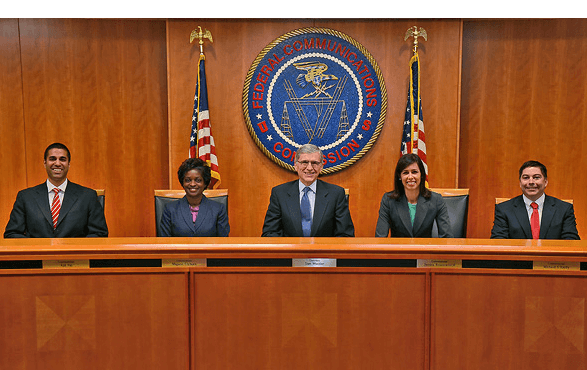
 The Federal Communications Commission voted 3-2 to adopt a new set of Open Internet rules proposed by Commissioner Wheeler and backed by the Obama Administration. All of the new rules, which are based on the FCC’s authority under Title II of the Communications Act of 1934, would apply to fixed and mobile broadband alike, while leaving room for reasonable network management and its specific application to mobile and unlicensed WiFi networks.
Here are the key provisions and rules of the Open Internet Order as outlined by the FCC:
Bright Line Rules: The first three rules ban practices that are known to harm the Open Internet.
- No Blocking: broadband providers may not block access to legal content, applications, services, or non-harmful devices.
- No Throttling: broadband providers may not impair or degrade lawful Internet traffic on the basis of content, applications, services, or non-harmful devices.
- No Paid Prioritization: broadband providers may not favor some lawful Internet traffic over other lawful traffic in exchange for consideration of any kind—in other words, no “fast lanes.” This rule also bans ISPs from prioritizing content and services of their affiliates. It also prohibits practices that target specific applications or classes of applications.
A Standard for Future Conduct: the Order establishes that ISPs cannot “unreasonably interfere with or unreasonably disadvantage” the ability of consumers to select, access, and use the lawful content, applications, services, or devices of their choosing; or of edge providers to make lawful content, applications, services, or devices available to consumers. The FCC will have authority to address questionable practices on a case-by-case basis, and will provide guidance in the form of factors on how the Commission will apply the standard in practice.
Greater Transparency: the Order requires that broadband providers disclose, in a
consistent format, promotional rates, fees and surcharges and data caps. Disclosures must also include packet loss as a measure of network performance, and provide notice of network management practices that can affect service. To further consider the concerns of small ISPs, the Order adopts a temporary exemption from the transparency enhancements for fixed and mobile providers with 100,000 or fewer subscribers, and delegates authority to the FCC’s Consumer and Governmental Affairs Bureau to determine whether to retain the exception and, if so, at what level.
Reasonable Network Management: For the purposes of the rules, other than paid prioritization, an ISP may engage in reasonable network management. The FCC’s standard takes account of the particular engineering attributes of the technology involved—whether it be fiber, DSL, cable, unlicensed Wi-Fi, mobile, or another network medium. However, the network practice must be primarily used for and tailored to achieving a legitimate network management—and not business—purpose.
Broad Protection
Some data services do not go over the public Internet, and therefore are not “broadband Internet access” services (VoIP from a cable system is an example, as is a dedicated heart-monitoring service). The Order ensures that these services do not undermine the effectiveness of the Open Internet rules. Moreover, all broadband providers’ transparency disclosures will continue to cover any offering of such non-Internet access data services—ensuring that the public and the Commission can keep a close eye on any tactics that could undermine the Open Internet rules.
Interconnection: the FCC address issue that may arise in the exchange of traffic between mass-market broadband providers and other networks and services. Under the authority provided by the Order, the Commission can hear complaints and take appropriate enforcement action if it determines the interconnection activities of ISPs are not just and reasonable.
Legal Authority: the order relies on multiple sources of authority including both Title II of the Communications Act and Section 706 of the Telecommunications Act of 1996. At the same time, the Order refrains – or forbears – from enforcing 27 provisions of Title II and over 700 associated regulations that are not relevant to modern broadband service.
FCC Chairman Tom Wheeler stated “There are three simple keys to our broadband future. Broadband networks must be fast. Broadband networks must be fair Broadband networks must be open. We know from the history of previous networks that both human nature and economic opportunism act to encourage network owners to become gatekeepers that prioritize their interests above the interests of their users. As the D.C. Circuit observed in the Verizon decision and as the public record affirms, broadband providers have both the economic incentive and the technological capability to abuse their gatekeeper position. Our challenge is to achieve two equally important goals: ensure incentives for private investment in broadband infrastructure so the U.S. has world-leading networks and ensure that those networks are fast, fair, and open for all Americans. The Open Internet Order achieves those goals, giving consumers, innovators, and entrepreneurs the protections they deserve, while providing certainty for broadband providers and the online marketplace.”
Writing in dissent, FCC Commissioner Ajit Pai stated “It shouldn’t be this way. For twenty years, there’s been a bipartisan consensus in favor of a free and open Internet. A Republican Congress and a Democratic President enshrined in the Telecommunications Act of 1996 the principle that the Internet should be a “vibrant and competitive free market . . . unfettered by Federal or State regulation.” And dating back to the Clinton Administration, every FCC Chairman—Republican and Democrat—has let the Internet grow free from utility-style regulation. The results speak for themselves. But today, the FCC abandons those policies. It reclassifies broadband Internet access service as a Title II telecommunications service. It seizes unilateral authority to regulate Internet conduct, to direct where Internet service providers (ISPs) make their investments, and to determine what service plans will be available to the American public. This is not only a radical departure from the bipartisan, market-oriented policies that have served us so well for the last two decades. It is also an about-face from the proposals the FCC made just last May… In short, because this Order imposes intrusive government regulations that won’t work to solve a problem that doesn’t exist using legal authority the FCC doesn’t have, I dissent.”
http://www.fcc.gov/document/fcc-adopts-strong-sustainable-rules-protect-open-internet
- The text of the Open Internet Order has not yet been published. The FCC said they hope to release it to the public shortly.