by Martin Nuss, Vitesse Semiconductor
2015 should be a defining year in the communications industry, thanks in large part to our world’s growing connectedness – between people, and machines, and more and more “things.” Here’s a look at what I expect will dominate the networking industry focus in the coming year.
Ethernet will be everywhere – 2015 will be the year where Ethernet will conquer industrial IoT networks
We have seen it again and again, and it’s about to happen at least twice more: networking protocols that have been long entrenched in specific markets and applications are being replaced by Ethernet.
This first happened for the Enterprise Local Area Network in the late 1990s, and we have seen the same thing happening in Carrier networks starting around 2010, where Ethernet replaced SONET/SDH, PDH, Frame Relay, and ATM. This transition is well underway, and another one just started: the transition of the many legacy Industrial-IoT protocols like PROFINET, ControlNet, Fieldbus, HART and Ethernet/IP to standards-based Ethernet. Why is this all happening? The answer is simply that the industry has evolved the Ethernet standards and protocols over time to address most, if not all, the of special requirements of the industrial market like high availability, quality-of-service, and network synchronization.
In 2015, we will see the Ethernet standards tackle the last hurdle: making Ethernet deterministic, so that a packet can be guaranteed to be delivered and accepted by mission-critical devices within a specific time window. This will be accomplished as part of the IEEE 802.1tsn (time sensitive networking) effort, after which Ethernet switches know exactly the time in the network, and can deliver packets out of queues at a certain time or within a certain time. This new Ethernet technology will be relevant not only to factory automation and industrial control systems, but also transportation in general and mission-critical systems like antilock brakes and advanced driver assist and collision avoidance systems in automobiles. The automotive market will thus be the next convert to Ethernet.
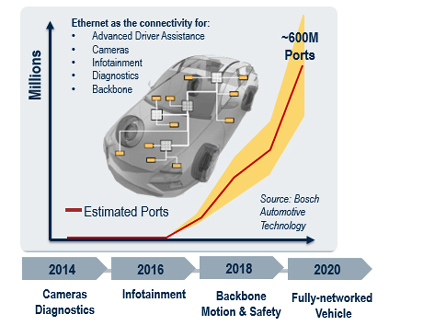
By 2020, the number of Ethernet connections in automobiles will exceed all other Ethernet-connected devices in the world
 All major automotive companies are driving the replacement of the many legacy and semi-proprietary protocols used within cars by Ethernet to drive economies of scale for the IC supply chain, and to accommodate the ever increasing connectivity and bandwidth challenges in the connected car. It started with infotainment systems and backup cameras being connected by Ethernet, but soon, much more critical systems like diagnostics, advanced driver assist (collision avoidance) systems, and even the main system bus in the car will be Ethernet-networked.
By 2020, more than 120 million cars will be equipped with Ethernet connectivity, with the premium segment connecting up to 35 systems with Ethernet, and in mid-range vehicles, between 8-20 systems. All in all, that translates to somewhere between 500-600 million ports, more than all the Ethernet LAN ports combined today. This is all enabled by new 2-wire Ethernet PHYs developed as part of the IEEE 802.3 100Base-T1 and 1000Base-T1 standards developments, as well as the IEEE 802.1tsn “Deterministic Ethernet” standardization.
In the near-term, all the Software-Defined-Networking (SDN) attention will cut into switch and router sales
Software-Defined Networking (SDN) and Network Functions Virtualization (NFV) have captured the attention and imagination of the networking world, and eventually will revolutionize networks of the future. In the near-term, however, they are putting a damper on switch and router sales as network operators and large enterprises figure out what SDN and NFV mean to them, what the business opportunities are, and how to migrate their networks to a more software- and IT-centric model. For wide-area operators in particular, SDN is a tough value proposition. Although the flexibility of a software-defined network can reduce operational and perhaps even capital costs, most of the equipment in the network is “free” since it is already there, and won’t be fully depreciated until years from now. The key to SDN’s success is therefore to figure out how to allow the existing network to participate in the new IT-centric operational model with more centralized control planes and network-wide orchestration. Once that is clear, switch and router sales will pick up again.
Management and network orchestration hold the key to the SDN/NFV network revolution
Although Software-Defined Networking (SDN) and Network Function Virtualization (NFV) are often mentioned in the same context, they are actually different beasts. But what is common to both is an IT-centric view of the network, as opposed to the traditional operational network model. The benefit of the IT-centric model is that network and compute resources can be abstracted from the underlying network and server infrastructure, and “orchestrated” together to deliver services to customers – in minutes and hours as opposed to months.
We predict that the biggest opportunity and revolution will be on this management and orchestration side, and to a lesser degree, on the networking and compute infrastructure side. This will be a dramatic and painful transition, as network operators have to assess skill sets and organizational structures and figure out how to migrate their networks to this new model. Once they do, the revolution can take place.
Security will be the key for Internet of Things (IoT) to succeed
Not a week goes by without a new security breach reported in the press. These threats are not isolated to consumers and credit card and identity thefts, but increasingly are also targeted at Industrial IoT networks. The biggest economic benefits are being realized only when more and more systems are connected to each other and to the cloud, but security becomes a central concern now. No single security scheme can solve all potential vulnerabilities, so it is important to secure applications, networks, and devices. The three As – Authentication, Authorization, and Accounting – apply to all of the above, and are commonplace now for the applications layer, combined with data confidentiality (encryption). But the same principles are enforced less for the network and device/link layer. The link/device layer may be particularly vulnerable since outside of physically secured locations, small cells could be swapped out for rogue devices that can get access to the entire network. Luckily, link layer AAA and encryption technologies like IEEE 802.1AE MACsec are now available even with strong 256-bit AES encryption technologies to secure those last links.
About the Author
 Martin Nuss is Vice President, Technology and Strategy and Chief Technical Officer at Vitesse Semiconductor. Dr. Nuss has over 25 years of technical and management experience and is a recognized industry expert in Ethernet technology including timing and synchronization for public and private communications networks. Dr. Nuss serves on the board of directors for the Alliance for Telecommunications Industry Solutions (ATIS) and is a fellow of the Optical Society of America and IEEE member. He holds a doctorate in applied physics from the Technical University in Munich, Germany.

Got an idea for a Blueprint column? We welcome your ideas on next gen network architecture.
See our guidelines.