• Home
  • Events Calendar
  • Blueprint Guidelines
  • Privacy Policy
  • Subscribe to Daily Newsletter
  • NextGenInfra.io
No Result
View All Result
Converge Digest
Wednesday, April 15, 2026
  • Home
  • Events Calendar
  • Blueprint Guidelines
  • Privacy Policy
  • Subscribe to Daily Newsletter
  • NextGenInfra.io
No Result
View All Result
Converge Digest
No Result
View All Result

Home » Software Defined NFV in Google’s Cloud Platform

Software Defined NFV in Google’s Cloud Platform

August 28, 2014
in All
A A

by James E. Carroll

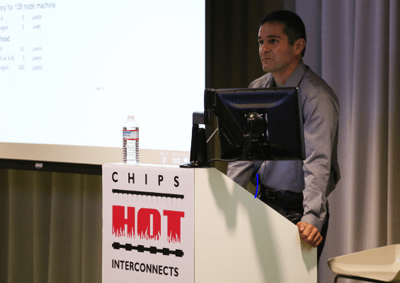
The really exciting phase of cloud computing is just beginning, said Google’s Distinguished Engineer Amin Vahdat, speaking at the 22nd Annual Symposium on High Speed Interconnects at Google’s HQ in Mountain View, California. It’s not about delivering old capabilities cheaper but about new programming models unavailable elsewhere, leveraging low-latency and massive IOPS.

To get there, Vahdat said the old way of networking simply is insufficient to achieve the performance and flexibility needed by next-gen compute and storage systems. Google is leveraging SDN and NFV to run its cloud.

Some key points in his talk:

  • Everything at Google runs on shared infrastructures.  The SDN creates the illusion that individual applications/services are running in their own networks with their own IP address space.
  • Google private backbone, which connects its data centers, is larger and growing faster than its public-facing network. Bandwidth between Google data centers is comparable to what others see inside their data centers.
  • Google has $2.9 billion of additional planned data center builds worldwide.
  • Operating at Google scale reveals that the dominant costs of running a big data center is power and cooling, not the cost of the initial equipment.
  • Google operates a global CDN of edge connectivity with express lanes back to its data centers.
  • Google Andromeda software stack provides the logically centralized SDN control that orchestratew VM, vSwitch, NIC, fabric switch, packet processors and routers.
  • A logically centralized/hierachical control plane with peer to peer data plane beats full decentralization.
  • Baseline NFV is in the fabric. While Google’s Andromeda contoller delivers NFV as a cloud service, new APIs will allow 3rd parties to offer additional network services over Google infrastructure.
  • DDoS protection is an essential NFV service. Large companies are under constant attack. The only question is how big is the ongoing attack.
  • Another NFV application is Google Cloud Load Balancing. This can be provisioned in 5 minutes and then takes 4 seconds to ramp. Steady state can be achieved in under 120 seconds. The total cost is $10.
  • Looking at future needs, the challenge is how to spin up a 1,000 port virtual network in a matter of seconds while ensuring isolation, load balancing, external access, bandwidth provisioning and SAN resources. Using Amdahl’s lesser known law (1 Mbps of IO for every 1 MHz of computation) and assuming 32-core CPUs supporting lots of VMs, we can see the virtual network will require 100s Tbps of switching capacity.
  • Future NPU must be >2X better than switches and CPUs for the same functionality.
  • Every piece of the system has to be in sync and to achieve this constant auditing is required. You are only as good as weakest link.

http://www.hoti.org

Tags: Blueprint columnsGoogleNFVSDN
ShareTweetShare
Previous Post

Nutanix Raises $140 Million for Converged Data Center Solutions

Next Post

Global Cloud Xchange Hires Mark Simpson

Staff

Staff

Related Posts

Anthropic Expands Use of Google Cloud TPUs, Targeting One Million Units 
AI Infrastructure

Google Cloud to Build New Türkiye Region as Part of $2B, 10-Year Investment

November 24, 2025
Anthropic Expands Use of Google Cloud TPUs, Targeting One Million Units 
AI Infrastructure

Google Commits $40B for AI Infrastructure in Texas

November 14, 2025
Google Cloud Details Ironwood TPUs and Axion CPUs for AI Inference 
AI Infrastructure

Google Cloud Details Ironwood TPUs and Axion CPUs for AI Inference 

November 9, 2025
Microsoft Cloud and AI Momentum Drive Results, CAPEX Rockets Up
AI Infrastructure

Google Sees Surging AI Infrastructure Expenses

October 29, 2025
Google and NextEra to Restart Iowa’s Duane Arnold Nuclear Plant 
AI Infrastructure

Google and NextEra to Restart Iowa’s Duane Arnold Nuclear Plant 

October 29, 2025
PECC Summit: Google’s Ryohei Urata on Reliability for AI Data Centers
All

PECC Summit: Google’s Ryohei Urata on Reliability for AI Data Centers

October 23, 2025
Next Post
Global Cloud Xchange Hires Mark Simpson

Global Cloud Xchange Hires Mark Simpson

Please login to join discussion

Categories

  • 5G / 6G / Wi-Fi
  • AI Infrastructure
  • All
  • Automotive Networking
  • Blueprints
  • Clouds and Carriers
  • Data Centers
  • Enterprise
  • Explainer
  • Feature
  • Financials
  • Last Mile / Middle Mile
  • Legal / Regulatory
  • Optical
  • Quantum
  • Research
  • Security
  • Semiconductors
  • Space
  • Start-ups
  • Subsea
  • Sustainability
  • Video
  • Webinars

Archives

Tags

5G All AT&T Australia AWS Blueprint columns BroadbandWireless Broadcom China Ciena Cisco Data Centers Dell'Oro Ericsson FCC Financial Financials Huawei Infinera Intel Japan Juniper Last Mile Last Mille LTE Mergers and Acquisitions Mobile NFV Nokia Optical Packet Systems PacketVoice People Regulatory Satellite SDN Service Providers Silicon Silicon Valley StandardsWatch Storage TTP UK Verizon Wi-Fi
Converge Digest

A private dossier for networking and telecoms

Follow Us

  • Home
  • Events Calendar
  • Blueprint Guidelines
  • Privacy Policy
  • Subscribe to Daily Newsletter
  • NextGenInfra.io

© 2025 Converge Digest - A private dossier for networking and telecoms.

No Result
View All Result
  • Home
  • Events Calendar
  • Blueprint Guidelines
  • Privacy Policy
  • Subscribe to Daily Newsletter
  • NextGenInfra.io

© 2025 Converge Digest - A private dossier for networking and telecoms.

This website uses cookies. By continuing to use this website you are giving consent to cookies being used. Visit our Privacy and Cookie Policy.
Go to mobile version