• Home
  • Events Calendar
  • Blueprint Guidelines
  • Privacy Policy
  • Subscribe to Daily Newsletter
  • NextGenInfra.io
No Result
View All Result
Converge Digest
Sunday, April 19, 2026
  • Home
  • Events Calendar
  • Blueprint Guidelines
  • Privacy Policy
  • Subscribe to Daily Newsletter
  • NextGenInfra.io
No Result
View All Result
Converge Digest
No Result
View All Result

Home » Gigamon’s Unified Visibility Fabric Architecture Spans Physical, Virtual, SDN

Gigamon’s Unified Visibility Fabric Architecture Spans Physical, Virtual, SDN

April 24, 2013
in All
A A

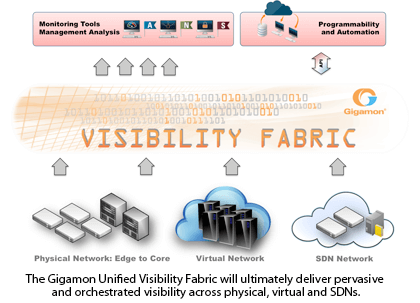
Gigamon outlined its vision for software-defined monitoring based on a four-layer architecture: a Services Layer, a Management Layer, an Orchestration Layer and an Applications Layer.

Gigamon said its strategy is to develop a unified Visibility Fabric architecture that would ultimately deliver orchestrated visibility across physical, virtual and software-defined networks (SDN). This will build on Gigamon’s existing architecture and the principles of SDN to provide a centralized, programmable approach that aims to bridge the gap between the raw data passing through the network and optimally presenting that data to the tools that monitor, manage, secure and ensure application and network performance.

  • The Services Layer currently provides advanced Flow Mapping® and intelligent packet optimization and normalization using GigaSMART technology across physical and virtual worlds and, and Gigamon expects to expand this layer to include software defined data networks with the GigaVUE-CV application which is currently being developed as a proof of concept.
  • The Management Layer consists of the GigaVUE-FM (Fabric Manager) which provides centralized management and a common policy framework for multi-department and multi-tenant traffic monitoring and manipulation policies across the Visibility Fabric architecture.
  • The Orchestration Layer will be developed by Gigamon to provide an open environment through a set of forthcoming APIs and SDKs to enable third party development of applications.  
  • The Applications Layer will consist of a set of visibility applications to be developed by Gigamon, as well as through independent software vendors to deliver optimal tool utilization and performance.

“As data networks evolve from physical to virtual to software-defined networks (SDN), the role of network visibility needs to evolve as well,” said Shehzad Merchant, Chief Strategy Officer at Gigamon. “The Gigamon Unified Visibility Fabric architecture has advanced the vision from providing intelligent traffic filtering and aggregation, to a centralized, policy driven fabric that serves multiple constituents, departments and tools, each with their own policy model. Going forward, we expect that the Unified Visibility Fabric architecture would enable customers to implement ‘Visibility as a Service’. And, as Gigamon continues to develop its offerings, our vision is that this ability will not just be for the physical network, but also across virtual and SDN ‘islands’ as well.”


http://www.gigamon.com/visibility-fabric-architecture

Tags: Blueprint columnsGigamonPacket SystemsTesting
ShareTweetShare
Previous Post

EarthLink Opens Data Center in Dallas for Cloud Hosting

Next Post

Sprint’s Network Vision Remains On Track

Staff

Staff

Related Posts

Ultra Accelerator Link group aims for open interconnect standard
Optical

Teradyne Acquires Quantifi Photonics to Expand IC Testing

March 10, 2025
Spirent: High-Speed Ethernet Market to Quadruple as AI Fuels Growth
Data Centers

Spirent: High-Speed Ethernet Market to Quadruple as AI Fuels Growth

October 24, 2024
ECOC24: MultiLane Launches Next-Gen Test Instruments for 224Gbps and 1.6T
Optical

ECOC24: MultiLane Launches Next-Gen Test Instruments for 224Gbps and 1.6T

September 20, 2024
Keysight’s New Optical Reference Transmitter for 200G/Lane Testing
Optical

Keysight’s New Optical Reference Transmitter for 200G/Lane Testing

September 18, 2024
Spirent and Nokia show 800G interoperability
All

Spirent Upgrades Octobox for Wi-Fi 7

September 17, 2024
Verizon carries terabit wavelength over 205km
Optical

Video: Scaling High-Speed I/O Jitter and Eye Diagram testing

February 13, 2024
Next Post
Sprint’s Network Vision Remains On Track

Sprint's Network Vision Remains On Track

Please login to join discussion

Categories

  • 5G / 6G / Wi-Fi
  • AI Infrastructure
  • All
  • Automotive Networking
  • Blueprints
  • Clouds and Carriers
  • Data Centers
  • Enterprise
  • Explainer
  • Feature
  • Financials
  • Last Mile / Middle Mile
  • Legal / Regulatory
  • Optical
  • Quantum
  • Research
  • Security
  • Semiconductors
  • Space
  • Start-ups
  • Subsea
  • Sustainability
  • Video
  • Webinars

Archives

Tags

5G All AT&T Australia AWS Blueprint columns BroadbandWireless Broadcom China Ciena Cisco Data Centers Dell'Oro Ericsson FCC Financial Financials Huawei Infinera Intel Japan Juniper Last Mile Last Mille LTE Mergers and Acquisitions Mobile NFV Nokia Optical Packet Systems PacketVoice People Regulatory Satellite SDN Service Providers Silicon Silicon Valley StandardsWatch Storage TTP UK Verizon Wi-Fi
Converge Digest

A private dossier for networking and telecoms

Follow Us

  • Home
  • Events Calendar
  • Blueprint Guidelines
  • Privacy Policy
  • Subscribe to Daily Newsletter
  • NextGenInfra.io

© 2025 Converge Digest - A private dossier for networking and telecoms.

No Result
View All Result
  • Home
  • Events Calendar
  • Blueprint Guidelines
  • Privacy Policy
  • Subscribe to Daily Newsletter
  • NextGenInfra.io

© 2025 Converge Digest - A private dossier for networking and telecoms.

This website uses cookies. By continuing to use this website you are giving consent to cookies being used. Visit our Privacy and Cookie Policy.
Go to mobile version