• Home
  • Events Calendar
  • Blueprint Guidelines
  • Privacy Policy
  • Subscribe to Daily Newsletter
  • NextGenInfra.io
No Result
View All Result
Converge Digest
Saturday, April 11, 2026
  • Home
  • Events Calendar
  • Blueprint Guidelines
  • Privacy Policy
  • Subscribe to Daily Newsletter
  • NextGenInfra.io
No Result
View All Result
Converge Digest
No Result
View All Result

Home » BlastWave secures remote access with microsegmentation + passwordless MFA

BlastWave secures remote access with microsegmentation + passwordless MFA

November 17, 2021
in All, Start-ups
A A

BlastWave, a start-up based in Palo Alto, California, unveiled a software-defined perimeter (SDP) solution that combines infrastructure cloaking and passwordless multi-factor authentication (MFA) for identity-based secure remote network access.

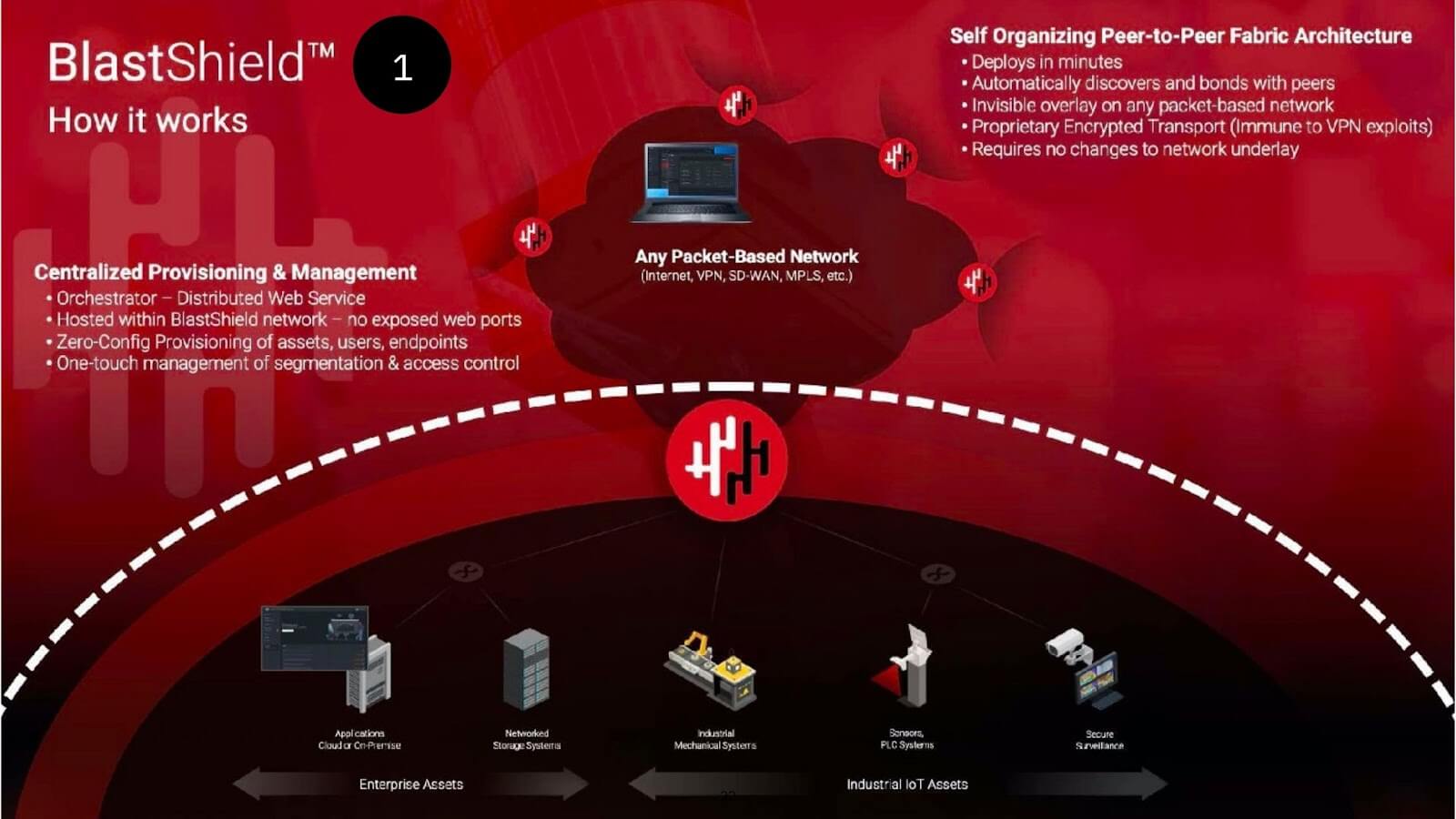
The company’s all-in-one “BlastShield” SDP solution aims to protect remote network access from inadvertent and intentional threats for organizations who’ve adopted a zero trust security model. BlastShield uses software-defined microsegmentation without modifications to existing network fabric and hardware to hide on-premise and cloud workloads from outsiders and insider threats. Using passwordless MFA, BlastShield prevents account takeovers while combining the SDP capabilities of asset cloaking to hide an organization’s infrastructure from cyberattacks.

BlastShield can be deployed on virtual machines, cloud, X86 platforms or as a host agent. It utilizes ultra-lightweight, software-based protective gateways and automatically bonds with “peers” to form an invisible peer-to-peer fabric. BlastShield renders protected assets and applications invisible to attackers and cannot be detected by network scanning technologies. 

BlastWave says its BlastShield solves the three most critical steps in the cyber kill chain for an attacker: (1) account takeover; (2) lateral movement; and (3) remote access compromise. By disrupting the adversarial decision-making process, the mean time to detection (MTTD) and mean time to response (MTTR) can be greatly reduced, lowering the cost of a breach and potential for data compromise.

“We took the time to speak with our partners and customers, asking CISOs and CTOs about security attacks and threats they were experiencing and why current solutions were not working,” said Tom Sego, Co-Founder and CEO, BlastWave. “Networks are becoming more complicated and diverse. Homes are becoming part of the corporate network, and more devices are getting IP addresses. Cybercriminals love this complexity as they can leverage a wider array of attack vectors. Traditional remote management solutions haven’t kept up with this evolution, which explains the explosion in ransomware and cyber-attacks over the past few years and exodus away from legacy VPNs and flat networks.”

Sego added, “With BlastShield, we apply both a zero trust framework and simplicity for users and administrators to eliminate and reduce human error and the most common threats. As an example, our authentication process is similar to Apple Pay. It’s quick, easy and extremely secure for users without the hassle and risk of dealing with passwords.”

BlastWave currently has eight customers and dozens of Proof of Concept (PoC) trials.

https://www.blastwave.io/blastshield

Tags: BlastWaveBlueprint columnsSecuritySilicon Valley
ShareTweetShare
Previous Post

AT&T and Microsoft launch 5G Azure Edge Zones in Atlanta

Next Post

Nokia jumps into Software-as-a-Service for CSPs

Staff

Staff

Related Posts

NIST Finalizes Quantum-Resistant Encryption Standards
Optical

Nokia Secures FIPS 140-3 Certification for Layer 1 Optical Transport in Quantum Era

November 3, 2024
Kinetic Reports Vandalism of Fiber Cables in Kentucky
All

WSJ: Salt Typhoon Cyber Espionage Campaign Targets U.S.

October 6, 2024
FuriosaAI Reveals High-Efficiency RNGD Chip for AI Inference
Semiconductors

FuriosaAI Reveals High-Efficiency RNGD Chip for AI Inference

August 27, 2024
xAI raises $6 billion to propel its AI ambitions
All

Groq Secures $640M Series D Funding for Fast AI Inference

August 6, 2024
NTT doubles down with optical research lab in Silicon Valley
Quantum

Tech Update: DigiCert on the Post-Quantum Threat

May 7, 2024
Arista unveils Zero Trust Networking Vision with Open API
Enterprise

Arista unveils Zero Trust Networking Vision with Open API

November 9, 2023
Next Post
Nokia jumps into Software-as-a-Service for CSPs

Nokia jumps into Software-as-a-Service for CSPs

Please login to join discussion

Categories

  • 5G / 6G / Wi-Fi
  • AI Infrastructure
  • All
  • Automotive Networking
  • Blueprints
  • Clouds and Carriers
  • Data Centers
  • Enterprise
  • Explainer
  • Feature
  • Financials
  • Last Mile / Middle Mile
  • Legal / Regulatory
  • Optical
  • Quantum
  • Research
  • Security
  • Semiconductors
  • Space
  • Start-ups
  • Subsea
  • Sustainability
  • Video
  • Webinars

Archives

Tags

5G All AT&T Australia AWS Blueprint columns BroadbandWireless Broadcom China Ciena Cisco Data Centers Dell'Oro Ericsson FCC Financial Financials Huawei Infinera Intel Japan Juniper Last Mile Last Mille LTE Mergers and Acquisitions Mobile NFV Nokia Optical Packet Systems PacketVoice People Regulatory Satellite SDN Service Providers Silicon Silicon Valley StandardsWatch Storage TTP UK Verizon Wi-Fi
Converge Digest

A private dossier for networking and telecoms

Follow Us

  • Home
  • Events Calendar
  • Blueprint Guidelines
  • Privacy Policy
  • Subscribe to Daily Newsletter
  • NextGenInfra.io

© 2025 Converge Digest - A private dossier for networking and telecoms.

No Result
View All Result
  • Home
  • Events Calendar
  • Blueprint Guidelines
  • Privacy Policy
  • Subscribe to Daily Newsletter
  • NextGenInfra.io

© 2025 Converge Digest - A private dossier for networking and telecoms.

This website uses cookies. By continuing to use this website you are giving consent to cookies being used. Visit our Privacy and Cookie Policy.
Go to mobile version