by Heather Broughton, AVP Marketing, Service Provider Solutions at NETSCOUT
Many communication service providers (CSPs) investing in 5G technology are turning to geomarketing solutions to better reach their revenue goals. This follows reports that 9 in 10 companies worldwide use location data, and that use is expected to grow in significance over the next few years.
However, geomarketing as an economic opportunity is underutilized because existing geolocation methods lack operational feasibility and precision, leading to many CSPs wondering how they can refine their approach and tap into additional geolocation revenue streams over the next decade.
That is the topic we will explore in this article, specifically how carrier geolocation data can increase revenue opportunities for subscriber location-based services without the need for GPS. This approach allows CSPs to analyze their data better and discover intelligent and timely insights into their subscribers, devices, services, networks, and applications.
Geolocation Solutions Rely on Precision
When we talk about precision in geolocation services, we first must address the fact that current legacy geomarketing methods in the market – such as Over the Top (OTT) GPS and passive geolocation – has fundamental flaws that restrict their capabilities for real-time use. Examples include errors in dense urban areas, limitations indoors where coverage is limited, and GPS systems that are easily turned off and run out of battery. Likewise, passive geolocation methods suffer from configuration errors rendering large locations, Net Energy Metering (NEM) and User Equipment (UE) Radio Frequency (RF) parameters that contain errors and bias, and higher latency due to ‘weighting’ past sessions to smooth movements.
By comparison, through a better understanding of network data, particularly by applying smart data instrumentation and analytics at the RAN level and beyond, mobile network operators can significantly improve accuracy compared with traditional methods. Machine learning (ML) models can be trained to learn on just 1% of 3GPP-based minimize drive test (MDT) calls to predict all other calls and provide a more precise, anonymized view of subscribers with fewer variations compared with traditional modeling. This type of data is extremely rich – giving insight into location-based activities and behavior – and, when combined with other sources within data lakes, can yield a range of revenue opportunities across sectors.
Geolocation Data Monetization Opportunities by Sector
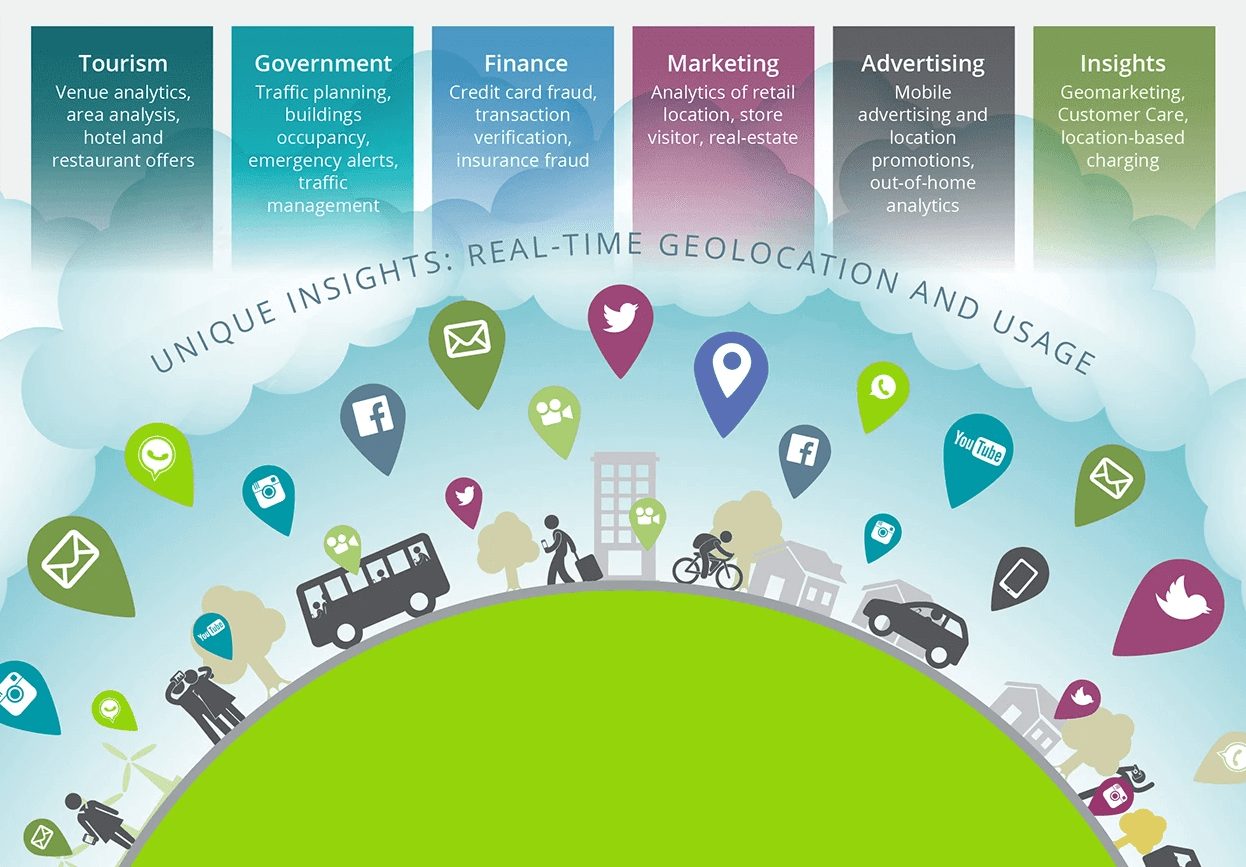
In general, geolocation data is becoming harder and harder to come by. Smartphone manufacturers and ecosystem players like Apple and Google have introduced measures in recent years to limit the amount of information collected by applications to improve user privacy. This affords mobile network operators considerable opportunity to provide precision geolocation data with many important use cases across industries. Consider just a few examples:
- Advertising and marketing: Geomarketing uses consumers’ location to provide relevant messaging for products or services they may be interested in at that particular point in time. With accurate geolocation data, CSPs can help advertisers set geofencing to trigger select mobile ads – such as to promote a new store or regional offer – and verify ad conversions.
- Fraud detection and prevention: Credit card fraud in the U.S. continues to rise each year, amounting to billions of dollars in costs to financial institutions. However, even with sophisticated algorithms, spotting fraud in real-time remains a challenge. Accurate, real-time geolocation data offers an opportunity for card issuers to verify transactions and stop payment before any funds are lost.
- Business & government planning: Before building a new branch location or paving a new road, planners want to know traffic patterns and behaviors. Having accurate geolocation data is invaluable in verifying other data sources and can help organizations set or adjust strategies to reflect the real world.
In conclusion, current geomarketing methods, including GPS and passive monitoring, have unique limitations, and emerging technologies such as smart data, RAN-based machine learning models can help ensure data accuracy to provide a range of unique services across industries. As 5G continues to advance in the next decade, CSPs will find new ways to improve existing geomarketing methods and provide a transformational experience for their subscribers.
About the Author
Heather Broughton is an area vice president overseeing communications service provider solutions at NETSCOUT. She has more than 20 years of experience in telecom, including positions held at Verizon/MCI focused on performance management and translations for both fixed and mobile networks.