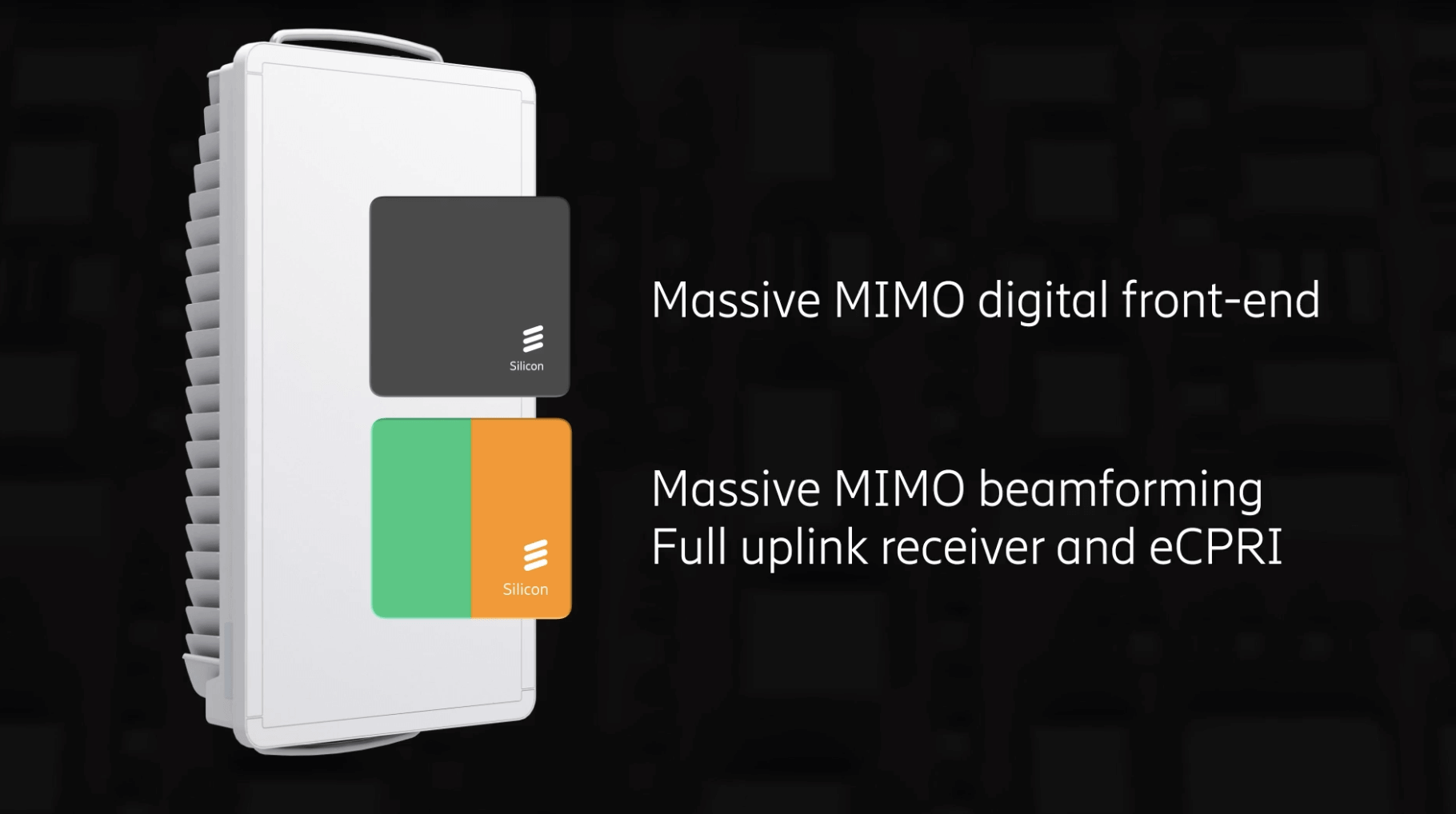
Ericsson introduced its most advanced RAN Compute products to date, designed for the network demands of 5G Advanced and enhanced artificial intelligence (AI) algorithms and powered by latest generation of Ericsson silicon.
Ericsson’s next-generation RAN Compute portfolio includes four products with high and standard capacity variants, and with both enclosure and outdoor formats, to cater to varying site needs. The two high-capacity processors, RAN Processor 6672 and Radio Processor 6372, offer four times the capacity compared to previous generation and can support up to six 4G and 5G modes, in a single unit. Advanced 5G markets typically utilize three to four modes in basebands at present.
Ericsson says the additional modes made possible by the products announced today will allow CSPs to run more technologies simultaneously on one RAN Compute board, including 5G time division duplex (TDD) Massive MIMO, 4G and 5G frequency division duplex (FDD), and more, with modes to spare for future needs.
Michael Begley, Head of RAN Compute, Ericsson, says: “Our new and enhanced RAN Compute portfolio was designed with Ericsson’s customers and their future needs in mind. It both addresses their need to maximize spectrum utilization and facilitates their desire to future-proof their networks with support for Open RAN architectures. The focus on innovation and energy efficiency while reducing both footprint and total cost of ownership has resulted in powerful hardware and software that is both reliable and flexible.”
Ericsson is working with Intel as key partner for this new generation of RAN Compute products, utilizing Intel 4 technology, as the two companies continue to build on their strategic collaboration.
Highlights
- Four next-generation processors in Ericsson RAN Compute: the high-capacity RAN Processor 6672 and Radio Processor 6372, as well as, standard capacity options, RAN Processor 6655 and Radio Processor 6355
- Two innovative software capabilities: Automated Carrier Aggregation, which helps automatically configure complex carrier aggregation cell relations using innovative software algorithms, as well as Carrier Aggregation Data Steering, a feature that significantly maximizes mid-band TDD spectrum utilization, while reserving the precious FDD capacity when needed.
- Two high-capacity Router 6000: Router 6678, a 4.8Tbps aggregation and Centralized RAN hub router that is three times more energy efficient compared to previous generation and Router 6671, an energy-efficient 25GE optimized cell site router. Both Router 6678 and 6671 have built-in intelligence for AI-analytics and automation, which can be leveraged through the new Ericsson Transport Automation Controller, announced separately
https://www.ericsson.com/en/press-releases/2023/11/next-generation-ericsson-ran-compute-breaks-ground-in-network-processing-power
- In July 2023, Ericsson confirmed plans to use Intel’s 18A process and foundry service for its next-generation optimized 5G silicon. 18A is Intel’s most advanced node on the company’s five-nodes-in-four-years roadmap. After new gate-all-around transistor architecture – known as RibbonFET – and backside power delivery – called PowerVia – appear first in Intel 20A, Intel will deliver ribbon architecture innovation and increased performance along with continued metal linewidth reduction in 18A. Under the agreement, Intel will manufacture custom 5G SoCs (system-on-chip) for Ericsson to create highly differentiated leadership products for future 5G infrastructure. Additionally, the companies will expand their collaboration to optimize 4th Gen Intel Xeon Scalable processors with Intel vRAN Boost for Ericsson’s Cloud RAN (radio access network) solutions to help communications service providers increase network capacity and energy efficiency while gaining greater flexibility and scalability.