By James E. Carroll, Editor
Intel provided an update on its large-scale neuromorphic systems based on its human brain-inspired Loihi 2 processors. Neuromorphic computing refers to a type of computing technology that mimics the neural structure and functioning of the human brain. The goal of this technology is to create computer systems that can process information in ways similar to biological systems, which are highly efficient in handling tasks such as pattern recognition, sensory processing, and decision making under uncertainty. Neuromorphic systems typically use a combination of hardware and software to emulate the network of neurons and synapses found in biological brains.
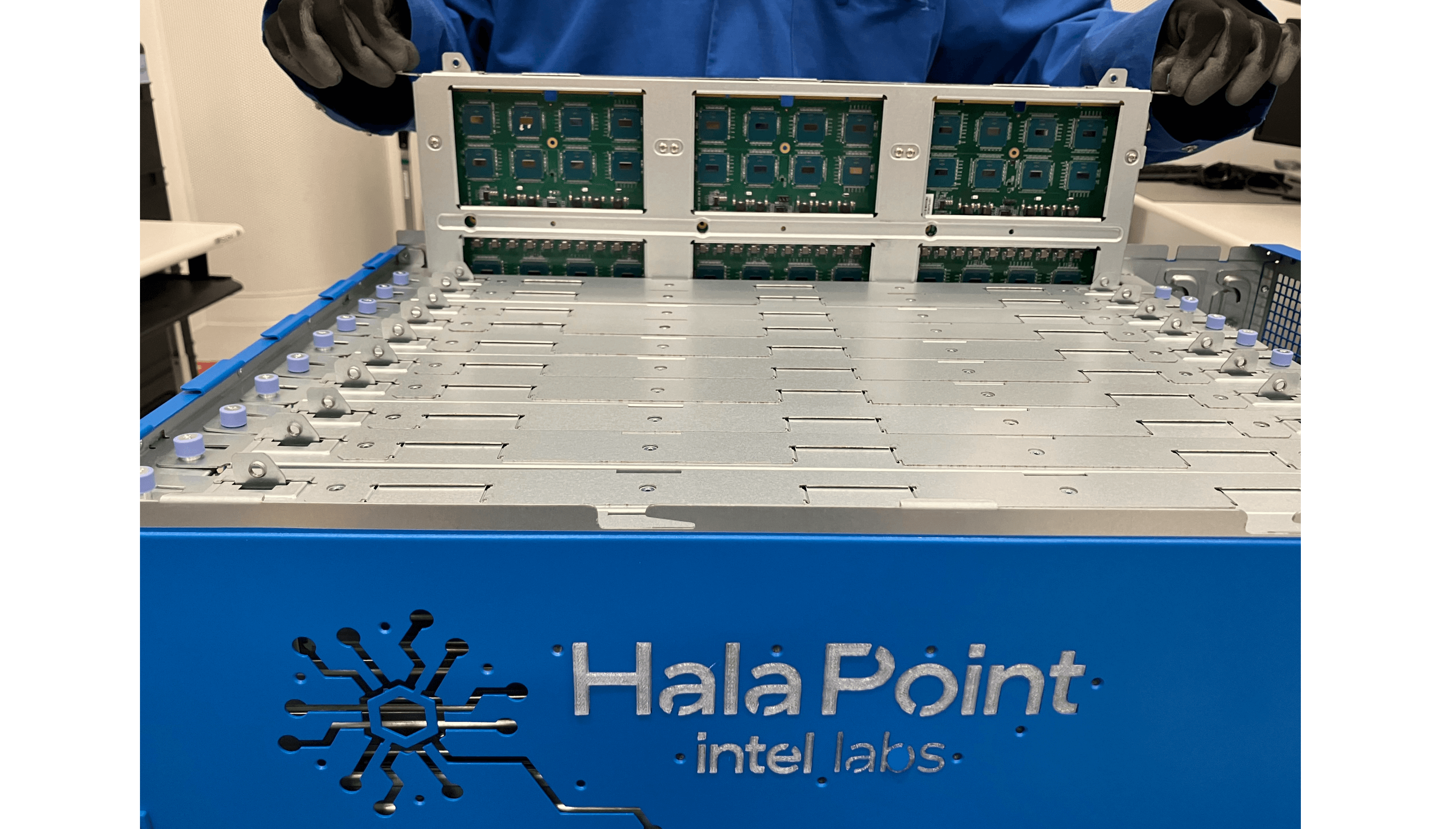
This wee, Intel disclosed progress on a new large-scale system (code named Hala Point ), which is deployed at Sandia National Laboratories, claiming over 10 times more neuron capacity and up to 12 times higher performance compared with its first-generation large-scale research system (code named Pohoiki Springs).
Intel said its Hala Point represents a significant advancement in neuromorphic computing, a brain-inspired approach designed to enhance the performance and efficiency of artificial intelligence (AI) systems. As the first large-scale neuromorphic system, Hala Point has demonstrated state-of-the-art computational efficiencies in mainstream AI workloads, capable of performing up to 20 quadrillion operations per second (20 petaops). Its efficiency is particularly notable, achieving more than 15 trillion 8-bit operations per second per watt (TOPS/W) when running conventional deep neural networks.
Sandia National Laboratories is set to utilize Hala Point forbrain-scale computing research. The focus will be on tackling complex scientific computing problems across various domains, including device physics, computer architecture, and informatics. This usage underscores the system’s potential to address high-level scientific and engineering challenges, leveraging its unique capabilities to advance knowledge in these critical areas.
Hala Point is integral to addressing sustainability challenges associated with the rapid scaling of deep learning models, which have grown to trillions of parameters. The recent developments in neuromorphic computing, including those showcased at the International Conference on Acoustics, Speech, and Signal Processing (ICASSP), emphasize the potential of this technology to revolutionize AI hardware.
Key Points:
- High Performance: Hala Point achieves up to 20 petaops with an efficiency exceeding 15 TOPS/W, surpassing GPU and CPU architectures. Research Applications: Sandia National Labs will utilize Hala Point for advanced scientific and computing research.
- Sustainability Focus: Neuromorphic computing addresses AI’s sustainability challenges by integrating memory and computing for energy efficiency.
- Neuromorphic Advancements: Loihi 2 processors, the basis for Hala Point, utilize brain-inspired computing principles for significant energy and performance gains.
- Industry Collaboration: Intel collaborates with over 200 entities in the INRC to further develop and commercialize neuromorphic computing technologies.
“The computing cost of today’s AI models is rising at unsustainable rates. The industry needs fundamentally new approaches capable of scaling. For that reason, we developed Hala Point, which combines deep learning efficiency with novel brain-inspired learning and optimization capabilities. We hope that research with Hala Point will advance the efficiency and adaptability of large-scale AI technology,” states Mike Davies, director of the Neuromorphic Computing Lab at Intel Labs.
“Working with Hala Point improves our Sandia team’s capability to solve computational and scientific modeling problems. Conducting research with a system of this size will allow us to keep pace with AI’s evolution in fields ranging from commercial to defense to basic science,” said Craig Vineyard, Hala Point team lead at Sandia National Laboratories.
Researchers have pointed to several potential advantages of Neuromorphic systems:
- Parallelism: Unlike traditional computers, which process tasks sequentially, neuromorphic systems use a highly parallel architecture, much like the human brain, enabling them to process multiple inputs and outputs simultaneously.
- Energy Efficiency: Neuromorphic computing aims to be highly energy efficient, mimicking the low energy consumption of biological brains.
- Learning and Adaptability: These systems are designed to learn from their environment and adapt over time, similar to how biological neural networks adjust their synaptic strengths.
- Event-based Processing: Neuromorphic computers often use event-based, or spike-based, systems where signals are processed only when needed (akin to neurons firing), which is more efficient than the continuous operation of traditional digital systems.