NTT reported a world-first milestone in long-haul optical transmission, surpassing 100 Tbit/s capacity over 800 km using newly developed wavelength band conversion technology. This achievement, made possible by integrating ultra-long wavelength (U-band) transmission into conventional optical fiber systems, represents a significant leap in optical communications and prepares networks for the future demands of 6G and the IOWN (Innovative Optical and Wireless Network) infrastructure. The transmission was conducted over existing fiber, maintaining the industry-standard 80 km relay spacing, a critical factor for practical deployment in current optical backbone systems.
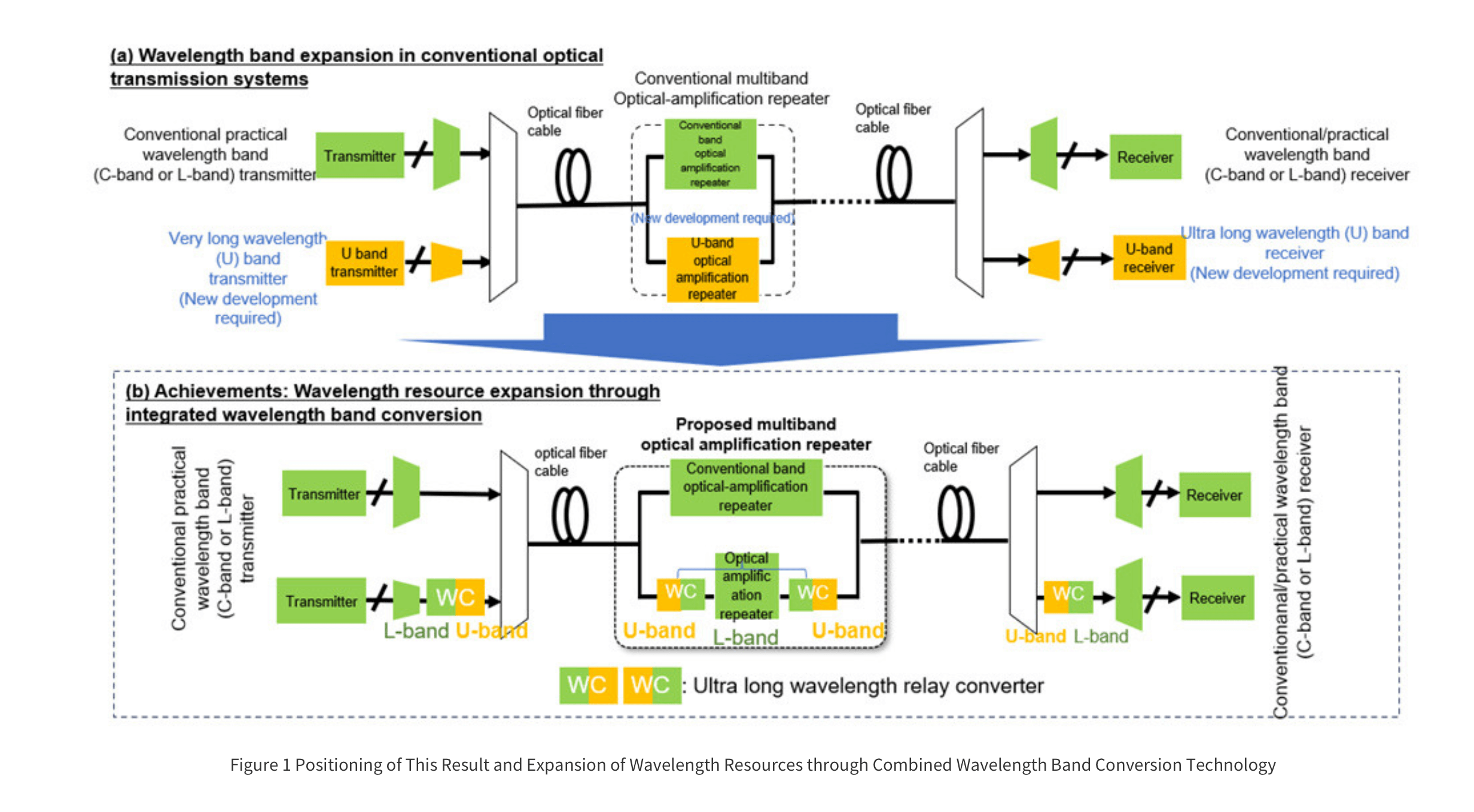
The breakthrough is centered on NTT’s application of periodically poled lithium niobate (PPLN) technology, which allows for wavelength conversion into the U-band, previously difficult to use due to higher optical loss and the need for new transmission equipment. Instead of requiring entirely new transceivers and optical amplifier repeaters, NTT employed its PPLN technology to enable U-band transmission while utilizing conventional C-band and L-band equipment. This innovation expanded the total wavelength resources to 14.85 THz, combining the C-band (4.5 THz), L-band (5.85 THz), and U-band (4.5 THz), enabling large-scale amplification relay and increasing the distance and capacity of optical transmission.

In the experiments, NTT demonstrated how its hybrid approach using conventional equipment with U-band wavelength conversion allowed for high-quality signal transmission over unprecedented distances. By optimizing the power balance using stimulated Raman scattering effects, they were able to manage the higher loss characteristics of the U-band while preserving signal quality. The tests involved 99 Wavelength-Division Multiplexing (WDM) signals, transmitted across the C, L, and U bands. With this configuration, the experiment achieved 125.6 Tbit/s over 480 km and sustained over 115 Tbit/s capacity over 800 km. Even after a distance of 2400 km, the system maintained a capacity of 72.6 Tbit/s, underscoring the potential for expanding the reach of ultra-long wavelength transmission.
The research highlights the potential for integrating U-band transmission into existing infrastructure, addressing the limitations of current optical transmission systems that are nearing their theoretical capacity limits in the C and L bands. The ability to extend transmission over distances greater than 500 km, which is vital for large optical backbones like Japan’s Tomei corridor, is particularly noteworthy. Additionally, NTT’s advances in high-precision transmission design, based on their improved Gaussian noise model, allowed for the effective management of wideband signals, overcoming the power distribution challenges posed by stimulated Raman scattering in multi-terabit transmissions.
The long-haul transmission experiment was conducted using an 80 km re-circulating loop configuration, which included hybrid amplifiers combining conventional Erbium-Doped Fiber Amplifiers (EDFAs) for the C and L bands with the new PPLN-based U-band conversion amplifiers. The experiment used polarization-multiplexed PCS-QAM signals with a symbol rate of 144 Gbaud, capable of transmitting up to 1.3 Tbit/s per wavelength, depending on the transmission distance. These high-speed signals are necessary for achieving multi-terabit transmission capacities and are part of the technological advancements required for supporting the massive data loads expected in the coming years.
NTT’s success with U-band wavelength conversion technology provides a critical step toward realizing the next generation of optical transmission systems capable of supporting the 6G and IOWN all-photonics network. By effectively tripling the usable capacity of a single-core optical fiber, NTT has opened the door to significantly higher transmission volumes over long distances, which will be essential for future high-speed, high-capacity applications, including AI, cloud services, and autonomous technologies.
• Over 100 Tbit/s capacity achieved over 800 km using U-band wavelength conversion technology.
• Expanded wavelength resources to 14.85 THz by integrating C-band, L-band, and U-band with hybrid amplification.
• Utilized existing C- and L-band equipment with new PPLN technology for ultra-long wavelength transmission.
• Achieved 125.6 Tbit/s over 480 km and 115.3 Tbit/s over 800 km, with 72.6 Tbit/s capacity sustained at 2400 km.
• Demonstrated high-quality signal transmission using 144 Gbaud PCS-QAM signals for multi-terabit optical transmission.
• Potential to increase fiber capacity more than threefold, essential for IOWN/6G infrastructure.
“Our success with U-band wavelength conversion demonstrates a major step toward the evolution of all-photonics networks for 6G,” said NTT Corporation.