• Home
  • Events Calendar
  • Blueprint Guidelines
  • Privacy Policy
  • Subscribe to Daily Newsletter
  • NextGenInfra.io
No Result
View All Result
Converge Digest
Sunday, April 12, 2026
  • Home
  • Events Calendar
  • Blueprint Guidelines
  • Privacy Policy
  • Subscribe to Daily Newsletter
  • NextGenInfra.io
No Result
View All Result
Converge Digest
No Result
View All Result

Home » Alcatel-Lucent: Mobile Infection Rate at 0.68% Worldwide

Alcatel-Lucent: Mobile Infection Rate at 0.68% Worldwide

February 12, 2015
in All
A A

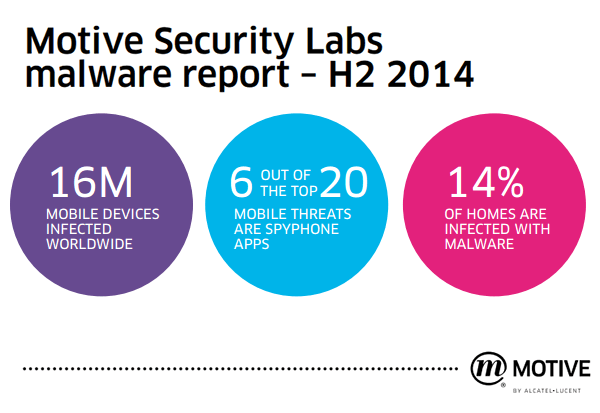
An estimated 16 million mobile devices worldwide have been infected by malware, according to a new study from Alcatel-Lucent’s Motive Security Labs.

The Motive Security Labs report – which looked at all popular mobile device platforms – found that such malware infections in mobile devices increased 25% in 2014, compared to a 20% increase in 2013. Android devices have now caught up with Windows laptops, which had been the primary workhorse of cybercrime, with infection rates between Android and Windows devices split 50/50 in 2014. While less than 1% of infections come from iPhone and Blackberry smartphones, new vulnerabilities emerged last year to show they are not immune to malware threats.

Some highlights of the Motive Security Lab:

  • The mobile infection rate in 2014 is 0.68%. Based on this Alcatel-Lucent estimates that worldwide, about 16 million mobile devices are infected by malware.
  • Mobile malware is increasing in sophistication with more robust command and control protocols
  • Mobile spyware, used to spy on a phone’s owner, is also on the increase. It tracks the phone’s location, monitors ingoing and outgoing calls, text messages, e-mail and tracks web browsing.
  • The overall monthly infection rate in residential fixed broadband networks is just under 14%. This is up substantially from the 9% seen in 2013. This is mostly attributable to an increase in infections by moderate threat level adware.
  • High-level threats such as ‘bots’, ‘rootkits’, and ‘banking trojans’ remain steady at around 5%.
  • The Motive Security Labs report also noted in 2014 an increase in Distributed Denial of Service (DDOS) attacks using network infrastructure components such as home routers, DSL modems, cable modems, mobile WiFi™ hotspots, DNS servers and NTP servers. Additionally, the first DDOS attacks launched from mobile phones took place, suggesting how so-called ‘hactivism’ movements against the mobile infrastructure might be launched in the future.

“With malware attacks on devices steadily rising with consumer ultra-broadband usage, the impact on customer experience becomes a primary concern for service providers,” said Patrick Tan, General Manager of Network Intelligence at Alcatel-Lucent. “As a result, we’re seeing more operators take a proactive approach to this problem by providing services that alert subscribers to malware on their devices along with self-help instructions for removing it.”


http://www.alcatel-lucent.com

Tags: Alcatel-LucentBlueprint columnsCyber SecurityMotive
ShareTweetShare
Previous Post

Facebook Brings Free Mobile Data Services to India’s Reliance Subscribers

Next Post

Alcatel-Lucent Intros 10G TWDM-PON

Staff

Staff

Related Posts

Blueprint: Brazil looks to municipal Wi-Fi 6E
Blueprints

Blueprint: Brazil looks to municipal Wi-Fi 6E

February 21, 2023
Blueprint: Building wholesale networks with OTN
All

Blueprint: Building wholesale networks with OTN

December 20, 2022
Oracle opens cloud region in Chicago
All

Oracle opens cloud region in Chicago

December 20, 2022
BT trials C-RAN in Leeds
All

BT trials C-RAN in Leeds

December 19, 2022
T-Mobile builds cloud native 5G converged core with Cisco
All

T-Mobile builds cloud native 5G converged core with Cisco

December 15, 2022
Meta halts data center expansion construction in Denmark
All

Meta halts data center expansion construction in Denmark

December 15, 2022
Next Post
Alcatel-Lucent Intros 10G TWDM-PON

Alcatel-Lucent Intros 10G TWDM-PON

Please login to join discussion

Categories

  • 5G / 6G / Wi-Fi
  • AI Infrastructure
  • All
  • Automotive Networking
  • Blueprints
  • Clouds and Carriers
  • Data Centers
  • Enterprise
  • Explainer
  • Feature
  • Financials
  • Last Mile / Middle Mile
  • Legal / Regulatory
  • Optical
  • Quantum
  • Research
  • Security
  • Semiconductors
  • Space
  • Start-ups
  • Subsea
  • Sustainability
  • Video
  • Webinars

Archives

Tags

5G All AT&T Australia AWS Blueprint columns BroadbandWireless Broadcom China Ciena Cisco Data Centers Dell'Oro Ericsson FCC Financial Financials Huawei Infinera Intel Japan Juniper Last Mile Last Mille LTE Mergers and Acquisitions Mobile NFV Nokia Optical Packet Systems PacketVoice People Regulatory Satellite SDN Service Providers Silicon Silicon Valley StandardsWatch Storage TTP UK Verizon Wi-Fi
Converge Digest

A private dossier for networking and telecoms

Follow Us

  • Home
  • Events Calendar
  • Blueprint Guidelines
  • Privacy Policy
  • Subscribe to Daily Newsletter
  • NextGenInfra.io

© 2025 Converge Digest - A private dossier for networking and telecoms.

No Result
View All Result
  • Home
  • Events Calendar
  • Blueprint Guidelines
  • Privacy Policy
  • Subscribe to Daily Newsletter
  • NextGenInfra.io

© 2025 Converge Digest - A private dossier for networking and telecoms.

This website uses cookies. By continuing to use this website you are giving consent to cookies being used. Visit our Privacy and Cookie Policy.
Go to mobile version