Amazon reintroduced its satellite connectivity program under a new permanent brand: Amazon Leo, replacing the long-running Project Kuiper codename. The move marks a shift from development to commercial readiness as Amazon accelerates deployment of its low Earth orbit (LEO) constellation. Amazon Leo now counts 150+ satellites in orbitafter its sixth consecutive launch and is preparing for service rollout as coverage and capacity expand.
The company says it now operates one of the world’s largest satellite production lines and has developed phased-array customer terminals capable of supporting gigabit-class connectivity. Early customers and partners—including JetBlue, L3Harris, DIRECTV Latin America, Sky Brasil, and NBN Co. in Australia—have already signed on to integrate the service. Amazon Leo expects to complete more than 80 launches to build out its initial constellation.
The rebrand underscores Amazon’s commitment to extending high-speed broadband to underserved communities and enterprise users globally. The name “Leo” is also an explicit reference to the constellation’s operating altitude, replacing the astronomy-inspired “Kuiper” label that guided the program through licensing, prototype testing, and early deployments.
• Amazon Leo now has 150+ satellites in orbit after six successful missions
• Initial constellation buildout includes 80+ launches
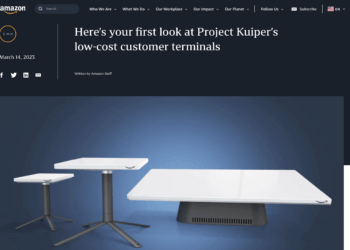
• Customer terminals use Amazon-designed phased-array antennas supporting gigabit speeds
• Early customers include JetBlue, L3Harris, DIRECTV Latin America, Sky Brasil, and NBN Co.
• Amazon operates one of the industry’s largest dedicated LEO satellite production lines
• Full service rollout to begin as capacity and coverage expand
“We’ve invented some of the most advanced customer terminals ever built, including the first commercial phased array antenna to support gigabit speeds,” said Rajeev Badyal, Vice President of Amazon Leo.
🌐 Analysis
Amazon’s rebrand aligns the program more clearly with the growing global LEO race, positioning Amazon Leo against Starlink, OneWeb, and emerging regional LEO systems. The steady cadence of launches and early customer announcements signal a transition to commercial scale, with Amazon leveraging its manufacturing footprint and multi-launch agreements to close the deployment gap. Competitors have moved quickly in aviation, government, and enterprise markets, making Amazon’s partner list and early gigabit-capable terminal design important markers as it prepares for full-service activation.
Addendum: Blue Origin Advances New Glenn Program, Supporting Amazon Leo’s Launch Cadence
Blue Origin successfully launched its New Glenn heavy-lift rocket today and completed a booster landing on its recovery drone ship, marking a major operational step for the company’s reusable launch program. The milestone strengthens Blue Origin’s position as a potential long-term launch partner for Amazon Leo, which requires a high-volume, multi-year manifest to deploy its full low Earth orbit constellation.

New Glenn’s lift capability and planned reusability are designed to support frequent, high-capacity missions—attributes that directly benefit Amazon Leo’s need to launch hundreds of satellites efficiently. While Amazon currently relies on a diversified slate of launch providers, progress at Blue Origin offers Amazon another pathway to secure reliable access to orbit, increase scheduling flexibility, and potentially reduce per-launch costs as the reusable system scales.
Blue Origin is privately owned by Jeff Bezos and operates as an independent aerospace company headquartered in Kent, Washington. The company employs several thousand people across multiple U.S. sites, including its engine production facility in Huntsville, Alabama, its Launch Complex 36 operations in Florida, and its test ranges in West Texas. Blue Origin’s mission centers on developing reusable rockets, lunar landers, human-spaceflight systems, and orbital transport capabilities as part of a long-term vision to expand access to space and build a sustainable space economy.
As New Glenn moves toward higher flight rates, Amazon Leo could benefit from deeper vertical integration between spacecraft manufacturing and launch operations—especially as it accelerates toward its planned 80+ mission deployment program.