Phase one launches with 100 MW of AI capacity in 2026
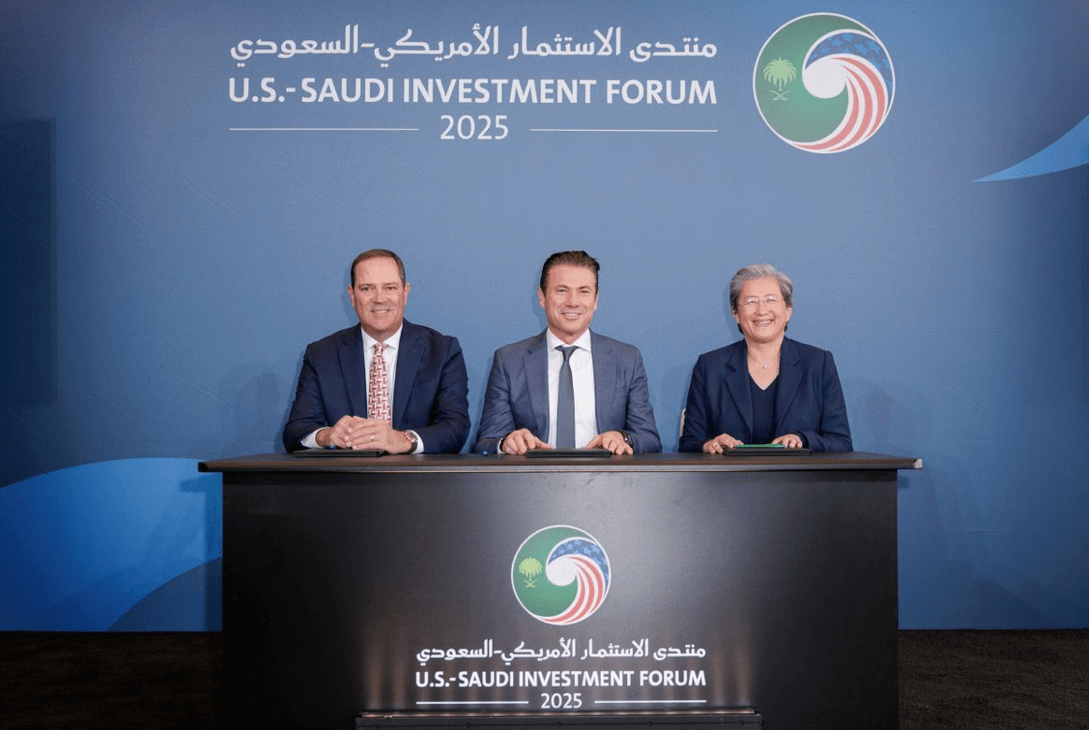
AMD, Cisco, and HUMAIN, a technology company backed by Saudi Arabia’s Public Investment Fund (PIF), announced plans to form a joint venture that will deliver up to 1 GW of AI infrastructure by 2030. PIF is the Kingdom’s sovereign wealth fund—one of the world’s largest—and is responsible for financing key national strategic initiatives across energy, technology, and digital transformation.
• The venture builds on the companies’ multi-year strategic collaboration announced during President Donald J. Trump’s visit to Saudi Arabia in May 2025.
• HUMAIN, AMD, and Cisco will all serve as founding investors, with AMD and Cisco acting as exclusive technology providers.
• The initiative aims to position Saudi Arabia as a regional and global center for AI compute and scalable digital services.
The joint venture intends to begin operations in 2026 with a 100 MW phase-one deployment, expanding to 1 GW by 2030. The program integrates HUMAIN’s modern data center assets with AMD’s leadership GPU accelerators and Cisco’s AI-class networking and datacenter infrastructure. The companies expect the combined stack to deliver cost-efficient, high-performance compute capacity to support government, enterprise, industrial, scientific, and multilingual AI workloads.
• Cisco’s AI Readiness Index shows that 91% of Saudi organizations plan to deploy AI agents, yet only 29% have sufficient GPU capacity.
• The 100 MW initial deployment is designed to accelerate the Kingdom’s transition to AI-driven services and sovereign model development.
• AMD will also establish an AMD Center of Excellence in Saudi Arabia to support local integration and next-generation AI innovation.
Technology Solutions Provided by AMD and Cisco
AMD Instinct MI450 Series: GPU compute for national-scale AI clusters
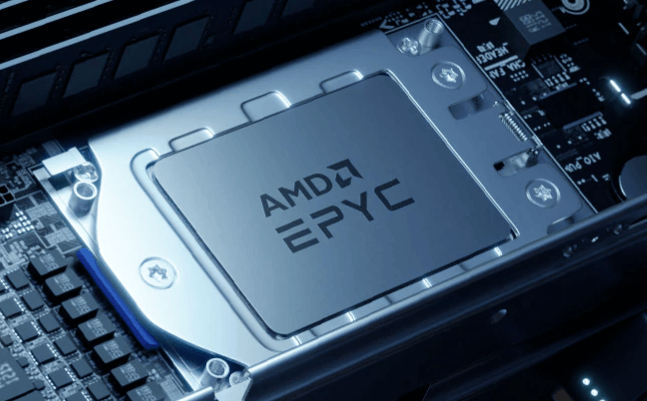
The joint venture will use the AMD Instinct MI450 Series GPU platform, part of AMD’s latest generation of accelerators optimized for large-scale training and inference. The MI450 architecture is designed for high memory bandwidth, improved energy efficiency, and scaled-out system configurations suited for multi-rack and multi-MW deployments.
• High-performance training for LLMs, vision models, and multi-modal AI.
• Improved cost-per-compute and power-efficiency metrics compared to prior AMD Instinct generations.
• Integration with open software frameworks enables broad compatibility with sovereign AI stacks.
Cisco: AI networking, critical infrastructure, and datacenter systems
Cisco will provide the networking backbone and critical datacenter infrastructure, including high-bandwidth fabrics, secure data center switching, and power-efficient architectures optimized for AI clusters.
• High-speed Ethernet switching designed for GPU fabrics and AI interconnects.
• End-to-end visibility and telemetry to support AI workload tuning.
• Critical infrastructure for power, cooling, and system resilience across multi-MW deployments.
Together, AMD and Cisco provide the core compute, interconnect, and operational foundation required for large sovereign AI deployments, enabling HUMAIN to scale from hundreds of megawatts today to gigawatt-class infrastructure by the end of the decade.
Analysis
Saudi Arabia’s AI strategy is accelerating rapidly, with the Kingdom building one of the world’s most ambitious sovereign compute programs. The AMD–Cisco–HUMAIN joint venture aligns with the national goal of advancing digital transformation under Vision 2030 and diversifying the economy through AI services, cloud platforms, and high-performance computing clusters. PIF’s involvement signals that this program is a strategic national priority rather than a commercial experiment.
• Saudi Arabia aims to become a supplier—not just a consumer—of AI compute capacity.
• Localized model training and inference reduce dependency on foreign cloud providers while strengthening security and data governance.
• The 1 GW target places this program among the world’s largest national AI infrastructure roadmaps.
While NVIDIA does not participate directly in this announcement, the global AI ecosystem continues to rely heavily on NVIDIA’s Grace-Blackwell and Blackwell Ultra architectures. The Kingdom has ongoing partnerships elsewhere that include NVIDIA hardware, but the AMD–Cisco–HUMAIN venture shows a deliberate effort to diversify supply chains, reduce exposure to GPU shortages, and avoid single-vendor risk. Sovereign AI strategies increasingly depend on this type of multi-vendor approach.
• Diversification ensures access to compute even during global GPU supply constraints.
• AMD and Cisco give the venture a combination of competitive accelerators and high-performance Ethernet fabrics.
• Saudi Arabia can balance its NVIDIA deployments with large-scale AMD clusters.
The geopolitical backdrop also matters. The May 2025 reveal of the AMD–Cisco–HUMAIN collaboration coincided with Crown Prince Mohammed bin Salman’s trip to Washington, D.C., and its focus on U.S.–Saudi cooperation in advanced technology, AI infrastructure, and supply chain partnerships. The Trump administration has encouraged U.S. semiconductor, cloud, and networking companies to deepen commercial and R&D engagements with Saudi Arabia as part of a broader strategic relationship.
• The U.S. sees Saudi Arabia as a pivotal partner in global compute scaling.
• Large-scale AI infrastructure deals fit into a wider pattern of U.S.–Saudi cooperation in cloud, energy, and digital systems.
• Today’s joint venture reflects expanding U.S. corporate participation in the Kingdom’s long-term AI roadmap.
Saudi Arabia’s ambition to build multi-gigawatt AI infrastructure places it in a small group of nations pursuing compute sovereignty at scale. If HUMAIN and its partners execute at the planned pace, the Kingdom could emerge as a major exporter of AI compute, training capacity, and digital intelligence.
HUMAIN is a Saudi Arabia–based full-stack artificial intelligence company backed by the Public Investment Fund (PIF) and positioned as one of the Kingdom’s flagship initiatives for sovereign AI infrastructure and advanced compute. The company is led by CEO Tareq Amin, formerly the CEO of Rakuten Symphony and the executive who spearheaded Rakuten Mobile’s fully cloud-native, Open RAN–based mobile network. With multi-billion-dollar funding commitments and gigawatt-scale data-center ambitions, HUMAIN aims to build globally competitive AI platforms, including large compute clusters, next-generation data centers, and integrated AI services for government, enterprise, and international customers.