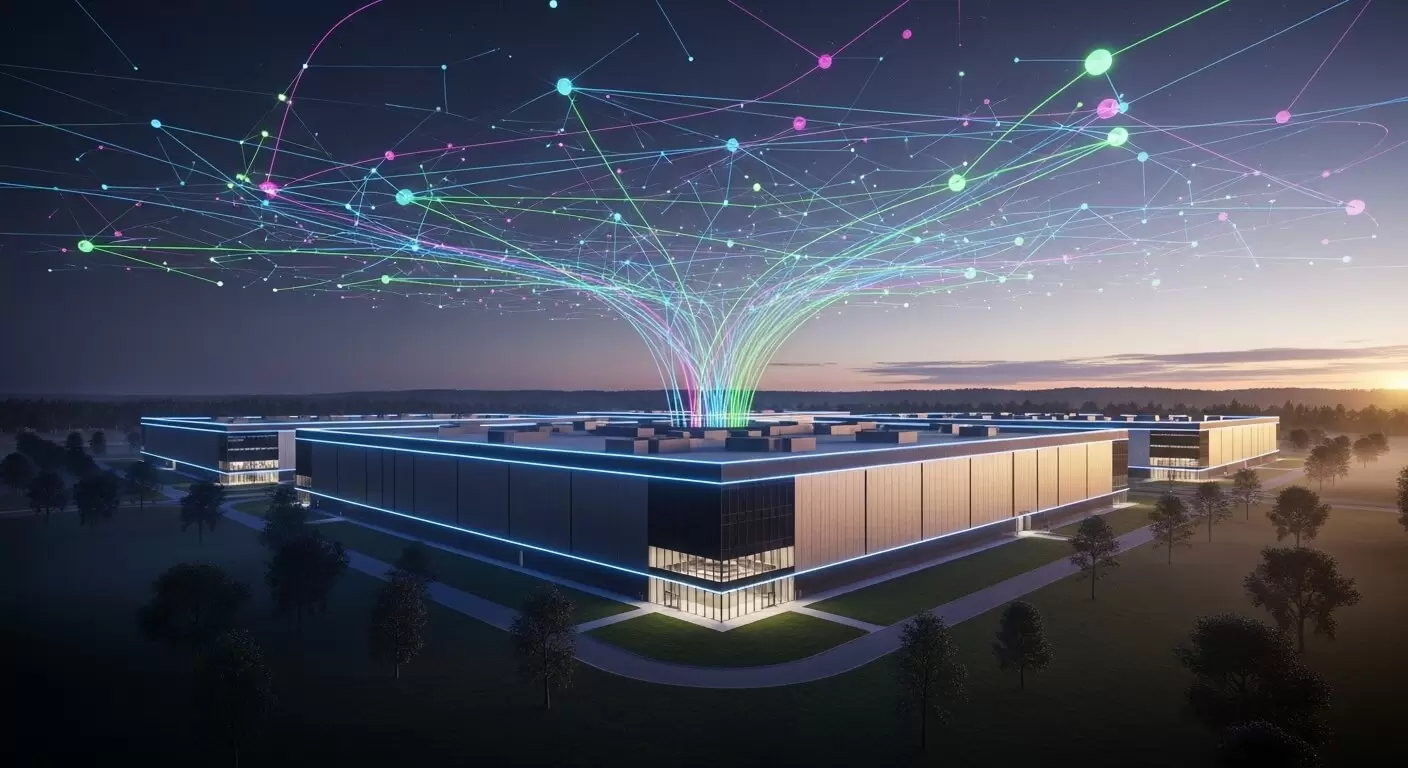
Anthropic launched a $50 billion build-out of U.S. AI infrastructure, selecting Fluidstack to develop new hyperscale data center campuses in Texas and New York, with additional sites in planning. The rollout centers on custom-built facilities optimized for Anthropic’s high-density training and inference workloads, including rapid access to gigawatt-scale power and tightly integrated cooling and server architectures. The company expects the first sites to come online in 2026 as part of a multi-year effort to expand compute capacity for Claude and its frontier research programs.
The program includes an estimated 800 permanent technical positions and 2,400 construction jobs, with average salaries near $144,000 for full-time roles. Anthropic frames the expansion as critical to meeting enterprise demand—now more than 300,000 business customers—and supporting the U.S. administration’s AI Action Plan aimed at domestic leadership in advanced computing. Fluidstack, headquartered in New York, will serve as the infrastructure partner based on its ability to deploy high-power campuses at accelerated timelines.
Anthropic said the investment reflects a strategic push to scale cost-effectively while sustaining training throughput for next-generation Claude models. The sites are engineered for high energy efficiency, deep integration with Anthropic’s safety and interpretability research workflows, and sustained support for large-account customers that have grown sevenfold year-over-year.
• Multi-billion-dollar expansion across Texas and New York, with additional locations planned
• Facilities optimized for frontier-scale training workloads and rapid gigawatt-class power delivery
• Targeting 800 permanent jobs and 2,400 construction jobs, with average salaries near $144,000
• Supports growing Claude demand from >300,000 business customers and rising large-account revenue
• Aligns with the U.S. AI Action Plan for domestic compute capacity and competitiveness
• Fluidstack selected for agility in hyperscale deployment and accelerated power-availability timelines
“We’re getting closer to AI that can accelerate scientific discovery and help solve complex problems in ways that weren’t possible before. Realizing that potential requires infrastructure that can support continued development at the frontier,” said Dario Amodei, CEO and co-founder of Anthropic. “These sites will help us build more capable AI systems that can drive those breakthroughs, while creating American jobs.”
🌐 Analysis
Anthropic’s $50 billion partnership with Fluidstack marks one of the largest single AI-infrastructure expansions announced in the U.S., reinforcing the shift toward purpose-built “AI factory” designs with high-density power and cooling. The project also follows similar mega-campus announcements from OpenAI-backed ventures, hyperscalers, and sovereign AI infrastructure funds, all competing to secure multi-gigawatt compute footprints. For Fluidstack, the deal elevates its profile among fast-moving AI-infrastructure developers racing to meet unprecedented capital and power demands across North America.
Anthropic, headquartered in San Francisco, is an AI safety and research company founded in 2021 by siblings Dario and Daniela Amodei and a team of former OpenAI researchers, with a mission to build steerable, reliable, and transparent AI systems. The company’s core technology includes its Claude family of frontier models and its Constitutional AI methodology, an approach designed to make model behavior more predictable and aligned with human intent. Anthropic is privately held and has secured major strategic funding from Amazon (up to $4 billion), Google, and a range of institutional investors, while partnering with Amazon Web Services and Google Cloud to deliver large-scale training and inference infrastructure. Key milestones include the launch of the Claude 3 model suite, rapid scaling of its research teams, and large U.S. data-center investments—most recently a $50 billion build-out with Fluidstack across Texas and New York to support next-generation model training.