Cloud services are coming increasingly under attack, according to Arbor Networks’ newly released, 11th Annual Worldwide Infrastructure Security Report (WISR). The report is based on a survey of Tier 1 and Tier 2/3 service providers and hosting, mobile, enterprise and other types of network operators from around the world. Data covers November 2014 through November 2015.
Some highlights:
Top 5 DDoS Trends
- Change in Attack Motivation: This year the top motivation was not hacktivism or vandalism but ‘criminals demonstrating attack capabilities,’ something typically associated with cyber extortion attempts.
- Attack Size Continues to Grow: The largest attack reported was 500 Gbps, with others reporting attacks of 450 Gbps, 425 Gbps and 337 Gbps. In 11 years of this survey, the largest attack size has grown more than 60X.
- Complex Attacks on the Rise: 56 percent of respondents reported multi-vector attacks that targeted infrastructure, applications and services simultaneously, up from 42 percent last year. 93 percent reported application-layer DDoS attacks. The most common service targeted by application-layer attacks is now DNS (rather than HTTP).
- Cloud Under Attack: Two years ago, 19 percent of respondents saw attacks targeting their cloud-based services. This grew to 29 percent last year and now to 33 percent this year – a clear upward trend. In fact, 51 percent of data center operators saw DDoS attacks saturate their Internet connectivity. There was also a sharp increase in data centers seeing outbound attacks from servers within their networks, up to 34 percent from 24 percent last year.
- Firewalls Continue to Fail During DDoS Attacks: More than half of enterprise respondents reported a firewall failure as a result of a DDoS attack, up from one-third a year earlier. As stateful and inline devices, firewalls add to the attack surface and are prone to becoming the first victims of DDoS attacks as their capacity to track connections is exhausted. Because they are inline, they can also add network latency.

Top 5 Advanced Threat Trends
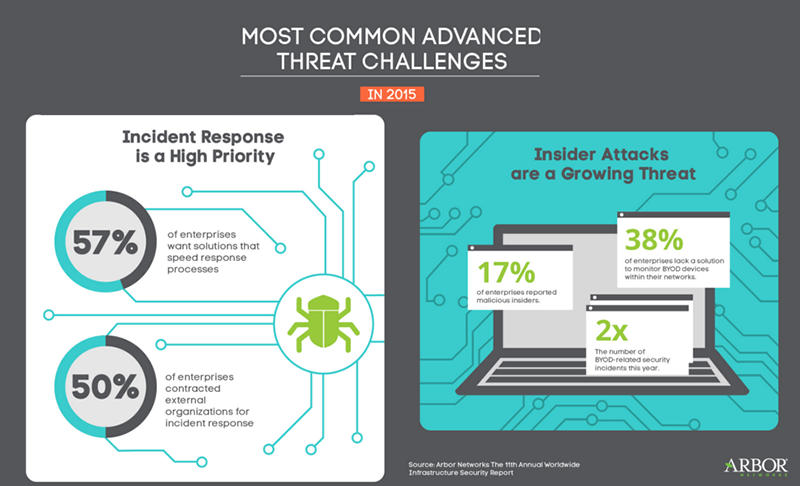
- Focus on Better Response: 57 percent of enterprises are looking to deploy solutions to speed the incident response processes. Among service providers, one-third reduced the time taken to discover an Advanced Persistent Threat (APT) in their network to under one week and 52 percent stated their discovery to containment time has dropped to under one month.
- Better Planning: 2015 saw an increase in the proportion of enterprise respondents who had developed formal incident response plans and dedicated at least some resources to respond to such incidents, up from around two-thirds last year to 75 percent this year.
- Insiders in Focus: The proportion of enterprise respondents seeing malicious insiders is up to 17 percent this year (12 percent last year). Nearly 40 percent of all enterprise respondents still do not have tools deployed to monitor BYOD devices on the network. The proportion reporting security incidents relating to BYOD doubled, to 13 percent from six percent last year.
- Staffing Quagmire: There has been a significant drop in those looking to increase their internal resources to improve incident preparedness and response, down from 46 to 38 percent in this year’s results.
- Increasing Reliance on Outside Support: Lack of internal resources this past year has led to an increase in the use of managed services and outsourced support, with 50 percent of enterprises having contracted an external organization for incident response. This is 10 percent higher than within service providers. Within service providers, 74 percent reported seeing more demand from customers for managed services.
“A constantly evolving threat environment is an accepted fact of life for survey respondents,” said Arbor Networks Chief Security Technologist Darren Anstee. “This report provides broad insight into the issues that network operators around the world are grappling with on a daily basis. Furthermore, the findings from this report underscore that technology is only part of the true story since security is a human endeavor and there are skilled adversaries on both sides. Thanks to the information provided by network operators worldwide, we are able to offer insights into people and process, providing a much richer and more vibrant picture into what is happening on the front lines.”
Download the full report (registration required).