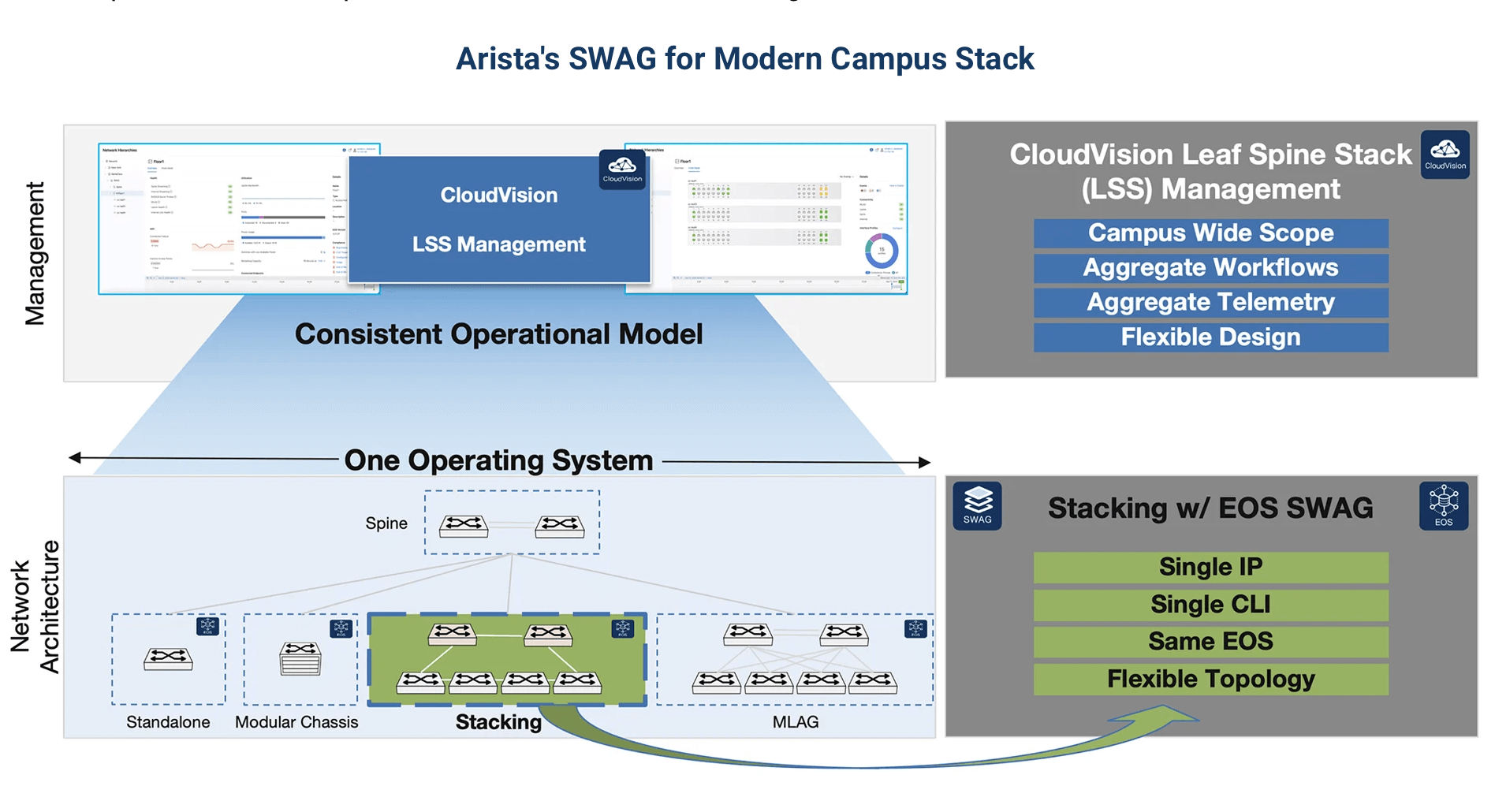
Arista Networks has introduced Switch Aggregation Groups (SWAG) in its EOS software to streamline campus network management. SWAG leverages industry-standard Ethernet to manage groups of switches under a single IP address. This eliminates reliance on proprietary stacking protocols and cables, providing greater flexibility and scalability. The new solution also integrates with Arista CloudVision’s Leaf Spine Stack (LSS) Management, allowing logical stacking across multiple locations or campus-wide. These innovations aim to replace legacy stacking systems that restrict network design and complicate upgrades.
Legacy stacking relied on proprietary solutions that constrained network topologies to rings or chains, limiting flexibility and scalability. Arista’s SWAG extends the principles of its Multi-Chassis Link Aggregation Groups (MLAG) to campus networks, enabling operators to migrate from older systems while supporting a broader range of network designs. By avoiding proprietary cables and embracing open standards, SWAG ensures compatibility with existing Ethernet cabling and optics, significantly reducing operational overhead.
CloudVision LSS complements SWAG by offering centralized management across logical stacks, regardless of physical locations. Operators can organize switches into groups representing real-world constructs, such as buildings or floors, and perform network operations seamlessly. This integration supports telemetry, compliance, and AI-driven insights, delivering operational efficiency across network hierarchies.
Key Points
• SWAG: Manages up to 48 switches via a single IP, conserving addresses and reducing operational complexity.
• CloudVision LSS: Extends logical stacking to any topology, enhancing network design flexibility.
• Open Standards: Avoids proprietary stacking cables, relying on Ethernet cabling for compatibility.
• Applications: Suitable for standalone switches, modular chassis, MLAG, and SWAG configurations.
• Key Benefits: Supports hitless upgrades, segmentation, and AI-driven insights, reducing downtime and TCO.