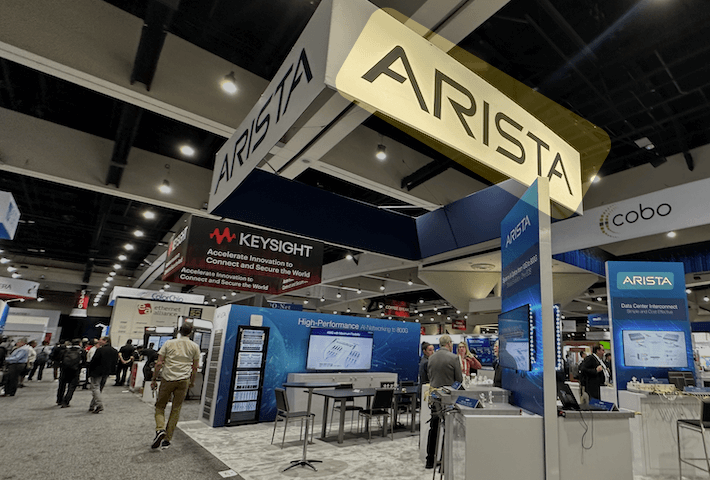
Arista Networks (NYSE: ANET) reported third-quarter 2025 revenue of $2.308 billion, up 4.7% from Q2 and 27.5% from the same period a year ago, driven by demand for data-center, AI, and cloud networking. GAAP net income rose to $853 million ($0.67 per share), while non-GAAP net income reached $962 million ($0.75 per share). Non-GAAP gross margin held steady at 65.2%.
CEO Jayshree Ullal said Arista’s “centers of data” strategy continues to resonate with customers seeking unified networking from client to cloud and AI centers. CFO Chantelle Breithaupt highlighted 25% year-over-year EPS growth as a result of “disciplined execution of our strategic roadmap.” For Q4, Arista projects revenue between $2.3 billion and $2.4 billion, non-GAAP gross margins of 62–63%, and operating margins of 47–48%.
Recent company highlights show Arista deepening its AI and open networking initiatives. Kenneth Duda was promoted to President and CTO, and Tyson Lamoreaux joined as SVP of Cloud and AI Networking. Arista launched AI agents to automate network operations and introduced CloudVision AI for end-to-end visibility across AI workloads. At the October OCP Global Summit, Arista co-founded the Ethernet for Scale-Up Networks (ESUN) initiative to advance open Ethernet standards for AI-scale networks.
• Q3 revenue: $2.308 billion (+27.5% YoY)
• GAAP net income: $853 million; Non-GAAP: $962 million
• Gross margin: 65.2% (non-GAAP)
• EPS: $0.67 GAAP; $0.75 non-GAAP
• Q4 revenue guidance: $2.3 – $2.4 billion
“Our centers of data strategy is resonating well across customers and analysts because it delivers a superior client-to-campus-to-cloud and AI centers experience,” said Jayshree Ullal, Chairperson and CEO of Arista Networks.
Key Takeaways from the Q3 2025 Earnings Call
• Arista achieved its 19th consecutive record quarter amid unprecedented AI buildouts; software and services contributed 18.7% of revenue.
• The company reiterated its AI target of $1.5 billion for 2025 and raised its AI-center goal to $2.75 billion out of $10.65 billion total revenue for 2026.
• CEO Ullal said demand remains robust and that shipment timing and component lead times (38–52 weeks) are the primary drivers of quarterly variability —not end-market softness.
• Gross margins are influenced by customer mix: cloud and AI titans yield product margins “significantly below 60%,” balanced by strong enterprise margins.
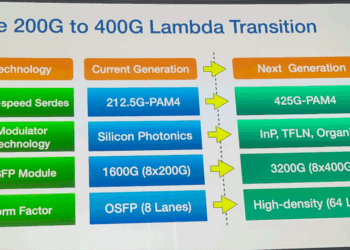
• EtherLink distributed switch fabric is now powering some of the largest AI networks in the world, moving from 800 Gbps to 1.6 Tbps with EOS and NetDI integration.
• Arista is participating in three AI network topologies — scale-out, scale-up, and scale-across — with scale-up expected to ramp post-2026 as Ethernet replaces proprietary links like NVLink.
• The company views front-end and back-end network convergence as an advantage, saying it is the only non-Chinese vendor supplying both ends of the AI fabric.
• “Blue Box” (disaggregated hardware) deployments will remain limited to 10–20 customers with advanced operational skills; margins are lower but volumes are expected to grow in scale-up use cases.
• Arista’s Ultra Ethernet Consortium (UEC) and ESUN standards initiatives are advancing modular Ethernet frameworks for AI scale-out and scale-up fabrics.
• Enterprise and campus expansion remains a key growth vector for 2026, aided by the VeloCloud acquisition and channel investments to win “white-space” accounts.
• New AI builds — not refresh cycles — are driving network demand as hyperscalers and AI companies construct gigawatt-scale data centers.
• Cash and investments ended the quarter at $10.1 billion; operating cash flow was $1.3 billion.

Analysis
Arista’s earnings call underscored its position at the intersection of AI compute and network scaling. While shipment timing and long lead times create quarterly fluctuations, demand for AI network fabrics remains strong and diversified across cloud titans, LLM developers, and NeoCloud providers. The company’s dual approach — supporting both proprietary and open Ethernet standards through UEC and ESUN — cements its role in the next phase of AI interconnects as the industry shifts from InfiniBand to deterministic Ethernet.
By linking front-end and back-end network designs under a unified software stack (EOS, NetDI, CloudVision AI), Arista is building a comprehensive platform that can scale from campus to AI factory. Its focus on the Blue Box model and reference design partnerships shows a pragmatic path to coexist with white-box ecosystems without diluting its high-end value proposition. The broadening enterprise push via VeloCloud integration and campus expansion adds diversification beyond hyperscaler-driven AI spending, offering balance against potential AI capex cycles.